Watching President Obama’s inauguration yesterday, I was pleasantly surprised when they followed up his speech with a poem by Elizabeth Alexander. It was interesting that Elizabeth Alexander was only the fourth poet to be asked to read at an inauguration (Robert Frost being the first in 1961). I was not familiar with her or her work–and while I did appreciate her “Praise Song for the Day”, I guess I was most impressed that in the midst of all the political hoopla the arts was given a “voice” on the world stage. Whether you liked it or hated it, that poem rubbed at your rusty imagination, causing you to pause for a few minutes–challenging you to think of new possibilities in a world running dangerously low on hope. Well, that’s what could have happened; assuming that you didn’t yawn and turn down the volume when you first heard mention of the word (ugh) poem.
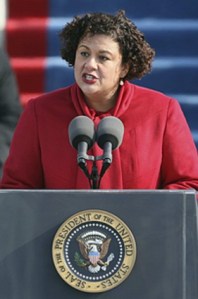
Think about it: how many poems did you read or hear this year? How many in the last decade? For most, that poem was probably the only one they’ve heard in a really long time. I think as a society we’ve become way too cynical and too impatient to appreciate poetry. TV and the world-wide-web is easier to decipher and it doesn’t require the use of our imagination. Poetry won’t solve the problems of national debt or global terrorism so let’s keep it holed up in coffee shops and college campuses.
But maybe poetry is just as important as politics in our quest for hope, love, and happiness. Maybe the art of poetry needs to be re-discovered in this generation. Perhaps that’s why President Obama’s speech was followed by a poem. Martin Luther King’s speeches sounded suspiciously like poetry, too.
This is something I’ve been thinking a lot about lately because I’ve come to realize that poets, by their very nature, are also prophets and they are called by God to speak. As artists they are misunderstood often, but there’s is an isolated but necessary calling within the greater community. Kathleen Norris, in her book The Cloister Walk, nailed this idea for me in her treatment of her call to be a writer as she related it to Jeremiah’s call as a prophet. I’ll leave you with some of her words on the subject:
“Art is a lonely calling, and yet paradoxically communal. If artists invent themselves, it is in the service of others. The work of my life is given to others; in fact, the reader completes it. I say the words I need to say, knowing that most people will ignore me, some will say, ‘You have no right,’ and a few will tell me that I’ve expressed the things they’ve long desired to articulate but lacked the words to do so.
By what authority does the poet, or prophet, speak? How dare the poet say ‘I’ and not mean the self? How dare the prophet say, ‘Thus says the Lord’? It is the authority of experience, but by this I do not mean experience used as an idol, as if an individual’s experience of the world were its true measure. I mean experience tested in isolation, as by the desert fathers and mothers, and also tried in the crucible of community. I mean a ‘call’ taken to heart, and over years of apprenticeship to an artistic discipline, developed into something that speaks to others.”

 yeti speak...
Leave a comment