The Criterion Collection DVD version of Francis Ford Coppola directed Rumble Fish (1983) includes bonus content in the form of a documentary entitled: Locations: Looking for Rusty James. In it, Alberto Fuguet, a Chilean movie director, explores the profound impact that the movie had upon him and many young South American men in the 1980s. The documentary, itself, was not all that engaging (for me), with its subtitled narration and interviews voiced over people-less scenes on different streets of Tulsa, Oklahoma (where the Coppola film takes place.)
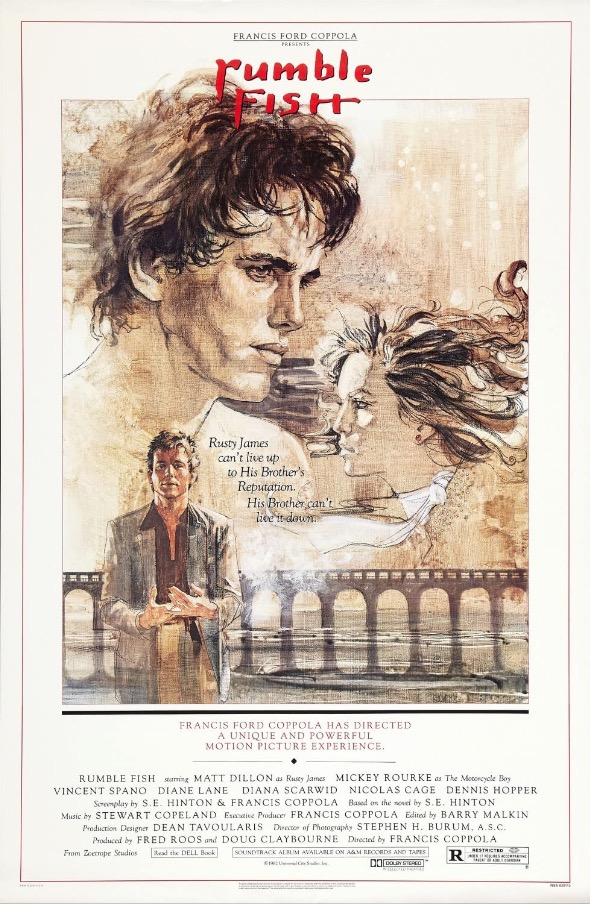
What was interesting to me were the testimonials about how impactful the movie was for Fuguet, and the young men who experienced it at the same time of life as the characters in the film. One voice mentions watching the movie 20+ times, another mentions watching it for the first time at a local theater late at night (?), staying awake until the next day, and then returning to watch the movie for its very next showing. Story after story reveal how for many young men in the 1980s, viewing Rumble Fish, which is a film adaptation of YA novel by S.E. Hinton, was a profound life changing experience.
As a man approaching fifty, Rumble Fish was not nearly as impactful to me as it was for Fuguet. Maybe it would have been if I’d watched it at 18. I know reading Hinton’s more widely known novel, The Outsiders, as a teenager did impact me to some degree, so maybe Rumble Fish would have had a similar affect. Either way, watching a Coppola movie (even a non-Godfather, lesser film) is a much more elevated and thought-provoking experience than say, watching Valley Girl. So let’s get into the Cage factors and unpack it a little bit.
Cage & Coppola. As we’ve established in previous posts, Nicolas Cage is related to Francis Ford Coppola and actually took the name Cage to get the proverbial “monkey off his back” that nepotism (rather than talent) was the reason for him landing bigger Hollywood roles. But that perception doesn’t stop Cage from appearing in a few of his uncle’s films, albeit not in a starring capacity. Rumble Fish will be the first of three Cage/Coppola team ups, the other two being The Cotton Club (1984) and Peggy Sue Got Married (1986). In some ways both Rumble Fish and The Cotton Club stand as unique identity markers pointing to the Coppola brand of directing, like two different fingerprints but on the same hand. This is true from a style, tone, and construction perspective, more so than the actual content or storyline of either.
In both films, Nicolas Cage plays a supporting cast role (Smokey in Rumble Fish, Vincent Dwyer in Cotton Club) but one that acts as a foil or problematic obstacle to the goals of the main characters in each (Rusty James / Matt Dillon in Rumble Fish, Richard Gere / Dixie Dwyer in Cotton Club). Cage provides that dark horse spark in each film, but is somewhat relegated to the sidelines, removed in many ways from the central plot and actions.
Coppola traits and characteristics in Rumble Fish. Even though Tulsa is Oklahoma’s second largest city by population, it feels like a small town in Rumble Fish. This could be because of the stark way in which the film was shot, almost entirely in black-and-white, the scenery (street gang culture), or it could be based on the theme of alienation that is carried so well by its main characters, Rusty James and his older brother The (oft whispery) Motorcycle Boy (played by Mickey Rourke). Whatever the reason, Rumble Fish feels really big, but intentionally hollowed out, with a lot of foreboding, like shouting inside an echoey wharehouse.
One trait of Coppola’s films (The Godfather, Apocalypse Now, etc) is that they are thematically sweeping–big themes, big entourage of actors, big moments of violence, big feelings / passion, etc. Rumble Fish is no exception to these characteristic. Looking at this cast list, (in hindsight) the film delivers on this prospect of being something much more than the sum of its parts:
- Matt Dillon
- Mickey Rourke
- Nicolas Cage*
- Diane Lane*
- Laurence Fishburne*
- Chris Penn (Sean’s brother!)
- Tom Waits* (as Benny, the diner owner)
- Dennis Hopper
I won’t go into the plot too much on this one (since entire documentaries have been made on the topic) but I will highlight my key observations:
- Rusty James. One small beef I have with S.E. Hinton is that she gets a little too cute with her off-the-wall “gang names”. Maybe these made sense in the 60s, but for the modern audience it’s just annoying. I remember thinking the same thing when reading The Outsiders in my teens. Really? He’s called Ponyboy? Soda Pop? Dallas, Darry? Well, in this film we have The Motorcycle Boy (eye-roll) and Rusty James (and we know he uses both names because every character calls his names at the end of most sentences.) I see you, Rusty James. You know what I mean, Rusty James! Yes you do, Rusty James. Very funny, Rusty James. In fact, Rumble Fish would make for a great drinking game. Take a shot of tequila for every Rusty James mention and you’d have to drink 42 shots by the end of it. I know I counted ’em all. Of those 42 mentions, eleven Rusty James were spoken by Rusty’s best friend, Smokey. I guess we can’t all have cool gang names like Pooh Shiesty.
- Smokey is a bad ass. Even though, I think Matt Dillon nails the brooding, streetwise but kinda dense, angsty younger brother in a way that Cage would have had a hard time pulling off, I much preferred Smokey’s character. Smokey sports a boufaant head of hair, a big-ass belt buckle (even bigger than the one he wore in Valley Girl) and this Wild Aces jacket with a racing stipe down both arms and a 2 of Spades emblazoned on the front. At the beginning of the movie, Smokey is the one who doesn’t really want Rusty James to get into a brawl with a rival gang member, because he knows he’ll be pulled into the action. He also recognizes things about the big picture that Rusty James does not, “You’ve got a bad habit of getting attached to people, man.” In the end Smokey even swoops in and steals Rusty James’ girl, Patty (Diane Lane). Bold move. I thought he might get punched for it, but no!
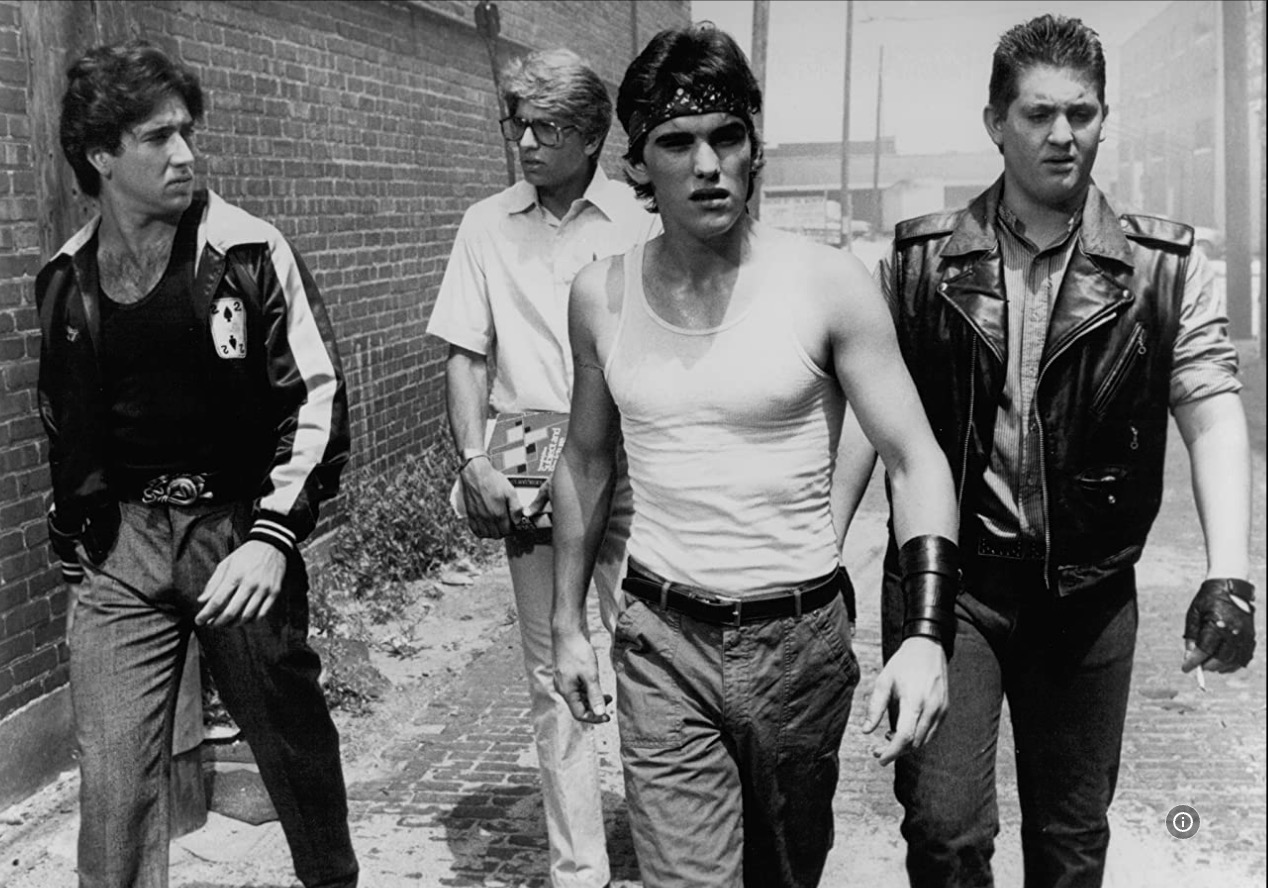
- Napoleonic influence. I don’t know why, but Napoleon Dynamite keeps coming up for me in these films. Steve, shown above second from left, had to be influential in developing the Napoleon character (100%). He had to be, right? Just look at him.
- Colorblindness, the struggle is real. Perhaps the oddest thing about this movie (and there’s a lot of things to choose from) is that The Motorcycle Boy (groan, I know) whom I am assuming is bi-polar / clinically depressed, is pretty obsessed with “rumble fish”. The rumble fish show up late in the movie in ultra-violet reds and blue (in and otherwise black-and-white world) and they seem to represent TMB’s own desire to be “free” from his life and this town (his fish bowl of conflict). A big deal is made of TMB’s colorblindness as evidenced in this choice of color usage, when in my mind the real problem is his mental state. There’s some inklings that his mother who left them was also bi-polar (or mentally afflicted) in some way. Plus, he’s always whispering, too, which I find kind of creepy and unsettling. Anyway, I guess colorblindness was / is a much bigger affliction than I originally thought, capable of pushing a man to the edge. (Ok, I’m being tongue-in-cheek here, but it was a pretty weird flex.)
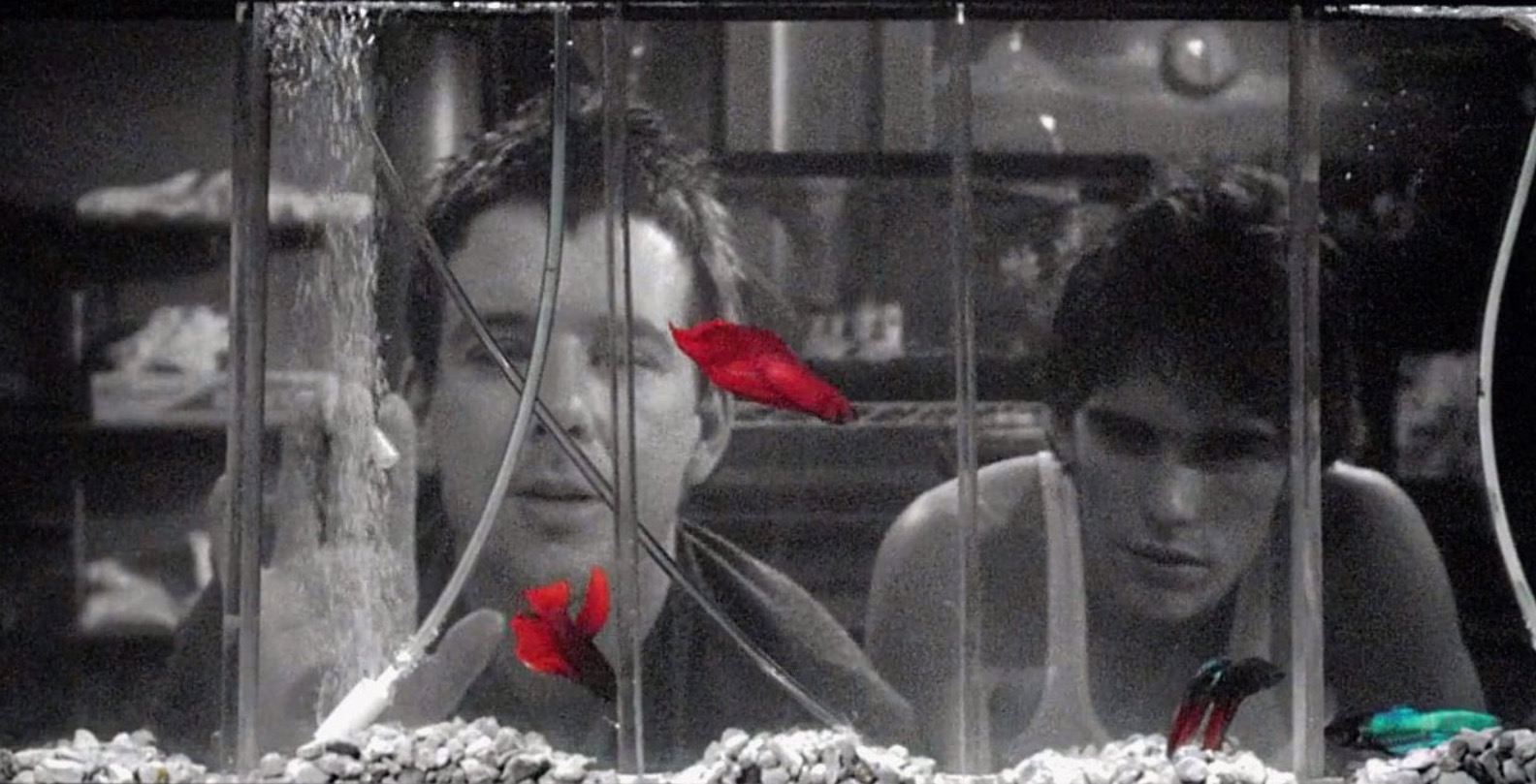
A few firsts for Nicolas Cage / Smokey character in this film:
- Stealing a best friend’s girl.
- Not getting blind-side punched for it.
- Playing pool.
- Saying Rusty James 11 times.
To conclude, I think Rumble Fish was an interesting film in the Coppola canon. It didn’t change my life, but represented a certain angsty young adolescent mood very well and had some surreal and artistic moments sprinkled throughout. Dennis Hopper (whom I didn’t give coverage to above) played an intriguing drunken, deadbeat dad that I will remember for a while. Overall, we could have a used a lot more scenes with Smokey in them. Maybe we’ll get those moments in the next Coppola / Cage team up, The Cotton Club. Maybe.
*Also appears in Cotton Club

 yeti speak...
Leave a comment