So technically, I suppose I am going against Guideline #1 (watching movies according to chronological release date) since Racing with the Moon came before The Cotton Club (1984) but because Rumble Fish and The Cotton Club shared so many of the same actors and the same director, I’ve decide to push this one up in the WATCH list (aka World According To Cage, Hee-HA!)
As I mentioned in my last post, Francis Ford Coppola’s signature movies tend to be sweeping epics, period-piece novels adapted for the big screen (e.g.The Godfather, Apocalypse Now, Rumble Fish) with big budgets (for the time) and big stars in big numbers. Although it was not based on a novel (that I am aware of) The Cotton Club, does not deviate from the formula. Carrying over some of the same cast members from Rumble Fish (Diane Lane, Laurence Fishburne, Tom Waits, Nicolas Cage) the Cotton Club adds many more stars to the mix (Richard Gere, Gregory Hines, James Remar, Bob Hoskins, Fred Gwynne, to name a few.)
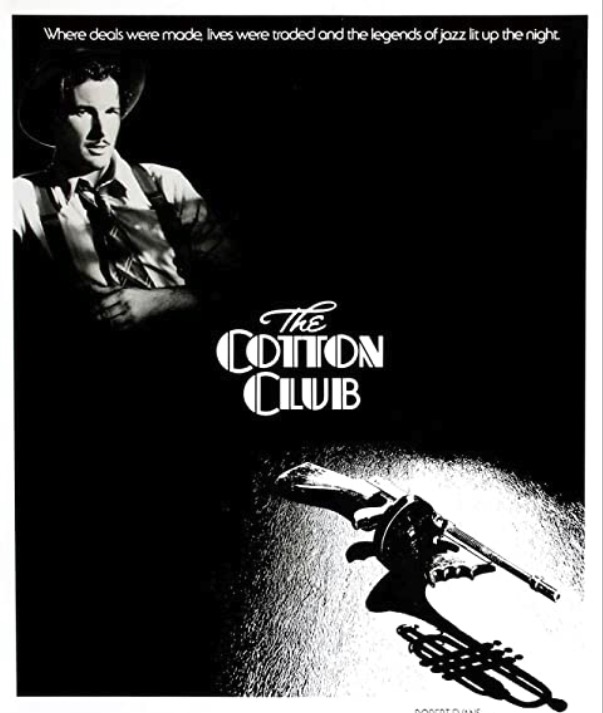
While the movie’s production was difficult, expensive, contentious, and it did not perform well commercially at the time, many reviewers rated it well, and I think it was well ahead of its time in artfully depicting the intersection of racial inequities and influence, organized crime, and the birth of an entertainment industry at a famous Harlem jazz club of the 1930s. Other than the extended airtime given to the music and dance numbers throughout the film, it’s easy to draw comparisons (or map influences) to more recent series like Boardwalk Empire and Peaky Blinders.
Because there’s so much going on plotwise in this film, let’s put most of our singular focus on Nicolas Cage’s role as Vincent Dwyer. In the film Vincent is the brother to one of the central characters in the film, Dixie Dwyer (played by Richard Gere). At the start of the film, Dixie, who is likely based on the real life actor George Raft, is a musician who regularly plays in Hell’s Kitchen and at The Cotton Club thanks to his ties with some local mob bosses who own the club. In the opening scene, Dixie instinctively helps subverts an assassination attempt targeting the Jewish-American mob kingpin, Dutch Schultz. In gratitude, Schultz pulls Dixie into his world (and ostensibly under his control for a while), by hiring him to be a sometimes-companion to his favorite gun moll, Vera Cicero (played by Diane Lane). It was one of those “offers you can’t refuse” where it would have been for Dixie to probably refuse “the gratitude” but not without the risk of angering a violent man.
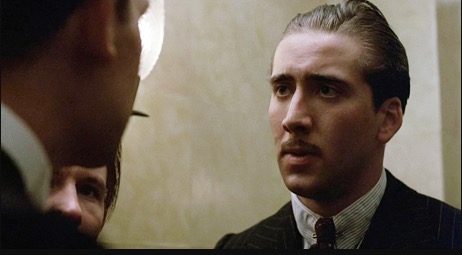
Similar to his brother, Vincent Dwyer gets pulled into Dutch Schultz’s sphere of influence, but because of his own ambition. He becomes an enforcer and eventually a public enemy, a “mad dog” who needs to be put down.
(Spoiler alert)
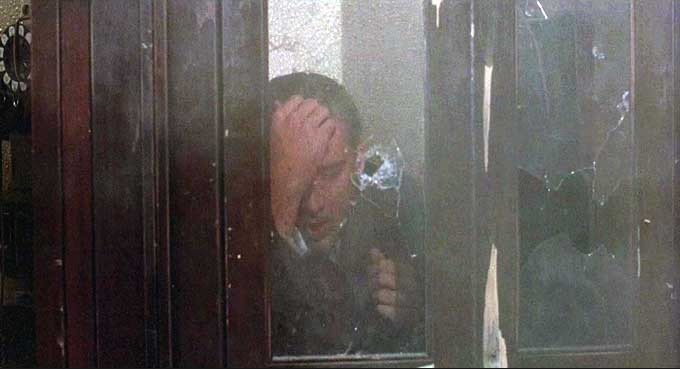
Vincent, who lacks the caution and wisdom of his more conscietious brother, and the talent / means to choose a different path, eventually gets caught up in the gang violence that he propagates; he is gunned down ignominiously in a phone booth.
Vincent’s minor role and story arc is not what makes The Cotton Club a compelling viewing experience, although his scenes do provide most of the action in the film. But since this is the WATCH, I’ll forego speaking to some of the more central themes and plots and just provide a few summary observations.
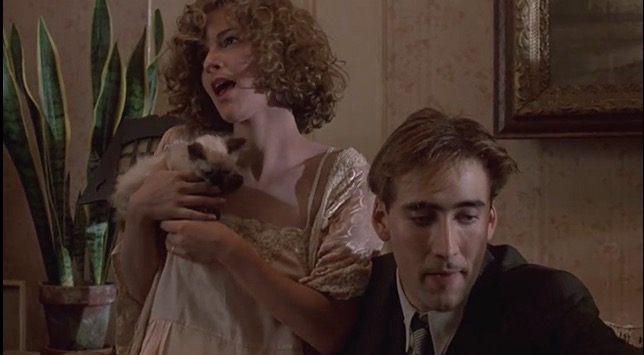
- Dirty dancing. The first time we see Vincent onscreen, he informs his brother Dixie that he’s gotten hitched. He then introduces Dixie to his newlywed wife Patsy (a young Jennifer Grey) who is currently staying with Vincent in their mother’s home. She’s wearing a short satin night gown, much to the disdain of Vincent’s mother. After multiple requests to “put on some clothes” go unheeded, Patty and Vincent retreat to a back bedroom where they consummate their new marriage (I guess). At one point, the camera shows Vincent mid-coitus punching the wall and screaming, “Ah! ah! ah!” But he’s doing so in an exaggerated staged sort of way, as if to draw his family’s attention to the act, not because he is actually in the throes of sex. It’s both weird and funny.
- Tap dancing. There’s a lot of tap dancing in The Cotton Club. And I mean a lot. Tap is a lost artform, and I’m torn as to how to feel about it. As a very young child (in the 1970s), my mom enrolled me in a tap dance class. I was the only boy in a class full of girls. When I hit my teenager years, and saw the photographic evidence of this time I couldn’t clearly recall, I may have been a bit salty about it. Sure, sure, the staccato tip-tap-clicking has a certain Clydesdale sort of charm to it, and watching Gregory Hines clogging away can be pretty mesmerizing, but still…there’s something that feels vaguely un-masculine about the dance. It’s hard to know if it’s exceptionally artistic or at best, outmoded, and at worst, ridiculous. I’m not questioning the talent involved in that type of choreography, but after watching it for 10 minutes or so you sometimes feel as if you’ve seen enough. If only Nicolas Cage had been given a chance to put on the tap shoes in this film. That was a missed opportunity. But I guess maybe that would be a bit too Guys and Dolls?
- Tommy guns. If you live by the tommy gun, you die by the tommy gun. I’ve seen enough mob movies to know that when a guy fires a hundred rounds into a restaurant or a group of men, women, and children walking down the street, there’s a pretty solid chance he’s going to die by a hundred bullets in a phone booth before the credits roll. Vincent (may he RIP) didn’t understand this mob movie rule and it caught up to him. What a way for Nic Cage to go! As his bullet-riddled body collapses through the phone booth glass his bloody hands go slack and spill out a handful of Jelly beans. (You can’t make this stuff up people.)
- Horsehead throwback. Not going to online research it for an answer (embrace the mystery, people!) but the mob boss responsible for Vincent’s demise, Owney Madden (played by Bob Hoskins), was on the other the line talking to Vincent when his henchman were “knocking him off”. After hanging up the phone (telling Vincent goodbye and good riddance) Madden is seen sketching a picture of a horse’s head. Was this a throwback reference to the decapitated horse head from the Godfather? Seems a little to on the nose to me since it’s definitely a powerful mafia revenge symbol.
A few film firsts for Nic Cage as the Vincent character in this film.
- First time he’s been a married man in a movie.
- First time he’s been a made man in a movie (mobster).
- First time he’s died on film.
- First New York / gangster style accent (a bit uneven at times)
- First time to cut a man’s ear with a straight razor.
- First death of a Nic Cage played character (with jelly beans in hand).
Best Vincent line:
“You can take your hundred, and you can shove it up your ass!” spoken to Dutch Schultz (a truly loathsome character.)
When my grandmother first got cable with all the “movie channels” in the mid-80s, I remember seeing previews of The Cotton Club. Back then, I thought, “Who would want to watch this? Looks so boring.” But as a grown man, I did enjoy it (even with all the Roku ads I had to endure) and realize now why it had such fanfare.
Nicolas Cage makes for a good gangster especially because he has that “will he or won’t he” unpredictability, the tightroping-an-angry-outburst that could get violent or ugly at any second. It will serve him well in different ways later in Raising Arizona, Wild at Heart, and Face/Off , but here, at the Cotton Club, we’re just starting to see the first inklings of it.
If we could just get get him into some taps shoes before his career is complete. Tip tap, ta-tap, tap, tip!

 yeti speak...
Leave a comment