Where I live it’s not uncommon to hear the blast of a train’s horn in the distance, the metallic squeal of steel wheels gliding over steel rails, the clickety-clack of each colored rusty car passing over wooden railroad ties. The times I’ve been close enough to watch or count these trains filing past me beside the open waters of the Puget Sound, I’ve been reminded of an old literary hero of mine, Jack Kerouac, jumping onto many a train and riding it down the coast or across the country. I am not so adventurous myself, as it seems a too risky and likely too uncomfortable a way to travel, but I like the idea of the taking such risks, of being young and spontaneous and fast, of seeing where one might end up in the face of life’s dangers and uncertainties.
In Racing With The Moon, Sean Penn and Nicolas Cage take on all the risks of young manhood as fast friends Henry “Hopper” Nash (Penn) and Nicky (Cage) who hop on trains, woo young women, and begin to face their own mortality as the prepare to enter the fray of World War II. The film, which takes place in the weeks leading up to their departure for the war, is titled Racing With the Moon because it describes Hop and Nicky’s moonlight practice of chasing down and riding passing trains along the coastline of their home-town in Point Muir, California (circa 1942.) While, at times, moving at a slower speed than passing trains, this film really does deliver some great acting moments from both actors which we will unpack here.
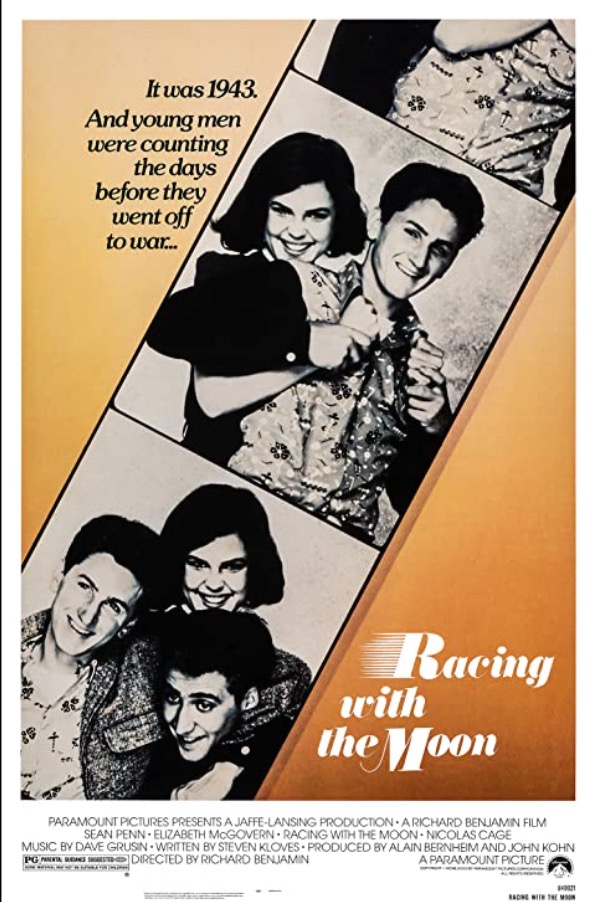
As we discussed in WATCH #1b, this is the second pairing of Penn and Cage on the big-screen, although the first can barely be counted as “Brad’s Bud” had no interaction with Jeff Spiccoli in Fast Times and Cage barely spoke a line in the movie. This film focused heavily on Hop and Nicky’s relationship and therefore gave us many examples of the chemistry of two young up-and-coming actors. We also see what Cage will be capable of in his own right, while still being slightly overshadowed by the excellent performance of Penn. But here are my observations:
Sean Penn is a good actor. I don’t know why this surprises me so much since Dead Man Walking is another favorite all-time for me. Comparing his performance in Fast Times with this film, it’s obvious that he successfully takes on the personas of two completely different characters with entirely different motivations and traits. No duh, you might say, that’s what actors do. But to do so, so well at a young age is pretty remarkable (from my laymen’s perspective).
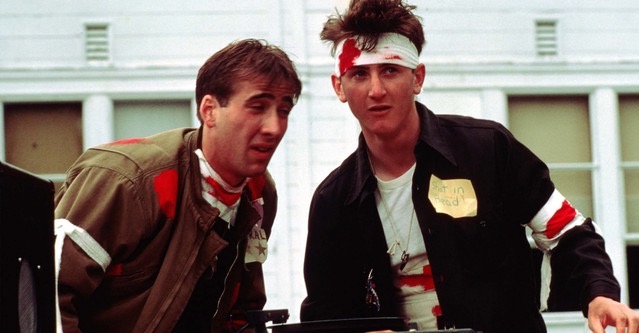
In Racing…, Penn is a highly sensitive young man who falls in love with Caddie Winger (played by Elizabeth McGovern, whom you may know from her later role on Downton Abbey) an assumed “Gatsby” (or a child of wealth) who (spoiler) isn’t really, since her mother works as a live-in maid at the big house on the hill. Hop pursues Caddie romantically in the weeks leading up to his deployment with the Marine Corps. There’s an innocence about him that is woven throughout the film (and arguably throughout many of his most poignant film characters.)
Some examples: he leaves a surprise daisy for Caddie at the movie counter where she works, gifts her with a whole pie while pretending to be a server at a local cafe, and tells her she can “keep her underpants on” while the two go skinny dipping, “since it is January.” The same nurturing spirit shows up in Hop’s relationship with Nicky whom he worries, “drinks too much” and whom he chastises for not caring enough about a girl he’s gotten pregnant and taken to an abortion “clinic”. “You didn’t even open the door for her, Nicky!”
Did I bet on the wrong horse? While I stick to my original purpose and goal, this is the movie that really made me wonder if I made a mistake. Should I be writing a blog called The World According to Penn instead? It would be a different sort of journey for sure, but with characters like Spiccoli, Hop, Pacman (from Colors), Milk, etc. it’s a compelling idea…
Pin monkeys. The coolest thing about this movie IMHO is that Nic and Hop work at the local bowling alley as pinsetters (aka pinchasers or pin monkeys). Before the invention of more automated methods, this was a manual process, where actual humans reset the bowling pins for each round of play. I’ve never thought about this before and didn’t realize it was an occupation one could have.
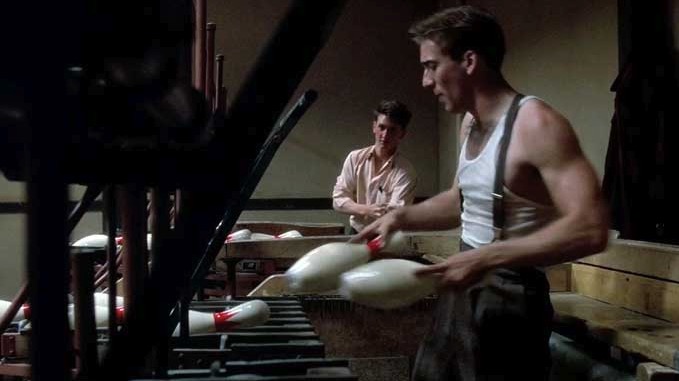
Watching Cage and Penn climbing behind the lanes and gutters awaiting their opportunity to refresh the ten pins was fascinating to me.
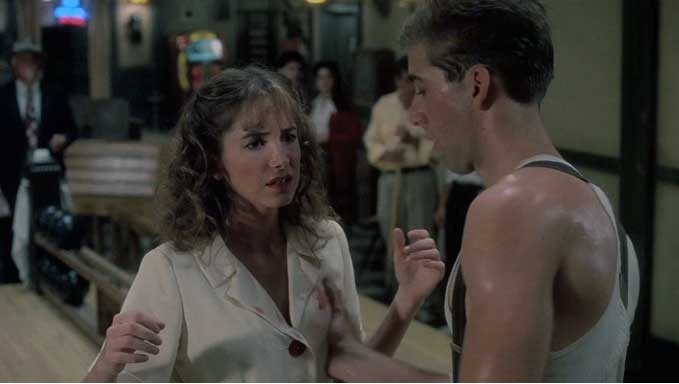
Maybe the highlight of the entire movie occurred when one Gatsby (played by Crispin Glover) kept throwing bowling balls down the lane before Hopper could move out of the way. This infuriated Hop, who yelled from the back of the lane for the Gatsby to stop doing it, eliciting a “Very lame!” agreement from Nicky. When the Gatsby sneered and threw another ball towards Hopper, after being warned, Hop erupted ran straight up the lane and punched the Gatsby right in the face, bloodying his nose.
While the bowling alley manager separated the two boys from fighting further, Nicky tried, with a cloth, to remove some of the blood that had spilled onto the blouse of Gatsby’s girlfriend. Without making much progress (since it was a bloodstain on a white shirt after all!) Nicky took a final pass with the towel and copped a quick feel of the girl’s breast, while he was there, (uh-oh!) but she didn’t seem to notices as she was more concerned about the stain. (Hee-ha!)
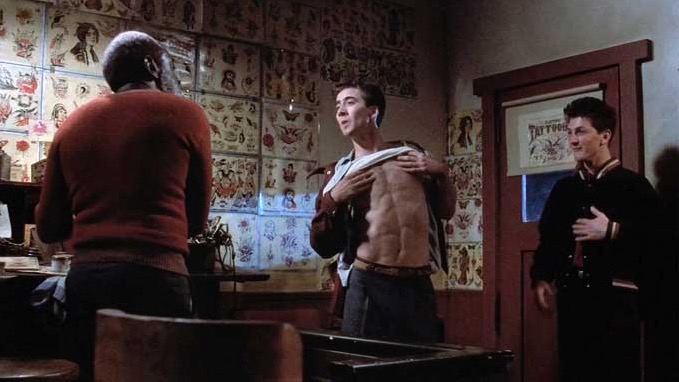
Drunken tattoos. After a drunken evening, Nicky and Hop go out in search of tattoos. Nicky needs some motivation for “killing Japs” and wants a giant eagle spread across his chest. Upon arrival, the tattoo artist wisely tries his best to persuade the drunken youths to forego the tattoo. Nicky replies, “I’m talking about the high-flying red, white, and blue bird of freedom here!” Finally, the tattoo artist asks them how much money they have. When they reply that the have $1.38 between the two of them the artist let’s them know they can only get “a sparrow” on their elbow for that which they presumably do not go for. Hilarious scene.
Thoughts on war. Since this movie was made in the 1980s, after our country has been through World War II, the Korean War, and Vietnam, it was interesting to see how the writing/directing would posit the sentiment towards war in the film’s plot and characters. I think the overall tone was true to the time period of the 40s in the optimism that our involvement in WWII was justified and we would “prevail” against the Nazis. In Hop and Nicky, we have two young Americans who are ready to go fight and kill “the enemy” at their first opportunity and without reluctance.
But there was also a more modern understanding that this could mean costly sacrifice, i.e the boys’ physical death (in the not-so-subtle symbolism of Hop’s father being a literal grave digger; in the funeral of high school friend who had already came back from the war in a body bag, and in the bizarre “medic / nursing drill” at the high school where male students pretended to be wounded so female nursing students could bandage and treat them as a record player blared combat sounds over a loudspeaker) and it would certainly mean the death of their innocence or childhood (i.e. a spiritual death). This theme–the inevitable passing of innocence–comes across loud and clear (and is perhaps the most informed by a longer history of war in this country) in the challenges the boys face leading up to their deployment.
Specifically, this shows up when Caddie takes Hop to a recovery ward so he can have his eyes opened to what war has done to the men of the town (maimed and broken them), when Nicky must take his girlfriend to the abortion clinic because of an unwanted pregnancy, and in the struggles both boys face economically as lower class men who wish to provide for potential mates. All in all, the film exercises a nice balance where the story stays true to war sentiments of the time, while still showing a more reflective and informed reality that no one really “wins” in a war, especially not the young men who fight them.
More firsts for Nicolas Cage as Nicky.
- First time on a train.
- First time in a pool hustle (and in one gone awry)
- First time impregnating a girl.
- First time lip synching to Tangerine.
- First time with a black eye in a film. (“Old man’s drinking again.”)
- First war-time movie.
Best lines from Nicky.
- “It doesn’t matter who and doesn’t matter what, as long as it looks like a girl.”
- “She’s a Gatsby girl. If you’re asking me you’re barking up the wrong pair of gams.”
- “This train’s an old friend, it would never hurt us. C’mon Hopper race with me.”
- “One second you’re John Wayne and the next your Minnie Mouse.” (Spoken to Hopper about the weapons the Nazi’s use (mines?) to blow men’s balls off.)
Racing with the moon, in the end, is a losing competition, as the moon lasts longer and will be here long after we runners have turned into the earth. But as Nicky and Hop have shown us, we can run with it for a while, and it’s a race that changes us, and is an endeavor worth pursuing. In this coming-of-age drama, we see two young men at a crossroads of life, that are about to be change by the path they are taking. Although there is conflict between them at times, and tragedy and heartache, in the end these two friends decide they need “to stick together”.
As the movie ends, Hop and Nicky stand at the platform of the train station getting ready to deploy. The whistle blows, the cars move, Hop’s dad frantically warns them, “Your train is leaving! You’re going to miss the train.” But with that knowing look, Hop and Nicky wait, and wait, and wait, smiling at one another, until the train begins to pick up steam and leave the station. Then, seemingly at the last minute, they run with all their might, and hop onto the last car, likely leaving the world they’ve known and their boyhood behind them in Port Muir.
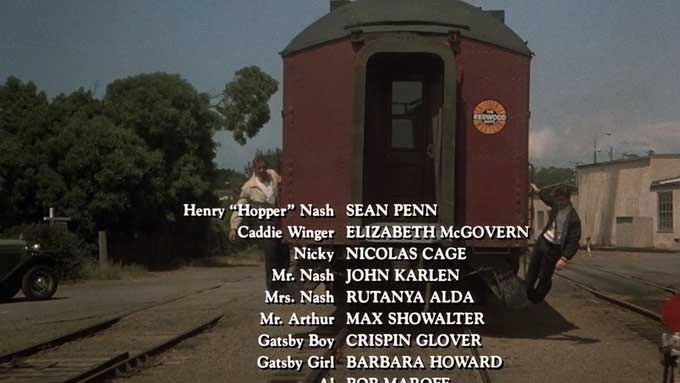
Roll credits.
If this movie was mostly about two men heading off to war, I believe the next one, Birdy, will be about two men who come home from war (at least the trailer teases as much.) So, what will Cage teach us next? Stay tuned!

 yeti speak...
Leave a comment