At the end of Racing With the Moon, Nicolas Cage and his best friend Hop jump onto the back of a speeding train as they set off to join the war effort. In the opening scene of Birdy (1984), a disfigured and bandaged Nicolas Cage (playing the character Al Columbato) is returning from the war by train, as if this movie were a sequel to the former, even though the two are completely unrelated. While the characters, themes and actors in the two movies were different (other than Cage of course), there were many parallel paths and complementary themes throughout that made watching Birdy a bizarre distorted echo of Racing With the Moon, as if we were fast-forwarding American history and culture from the optimism and naïveté of the 1940s and 1950s into the skepticism and doubts of the 1960s and early 70s.
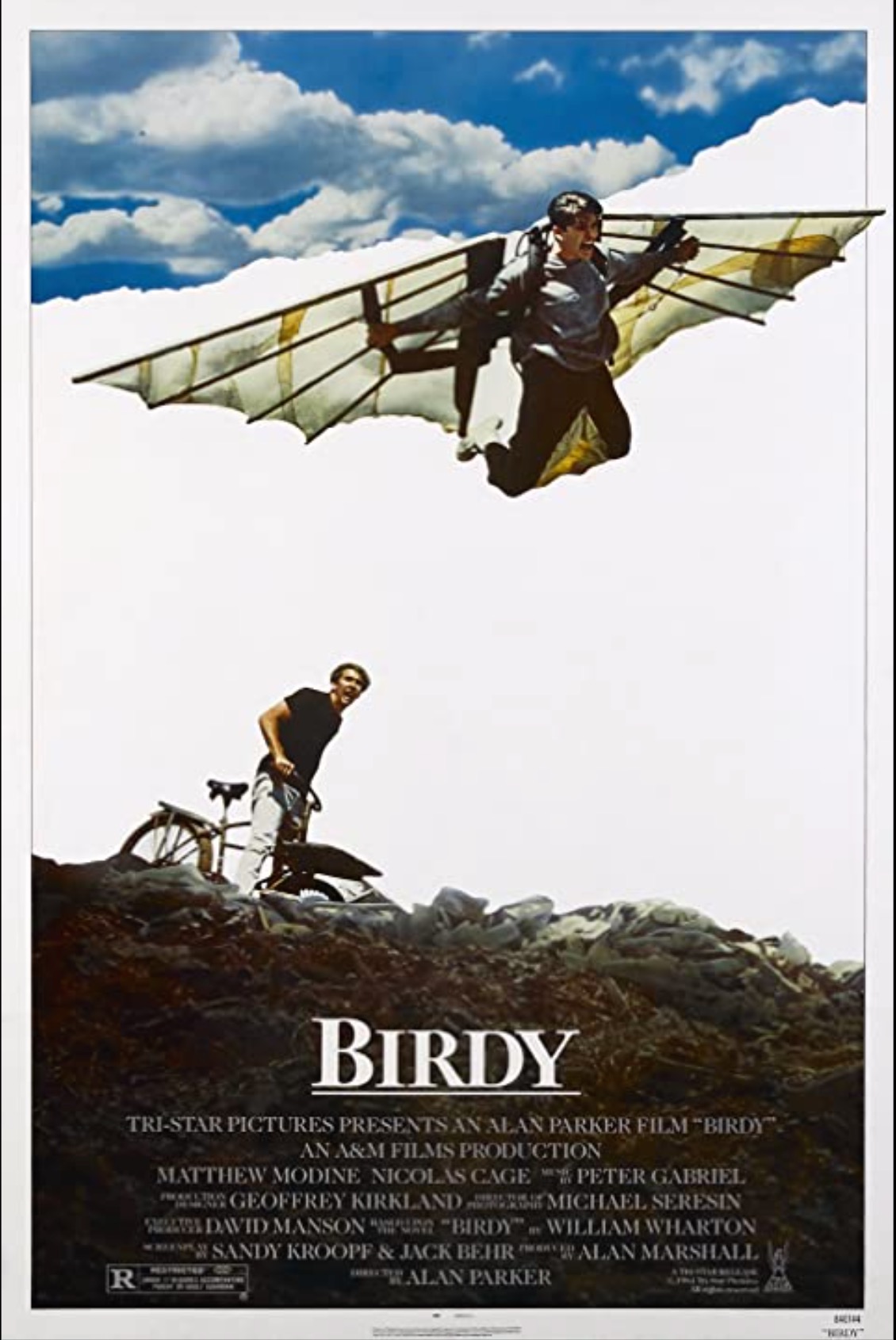
If Racing With the Moon centered around the coming of age of two young adolescent boys on the dangerous cusp of manhood, Birdy was a story of how two young men try to cope with the recognition of the loss of their childhood innocence. One story looks forward to an unknown (war-torn) future with some trepidation and expectancy, while the other looks back, beyond the war-torn present, to a simpler time in the past where pain and loss had not yet taken hostage two young men. The first movie was about personal accountability and friendship. The second was about the loss of mental health and devotion.
But all of these descriptions, which I think are accurate, also make the movie sound way more academic and high brow than it actually was. It was wack-a-doodle and kind of a “bird-brained” mess, in my opinion, for reasons we will get to shortly.
The thrust. In two sentences, this movie was about an injured Vietnam veteran Al returning from combat to look in on his old friend, Birdy (Matthew Modine) also a veteran, who is being held at a military mental hospital because he is in a catatonic state, and bizarrely behaving like the thing he has loved most in life: a pigeon. Al seeks to bring Birdy back to consciousness / mental health, “before it’s too late” by reminding him of their past history and good times growing up together in New Jersey.
Here’s my observations of this weird-ass movie via the world according to Cage:
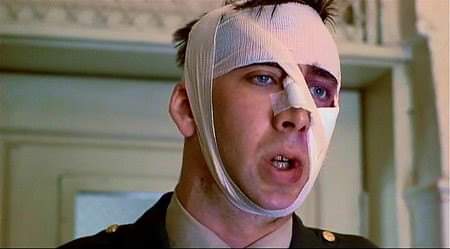
Mummy dearest. This isn’t the first time we’ve seen Cage in bandages. (That would also be in Racing With the Moon, when they were doing the nurse / medic “practice drill for the local high school.) But this is the first time we’ve seen Cage wrapped in a facial bandage throughout the movie. Ironically, the bandages didn’t mask either of his eyes, nor most of his nose and mouth, so I question how “disfigured” he was for a guy who had a bomb go off in his face. Evidently Cage, took on the “identification with the pain” seriously though. For the role he lost 15 pounds and got four of his baby teeth pulled out, foregoing the anaesthetic so he could share in the ongoing anguish a Vietnam vet would face. Badass. The teeth needed to be pulled anyway I guess. (which also solves the mystery I’ve been trying to suss out about why his teeth look so odd in these early films.)
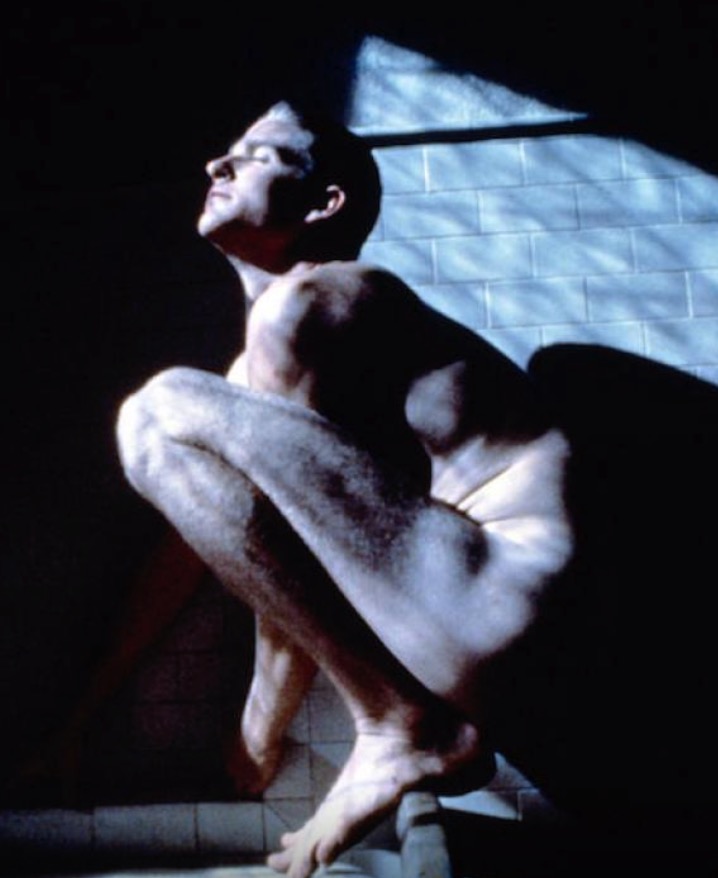
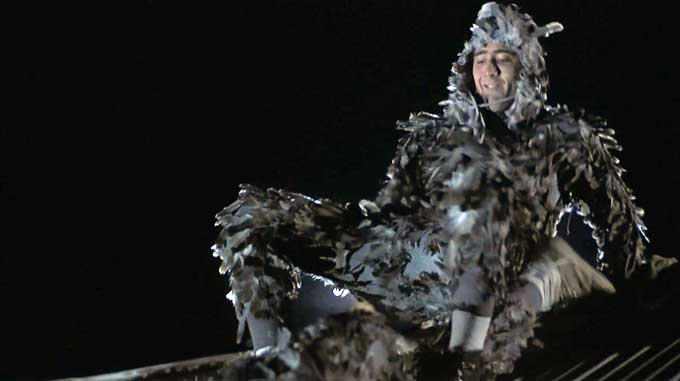
Modine’s naked ass. For me, the psychology of Matthew Modine’s character Birdy is really hard to follow in this film. The PTSD after the war is one thing, I can get that, but from the very beginning of the film we get the sense that Birdy is “not quite right” by most definitions of the word normal. From wearing a full-feathered pigeon suit, to spending his spare moments breeding canaries and watching their eggs hatch, or leaving behind his buxom “mammary glanded” Prom date to strip down and spend the night alone with his birds, Birdy was gone-daddy-gone way before he set foot in Vietnam. Was it a form of autism? I don’t think so. Suppressed homosexuality? Nah. In this day and age, I think maybe he’d be a furry or some other kinkified version of an ornithophile, but whatever the case, seeing him twist and contort his body, wedging it behind his hospital toilet, or squatting naked on his metal bed frame, I just had a hard time not watching the clock as Birdy moved from one silent disturbing pose to the next.
What’s in it for Al? I also was not really clear why Al would choose Birdy as his wing man (so to speak) in the first place. The two meet in high school because Birdy’s home was adjacent to the local sandlot where all the “normals” (my term) played pick up baseball games. But anytime a baseball sailed over the fence into Birdy’s yard, Birdy’s cantankerous mother would confiscate the ball thereby ending the game. Al would petition Birdy’s mom to return the ball and have some mercy, but she never did. Over the years, Al would try to get Birdy to help him find the secret stash of baseballs, but it was evidently well-hidden. Other than having a tough Italian father, Al seemed well-liked and well-adjusted, but was inexplicably drawn into this oddball relationship with Birdy a boy who enjoyed catching pigeons and trying to figure out ways that he could learn to fly. OK? I guess.
Am I missing something? This movie was directed by Alan Parker who also directed Pink Floyd: The Wall, Midnight Cowboy, Angel Heart, The Commitments, Evita, and Missippi Burning. So, when it comes to direction, this guy is no slouch! The soundtrack for the film was done by Peter Gabriel. It didn’t blow me away, but still it’s Peter Gabriel. The movie has decent ratings on IMDB and Rotten Tomatoes. So maybe I’m missing something here? Maybe it’s the depth of the relationship between Al and Birdy, or maybe it’s the way the film realistically addresses the mental toll of war on soldiers. I’m not sure, but I didn’t like it nearly as much as others seemed to.
Funny lines from the film
- “You’re going to break your crazy neck one of these days.” (Al to Birdy after Birdy falls about 100 feet from the rooftop of a building that he likely would have broken his neck from.)
- “That’s the first thing you gotta learn about your dealings with women, Birdy. You never let them know what you’re thinking.” Al to Birdy.
- Al speaking about the butcher from the market, “Yeah, that guy’d dress his mother as a chicken if he thought he could get 69 cents a pound.”
- “He wouldn’t like to be cooped up here.” Al speaking about Birdy.
Firsts for a Nicolas Cage character (Al):
- First time in a full bird body suit
- First time refurbishing a vehicle
- First time on a roller coaster
- First time arrested (for taking the car he refurbished which was registered by his father)
- Spoon feeding an adult grown man.
Seconds for a Nicolas Cage character (Al):
- Kicking a guy in the nuts (see Racing with the Moon)
- Pumping iron (see The Best of Times)
- Wearing bandages on his head (see Racing with the Moon)
- Fondling a girl’s breast (see Racing with the Moon)
My summary was that this movie was for the birds, so to speak. I watched it as I painstakingly watched the clock. Nicolas Cage gives a pretty good performance, and really shows off more of his acting capabilities than we’ve seen thusfar. The last soliloquy he gives where he cradles Birdy and tells him he will never leave him was moving if a bit over-acted. The 80s ending drew an eyeroll from me and I thought they missed an opportunity for Birdy to fly straight to the ground, but I digress.
Let’s hope Peggy Sue Got Married is a little bit more straightforward and less flighty.

 yeti speak...
Leave a comment