I recently read a book called Of Boys and Men: Why the Modern Male Is Struggling, Why It Matters, and What to Do about It. The book was published recently, so it focuses attention on the fact that men have left the workforce in droves (since the pandemic), are much less likely to get married, are not entering colleges and getting college degrees at the same rate as women, and (surprisingly) are falling behind women in many key success-metrics at a increasingly rapid pace.
The book argues that the gender gap that was once wide has now narrowed and started to shift and may even be turning the other way–leaving the men behind. The book is research driven, and leans centrist (or slightly-left) politically, but does a good job of showing different and opposing perspectives on the topic, and also provides some convincing proof that the role of men in society has been changing (often with negative consequences) since the upheaval of the feminist revolution. The book does not argue for a return to 1950s-era gender roles, norms, and values, but instead seeks to explain some key differences between men and women (socially/historically/sexually) that often get buried in the rhetoric, and it also provides some new solutions for ways men can adapt and thrive in this increasingly more equitable world.
Book report over! Let’s get the Cage.
And speaking of masculine men trying to adapt in a fast-changing but more equitable world, let’s talk about one of my favorite Nicolas Cage characters of all time: H.I. McDunnough. Herbert I. McDunnough, or “Hi”, takes the center stage in the Coen brothers 1987 comedic masterpiece, Raising Arizona, and his name (which can be shortened to Hi, He, or HIM) seems almost a prophetic wink from the pre-politically correct 80s to the pronoun-conscious wokeness of the early ’20s. To focus attention on only Hi though, as the lead alpha-male in this movie, would be a grave mistake, since Cage isn’t really, and is only one part of the nuclear family that the entire plot rests upon. The other atomic particles include Ed (short for Edwina), Hi’s head-strong and law-abiding cop / wife (played expertly by Holly Hunter) and Nathan Jr., one fifth of the “Arizona Quints” children whom Ed and Hi kidnap at the start of the film and plan to raise as their own.
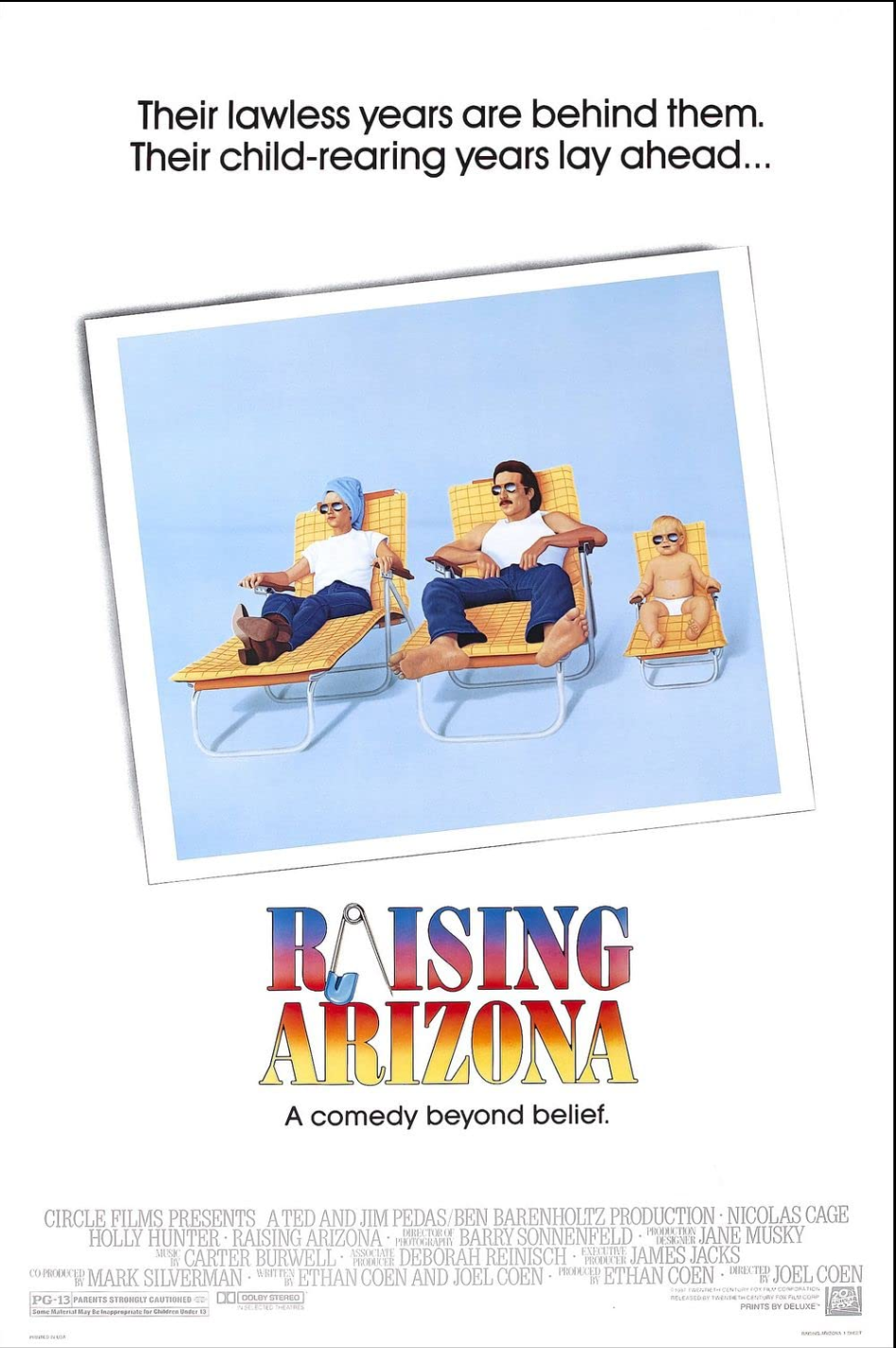

As the title of the film suggests, raising Arizona is just your classic romantic comedy about a man and a woman falling in love, getting married, starting a career, and raising a family. Except, if you’ve been blessed enough to actually watch it, you know this is NOT how you would describe it at all. It’s so much more! And that’s what makes it so great! So let’s dive right in.
The World According to Hi Observations…
Lovable misfit. The thing I love about Nicolas Cage, at his finest, is that he plays the dark horse really well. He takes on the role of the misfit, the outsider, the down-and-out deadbeat, and he elevates him to the status of anti-hero. Of all his movies I’ve seen, Raising Arizona is the one that stands out as “pure”, “unfiltered” and “unadulterated” Nicolas Cage. From Hi’s bedraggled appearance (he looks like Bill the Cat from Bloom County throughout), to his self deprecating melancholy, to his slow motion, twangy (?) drawl, everything about him screams “loser” and yet, you have the sense that with all the cards stacked against him, Hi is still going to get lucky once–and once will be enough.

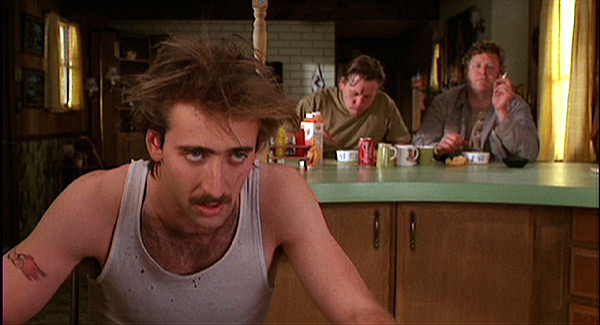
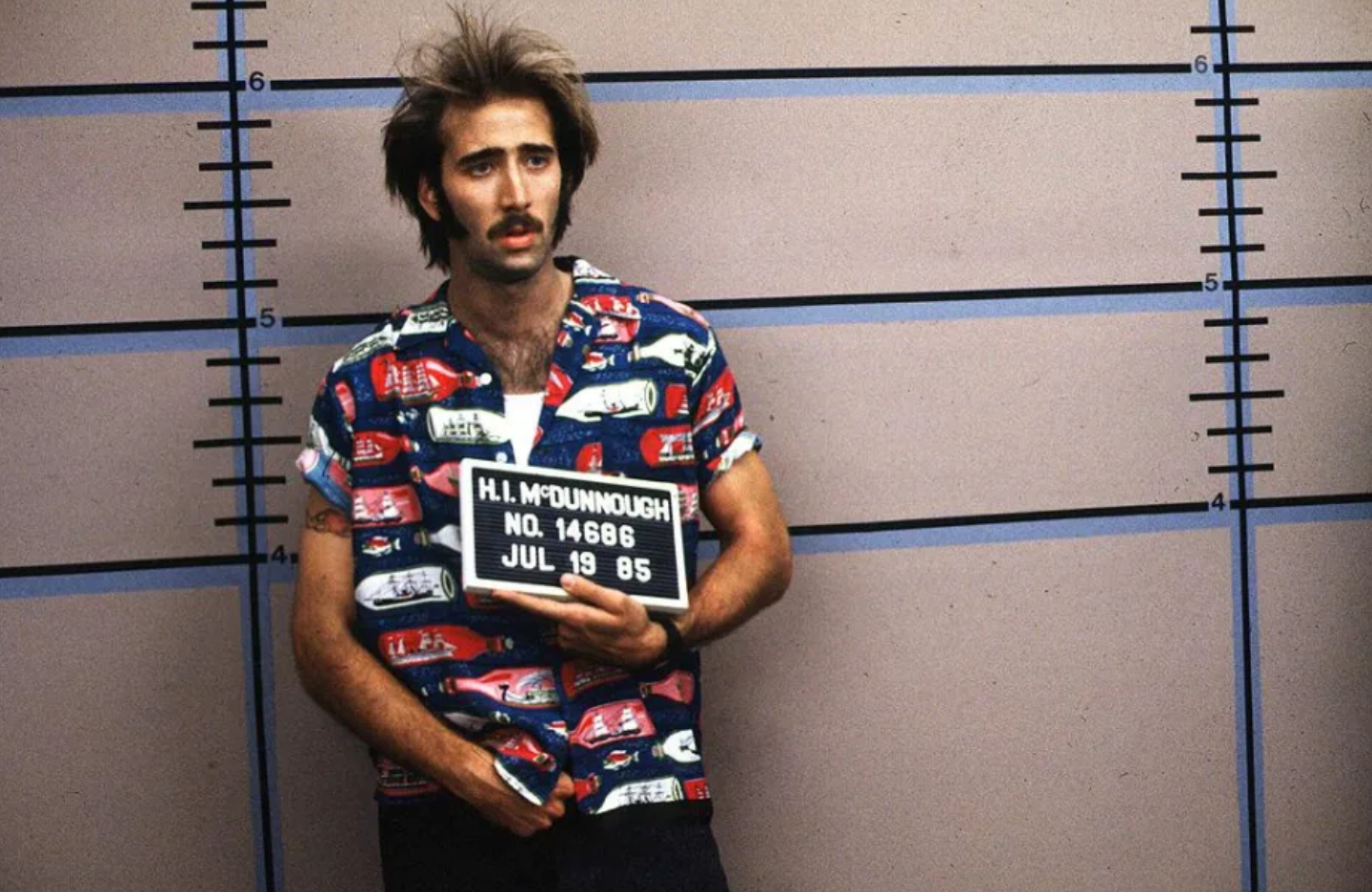
Raising Arizona takes this Cage quality of lovable misfit and unleashes it on the audience. From the very first intro scene, we know that the deck is stacked against Hi (and that he has done most of the stacking himself) as he is arrested time and again for robbing convenience stores in Maricopa county, Arizona. But it’s the awareness of his own fallibility, the authentic way that he woos Ed, his processing officer who snaps his mugshot and gathers his fingerprints (“Show the tattoo!“) that brings the audience over to Hi’s side, almost immediately. The whole movie is really about a man who is trying to “stand up and fly straight” but who by-and-large can’t get out of his own way enough to do so.
I have seen this movie so many times I can quote large portions of it by heart, but I’ll spare you, dear audience, in hopes that you’ll go back and watch it yourself and fall in love with this lovable misfit all over again. Except for this one line, spoken by Hi’s parole board, which I’ll use as my coda–recidivism, repeat O-fender–throughout:
Ok, then.
Of boys and men. What makes this film so funny is also what makes it tragic…for the state of men / manhood. Like I hinted to earlier, it’s a movie about the clash that happens when traditional gender norms no longer apply, but when societal expectations remain unchanged or barely altered. It’s a movie about the male role in the family (and in society) and about the lawlessness that lies buried within the heart of most men (and women) when what they desire most goes unfulfilled (or fails to satisfy).
Some examples of this:
- In a the traditional family, (pre-feminism) the husband / father acts as the provider and protector and the mother / wife is typically the nurturer and caregiver. From the start of the movie, Hi is a convicted felon, who cannot hold down a job and is “powerless” to protect his love interest Ed, because he is behind bars and removed from any productive role in a family or society. (“I’m walkin’ in on my knees, Ed. A free man proposin’.“)
- He sees himself as the “outlaw” but even in this role or perception, he emasculates himself from really harming anyone except himself (for example, he literally is “shooting blanks” as he robs convenience stores with an unloaded gun, and is outed by an old man who sees his stockinged face after a botched robbery, “Son, you’ve got a panty on your head.“)
- Edwina, whose goes by a typically masculine name, Ed, holds a high-power position in society (as a policewoman) and in her relationship with Hi. Rather than being the “submissive” wife, as was the norm of the 1950s, Ed is typically the driving force behind Hi’s desire to be rehabilitated, take on a job, and have a family. When it comes to bearing children, however, it is Ed who is barren and unable to conceive–failing that stereotypical female sense of purpose in birthing and raising a child.
- When Hi does try to take on the provider role, he is forced to work at a low-skill, low-pay factory job where his task is to drills holes in sheets of metal all day. “Work was a lot like prison, but at least I got to come home to Ed at the end of each day.” But even his working man attempts go south when Hi’s boss (an emasculated / in man in his own right) suggests the way to spark up the marriage is to “step out of it” by sleeping with other people.
- Hi making the transition from outlaw to married man and father is met with confusion and resistance from his ex-con peers. “You’re young and you’ve got your health. What would you want with a job.” Gale (played by John Goodman) can see who “wears the pants” in the family and wonders aloud whether or not Hi’s domestic situation is really working out for him.
- Hi himself seems unsure of his decision to take on the role of husband / father at times and feels that his decision to kidnap Nathan Junior has unleashed a doppelgänger or some otherworldly “fury” from inside him in the form of the apocalyptic bounty hunter, Leonard Smalls.

There’s other examples of these gender-blurred roles and topics, of course (like the prisoner who feels like a woman trapped in a man’s body because “he gets the menstrual cramps real bad“) but what ultimately comes to the forefront is that the film upholds and celebrates the idea of family in light of all the gender differences and role confusion in the modern world.
We know that Hi really wants to be a good father, but often feels like he can’t live up to the task “What?!? Are you kidding? Have we got ourselves a family here,” “We’re about to pop, honey.” We know that he wants to protect his marriage and his Ed from those who would do either harm, “Keep your damn hands off my wife.” And we know that in the end, he even finds his more nurturing self as he lets go of his own demons, “I’m sorry,” he whispers to Leonard Smalls as he pulls the pin on the hand grenades that would blow the man (his dark self) to smithereens.
Ok then.
Redneck chic.
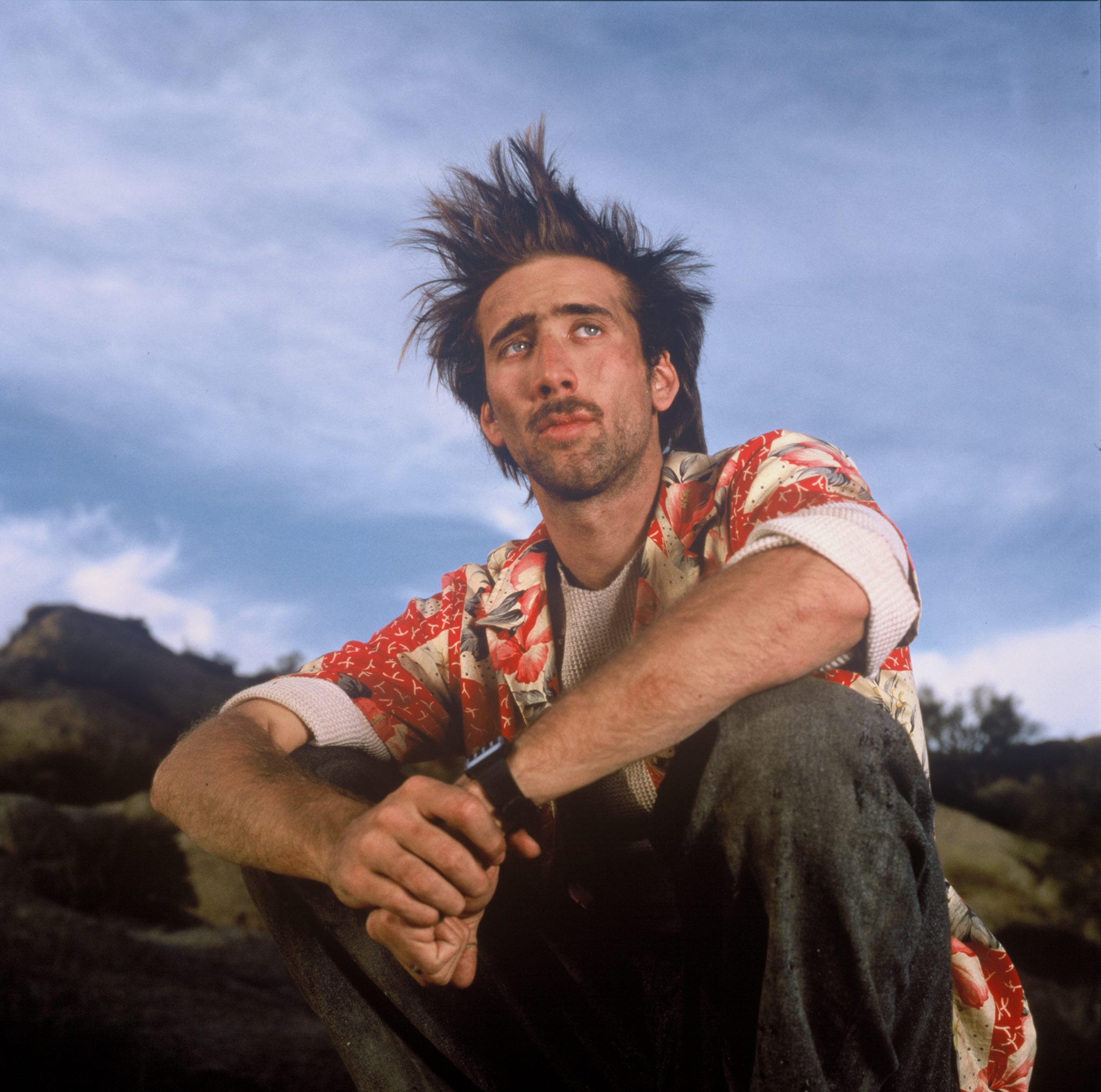
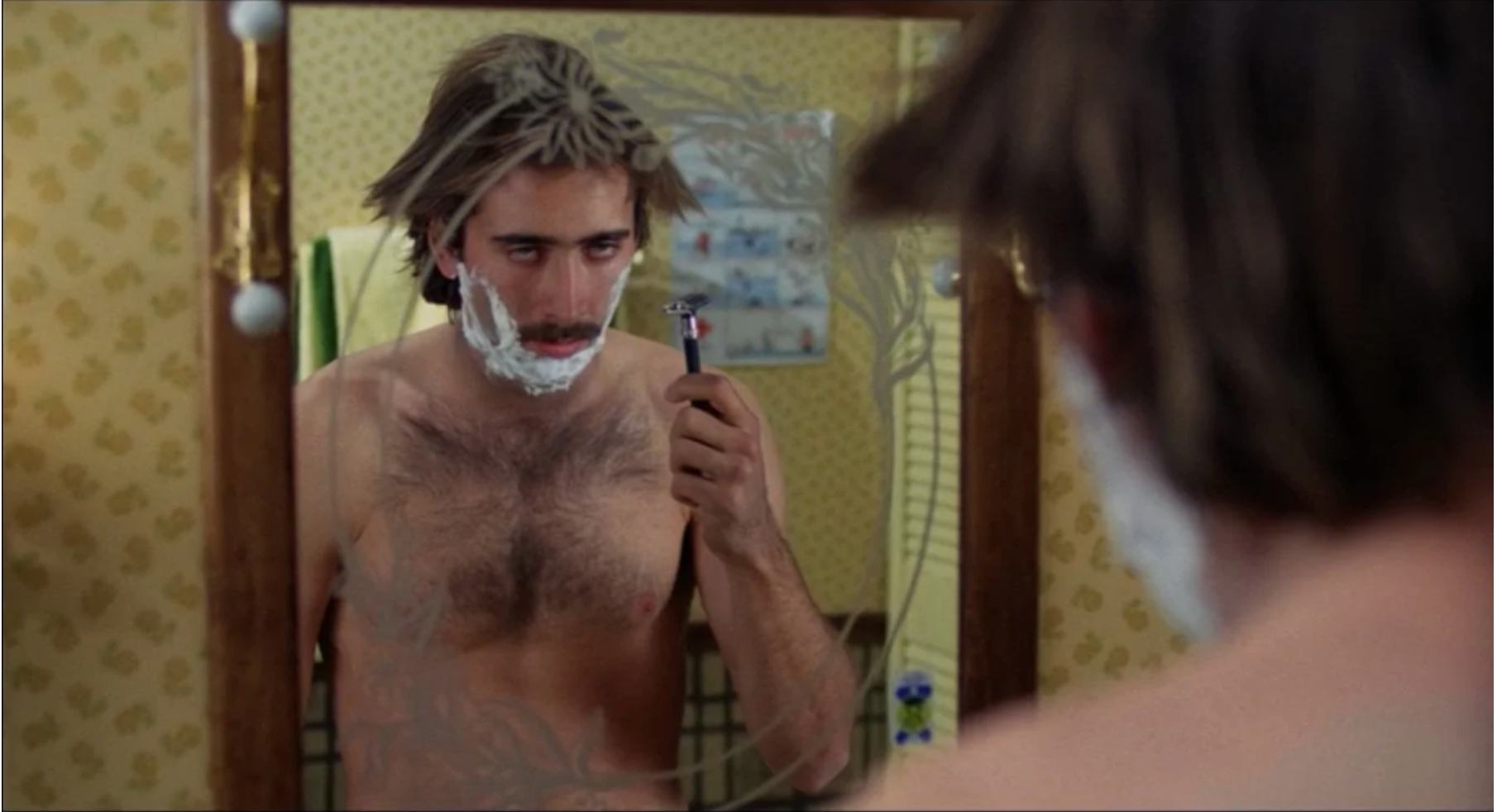
I would be remiss if I didn’t make at least a few comments about the untouchable style of this movie. I’ve never been to Tempe, Arizona and know of Maricopa county only from the conspiracy-fueled controversy surrounding recent election years, but the way the Coen brothers brought this trailer park vision to life is truly remarkable. From the scenes where Hi and Ed are sitting in lawn chairs watching the sunset over the wasteland dessert landscape, to the “seed bank” backwater towns full over overall wearing hicks, to Hi shoe-horning his penny loafers over his white tube socks, this movie sets the bar for what I’ll call Redneck Chic. Cage’s hair alone is a masterpiece. At times, it looks like the early stages of an overgrown mullet, at other times it’s got the Johnny Rotten bed-head punk rock somebody-must-have-puked-here presence, and when it’s slicked down, woah, it looks like powder blue suits from awkward family photos from the 1970s. The Coens would go on to create a slough of cult classic films after this (Barton Fink, The Big Lebowski, Fargo, O Brother Where Out Thou) but this one really sets a standard for me. It captures that little piece of Americana that should not EVER be forgotten (or repeated).
“There’s other examples of these gender-blurred roles and topics, of course (like the prisoner who feels like a woman trapped in a man’s body because “he gets the menstrual cramps real bad”) but what ultimately comes to the forefront is that the film upholds the idea of a family in light of all the gender / role confusion. Raising Arizona celebrates these differences. We know that Hi really wants to be a good father, but often feels like he can’t live up to the task “What?!? Are you kidding? Have we got ourselves a family here?”
Firsts for Nicolas Cage character / Hi:
- First tattoo, road runner.
- First mustache.
- First shoot-out.
- First time parent / adoption / kidnapping.
- First unarmed-robbery (the gun wasn’t loaded)
- Chased by pack of wild dogs through a grocery store.
- First time in front of a parole board.
- First time destroying a modular home in hand to hand combat.
- First kill in hand-to-hand combat (poor Leonard)
Best Nicolas Cage lines from Raising Arizona
There really are too many to list. Most are the way that he says things and there are some great soliloquy’s and dream sequence talks, too. Here’s just a few that I haven’t already quoted.
“I even caught myself driving by convenience stores…that weren’t on my way home.”
“I tried to stand up and fly straight, but it wasn’t easy with that sumbitch Reagan in the White House.”
“Yeah, he’s awful damn good. I think I got the best one.” Hi referencing Nathan Jr after abducting him from his home.
“Nathan needs some Huggies, I’ll be out directly.”
Summary
I didn’t really speak to the humor of the film as much as the societal messages encoded within it. But this movie is so funny. I remember rewatching it in college and almost crying as I tried to catch my breath during the Huggies robbery scene. Since then I’ve seen it so many times, it’s lost the original punch it once had due to over-familiarity, but I appreciate it in completely different (and deeper) ways now as a father and a husband. Raising Arizona will be a difficult movie to topple from my top ranking. I’m not sure if any will compete or even compare for me. But there are still a hundred plus movies to go, so I’m willing to be surprised.
Sumbitch.
Ok then.


 yeti speak...
Leave a comment