Prologue
Ok, so I narrowly avoided making the exact same mistake I made early on in this WATC(H) journey. When it came time to view this next Cage movie, Giuliano Montaldo’s production of Time to Kill (1989), I instead almost watched A Time to Kill (1996) starring Matthew McConaughey, Samuel L. Jackson, and Sandra Bullock. I even went so far as to place a hold on the Gresham-novel adaptation from my local library.
Thankfully, I averted miswatch #2, when I realized my mistake. But, as fate would have it, the Italian-produced Time to Kill starring Nicolas Cage is currently unstreamable (and difficult to even find). Similar to the roadblock I faced with WATC(H) #7 The Boy In Blue, which I skipped–for now–I found myself struggling to find a way to watch Time to Kill.
Luckily for me, one of the largest videos archives in the world, Scarecrow Video, with it’s 149,000+ rentable titles, is just a short 20 min drive away and still (inexplicably) open for business. As if I traveling by time machine, I drove myself to ye olde video store, opened up an account, perused the labyrinth of DVD-stacked shelves, and found a single copy of Time to Kill, which I then rented and brought home for viewing.

No Time to Kill
When you rent a movie you are really buying a sense of urgency. Especially when you do it the old fashioned way at a “brick and mortar” establishment that carries with it that tangible shiny plastic disc with clear time parameters and associated late fees. The clock starts ticking and there’s (pun highly intended) no time to kill. So I watched Time to Kill with a time-driven task-based sense of investment (hey, I paid for this!) but fearful about the expected outcome (and it probably won’t be worth a damn!)
Every rental has that high degree of disappointment baked right into the premise.
When a movie goes out of print (or out of general circulation) like Time to Kill has, the suspicion is that this is also an implied indictment on the movie’s overall quality. After all, even mediocre films tend to stick around forever, especially when there is money to be made on them and a million different streaming platforms that act as life-support outlets. This, coupled with Time to Kill‘s middling five out ten rating on IMDB had me expecting the worst.
Was it the worst? With Nicolas Cage, hope springs eternal…
Time to Kill Observations
This movie was not the worst, but it was problematic and messy (like many of Cage’s early works). To start, the cinematic quality was poor. I’m not sure if this was due to the standard def DVD production quality of the late 80s, stylistic choices of the director, or some other budget corner-cutting that was needed to release the film, but the scenes all looked grainy, washed out, and low budget on my flatscreen. The storyline itself, which centers on the Italian army occupying arid regions of 1930s Ethiopia, may have played into this visual design choice. Perhaps the desert lends itself to a too bright then too dim filters that show up in the film, but it didn’t inspire a lot of confidence that the filmmakers knew what they were doing.
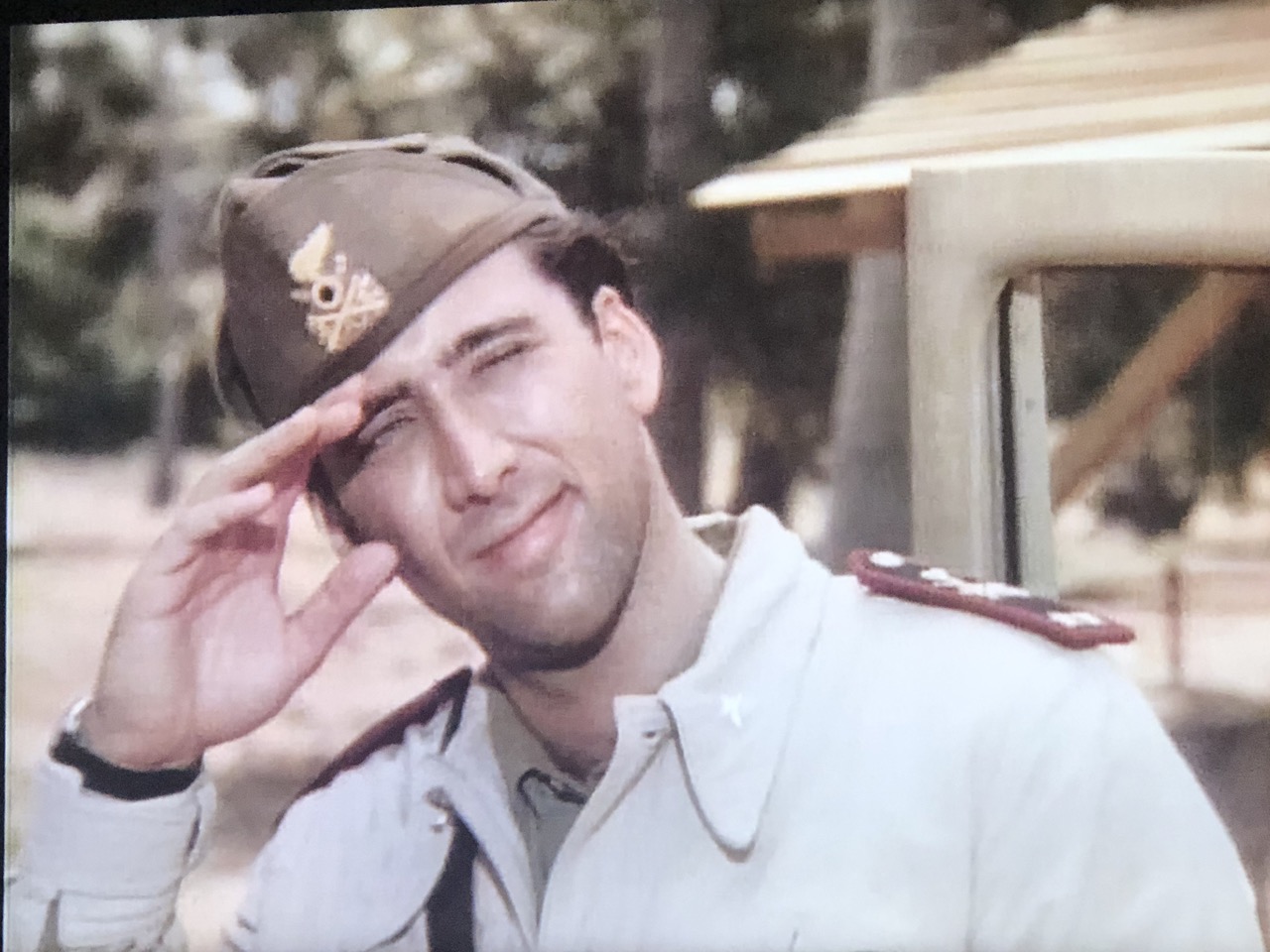
So that’s strike one, but what about the plot? Nicolas Cage plays Lieutenant Enrico Silvestri, an army officer with a toothache, who takes a shortcut through the Ethiopian wilderness in hopes of arriving at a town (or a base?) with a dentist. Along the way Silvestri meets up with a young Ethiopian lady, Mariam, bathing alone near a waterfall, that he forces himself upon (and then tries to court a bit) and then develops a one-day (?) relationship with (though they don’t speak a common language).
Tragically (and stupidly) Silvestri accidentally shoots Mariam while trying to kill a harassing hyena. The two were inside a cave and evidently the bullet ricocheted into Mariam’s stomach. Silvestri then decides he must end her suffering (by shooting her again), he hides/buries her body in the cave, and erases all evidence that the two were ever there. The rest of the movie is focused on Silvestri trying to leave the country, and return to his wife in Italy, at first via furlough and then by going AWOL. But his flight becomes more and more desperate and unhinged after he makes the startling discovery that Mariam had leprosy which he fears he has contracted through intercourse.
Eventually Silvestri realizes (by befriending and taking refuge with Mariam’s family) that Mariam was not a leper after all and he finds some resolution for his guilt when he confesses his crime and reveals Mariam’s resting place to her father. The Italian occupation of Ethiopia comes to an end, and Silvestri and the other troops are happy to finally return to Italy, but with World War II just on the horizon, their hope and optimism seem like they will be very short-lived. The end.
Cage makes me uncomfortable, but…
Nicolas Cage characters can be quite cringey. As we’ve discussed in a few posts (this one and this one) his characters take advantage of / grope women, put them in compromising positions and/or (in extreme cases) sexually assault them. This movie was the pinnacle of disturbing male behavior continuing the theme from Vampire’s Kiss. It’s unclear how old Mariam actually is, but she looks young and though she and Silvestri cannot communicate in the same language, she is clearly trying to stop his first sexual advances. Silvestri is undeterred and forces her to have sex with him. In the end she complies, and weirdly doesn’t seem traumatized by the experience, but culturally this may be the way that women were conditioned to behave in that part of the world. I have no idea, speculating here. We’re left wondering this. To make matters worse, he tries to pay Mariam afterwards with money, food, and trinkets. Ugh.
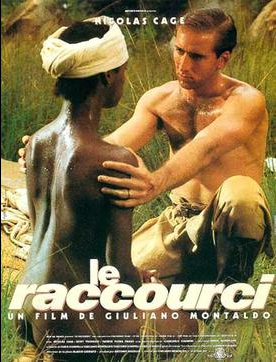
In some ways this whole interaction feels like a very literal metaphor for the way western colonialists “raped and pillaged” the African continent for centuries. These undertones are definitely present throughout the film in the treatment of the locals by the infiltrating Italians.
The whole rape scene made me very uncomfortable BUT the poetic justice does come later in the movie (after Mariam is long-dead and Silvestri is starting to feel the weight of his own guilt in causing her demise). In a great scene where a senior Italian officer is goading another lieutenant to try and flirt with some local girls, we discover that the local women who wear a “white turban” in this Ethiopian town are marked as those who have leprosy. (The officer actually says, “Stick no dick in a white turban.”) Silvestri quickly put the pieces together: Mariam also had a white turban, Mariam was alone in the wilderness, Mariam tried to refuse his sexual advances although she did seem interested in him (and afterwards actually desired to be with him).
All these clues, plus the fact that Silvestri has a wound on his hand that won’t heal, seem to point to the fact that the lieutenant probably has leprosy and has royally fucked up his life. Poetic justice served. After this revelation, Silvestri spirals as he tries to hide his infirmity from others, find a way to get on a boat back to Italy, and cope with the reality and consequences of his transgressions.
Cage always does cool shit.
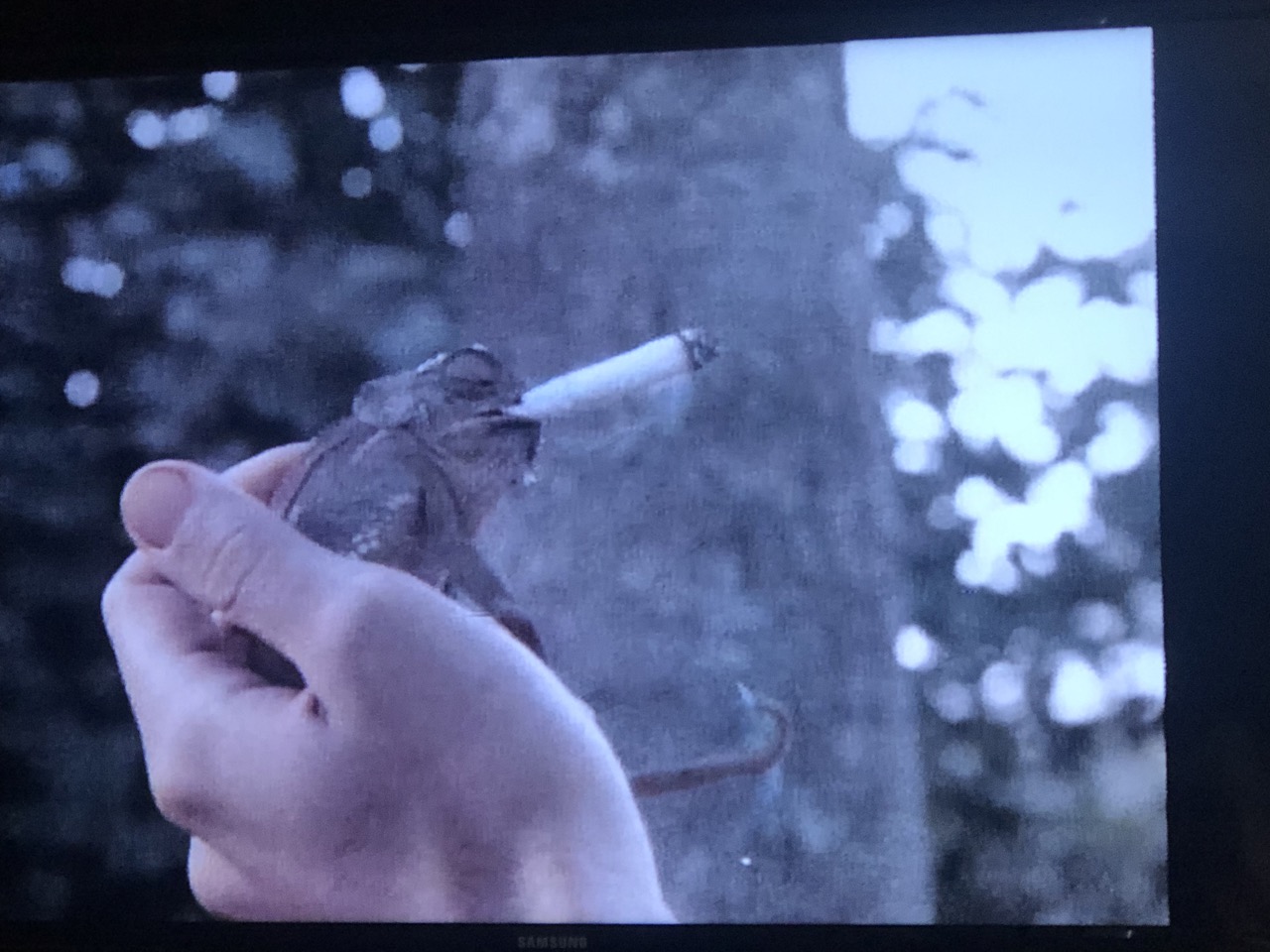
As much as he makes me uncomfortable in his movies (e.g. his sexual aggression, volatile tantrums, anger management issues) his characters also do some pretty cool (and pretty unexpected) shit. Like this epic moment when he helps a lizard smoke a cigarette.
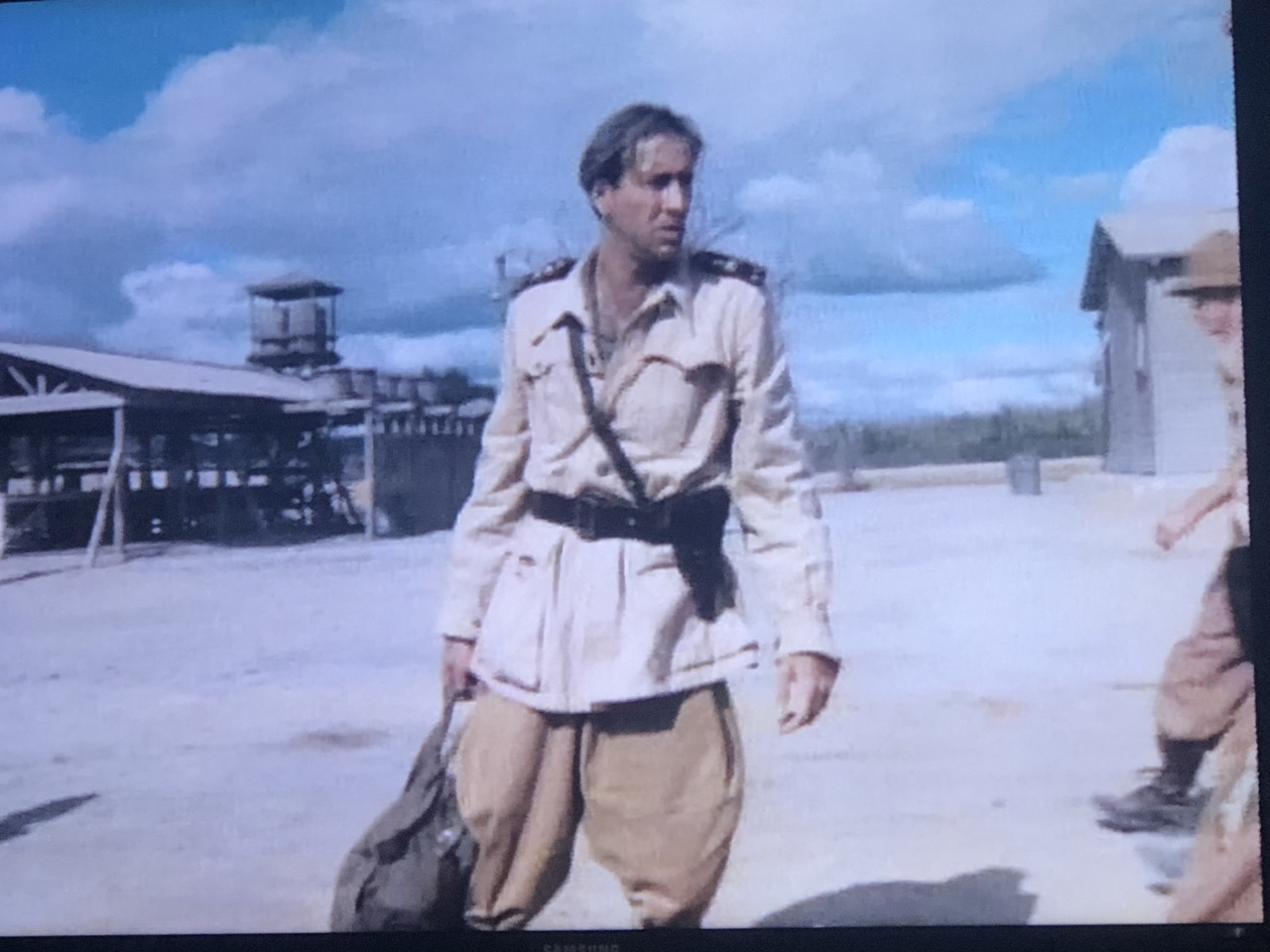
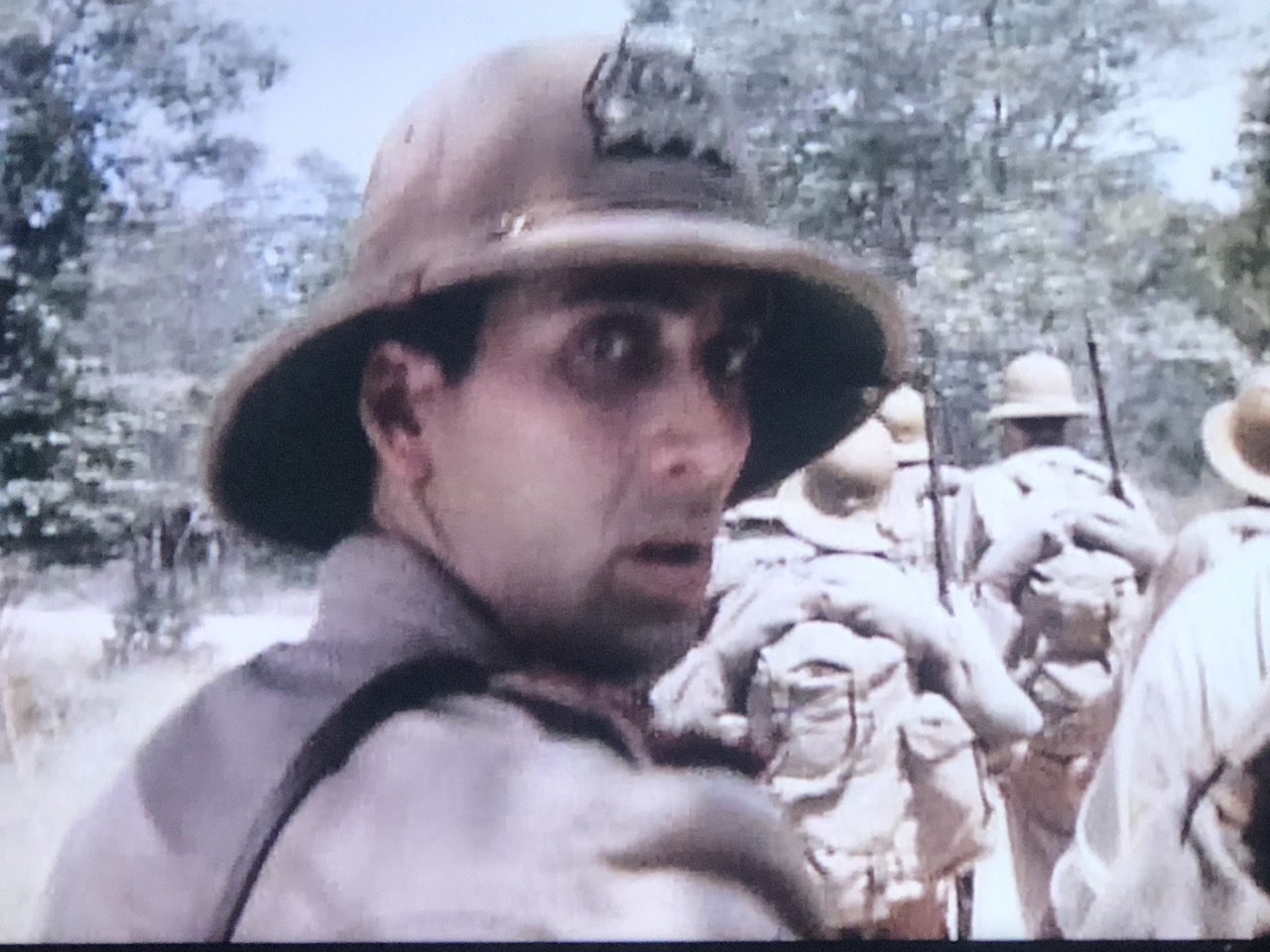
Or this time when he is wearing MC Hammer Style Pants. Or this time when he is sporting the classic missionary pith helmet. (Can you imagine how cool Jumanji would have been if Cage had been cast in a starring role?)
The best scene. Probably the best scene of the movie was when Silvestri is trying to nonchalantly and anonymously broach the topic of his suspected leprosy with a military doctor. Silvestri explains to the doctor, “I have in mind a novel about a man who comes to Africa [cough] and becomes infected with a mysterious disease. Maybe I will have some of that iced tea.” Then Silvestri goes on to explain that his fictitious character (I’m “asking for a friend”) maybe has leprosy, and he wonder swhat the doctor would recommend. How might “the character” might expect his life to change with this diagnosis. The doctor plays the straight man in this conversation and goes through all the ramifications of this character getting leprosy and all the ways in which the person would ultimately be doomed, deflating all of Silvestri’s hopes and dreams in a second by second visual encounter. The scene is quite hilarious.
I’d say the modern-day equivalent would be going out to WebMD and putting in your symptoms rather than asking a professional, because you are afraid of what the actual diagnosis might be. Yes, sir. As the doctor gets wise to Silvestri’s “hypothetical situation” Enrico gets nervous and tries to shoot the good doctor, but misses. He runs off.
This movie is a mess.
If all the things previously mentioned aren’t enough to convince you, the ending of this movie should tip the scales on the fact that Time to Kill is just that–time you are killing when you could probably be doing better things.
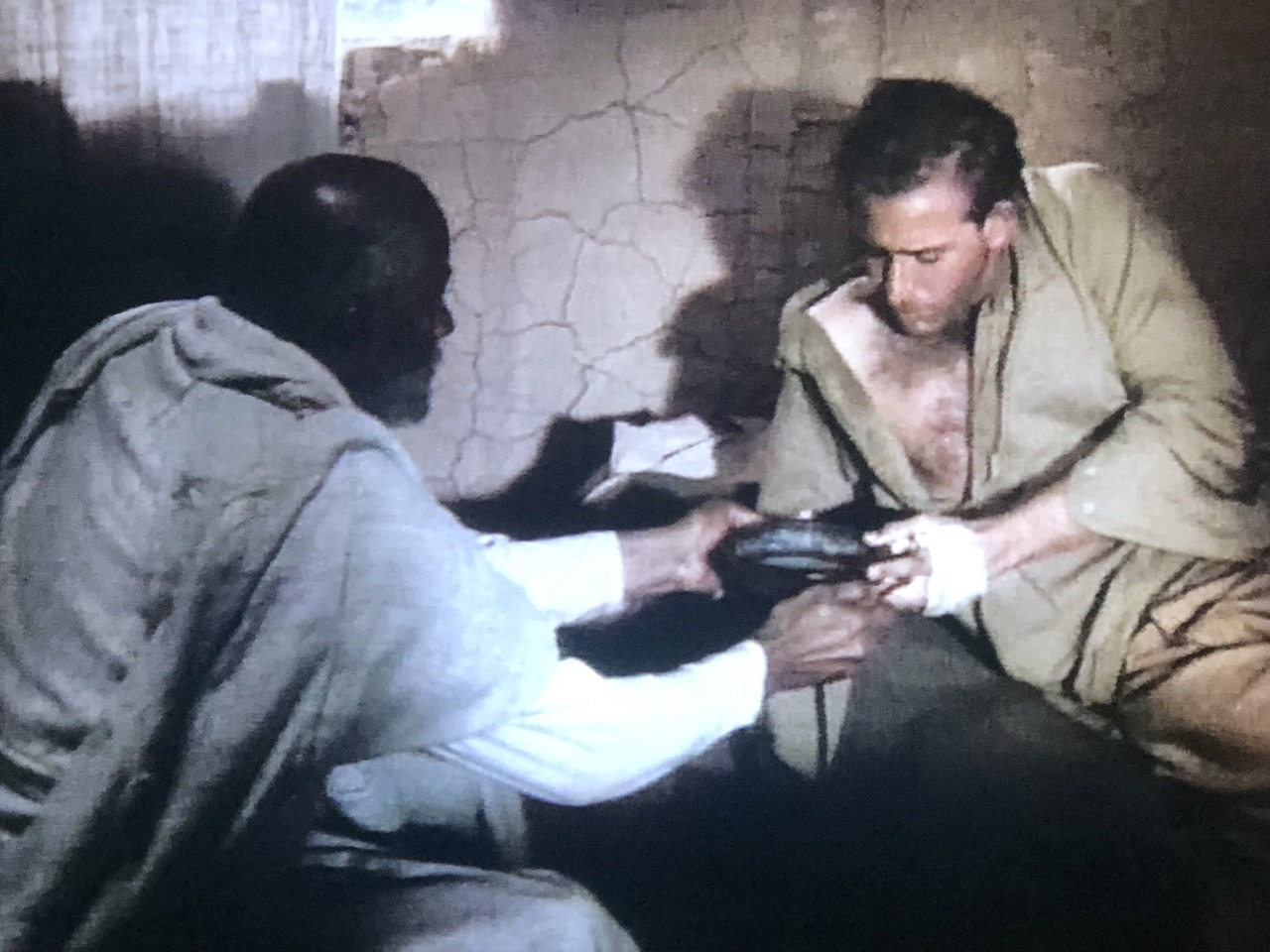
The evidence in summary: After Silvestri despoils and ends the life of an innocent Ethiopian girl, he squanders his opportunity to leave and return to Italy, he berates Mariam’s younger brother for no good reason, he robs a fellow officer who sorta tries to help him out, he dooms the said officer to death by leaving him unarmed in a bandit-patrolled area, he forces himself on Mariam’s family who must take care of him while he is ill, and he leaves the country without facing any consequences for his actions (remember Mariam never actually had leprosy to being with.)
White man wins again! Another score for the patriarchy…
Best lines from the movie:
- How long can a person live with a bullet in their gut?
- It’s too bad we can’t get a little conversation going? (Said by Silvestri to Mariam after non-consensual sex.)
- I wanted to scream. I wanted to pull my eyes out. And I left.
- Life boat drill. Jolly. (Last line of the movie as Silvestri walks across the deck of the ship.)
- Spoken about Silvestri by the narrating lieutenant, “Never saw Enrico again. But for years, I could smell the hair lotion he used. It was sweet and cloying like flowers in a cemetery.”
Firsts for Nic Cage character in a flim, as Enrico Silvestri:
- Trip to the dentist for a toothache (screams in pain as the dentist removes the tooth)
- First time as an officer in the Italian army
- Appearance on the African continent
- Wearing knee-high combat boots
- Taking a lethal shortcut
- Appearing silhouetted in front of a large waterfall
- Nearly getting an STD (if leprosy counts as that)
- Sucking the yolk out of an egg
- Peer-pressuring a reptile to smoke
Repeat occurrences for a Nic Cage character
- Sexual assault (cringe, see Vampire’s Kiss)
- Enlisted man (see Racing with the Moon, Birdy)
- Bandaged (see Racing with the Moon, Birdy)
- Throwing a piece of paper / object in a tantrum-like fashion (see Vampire’s Kiss, Birdy, Moonstruck)
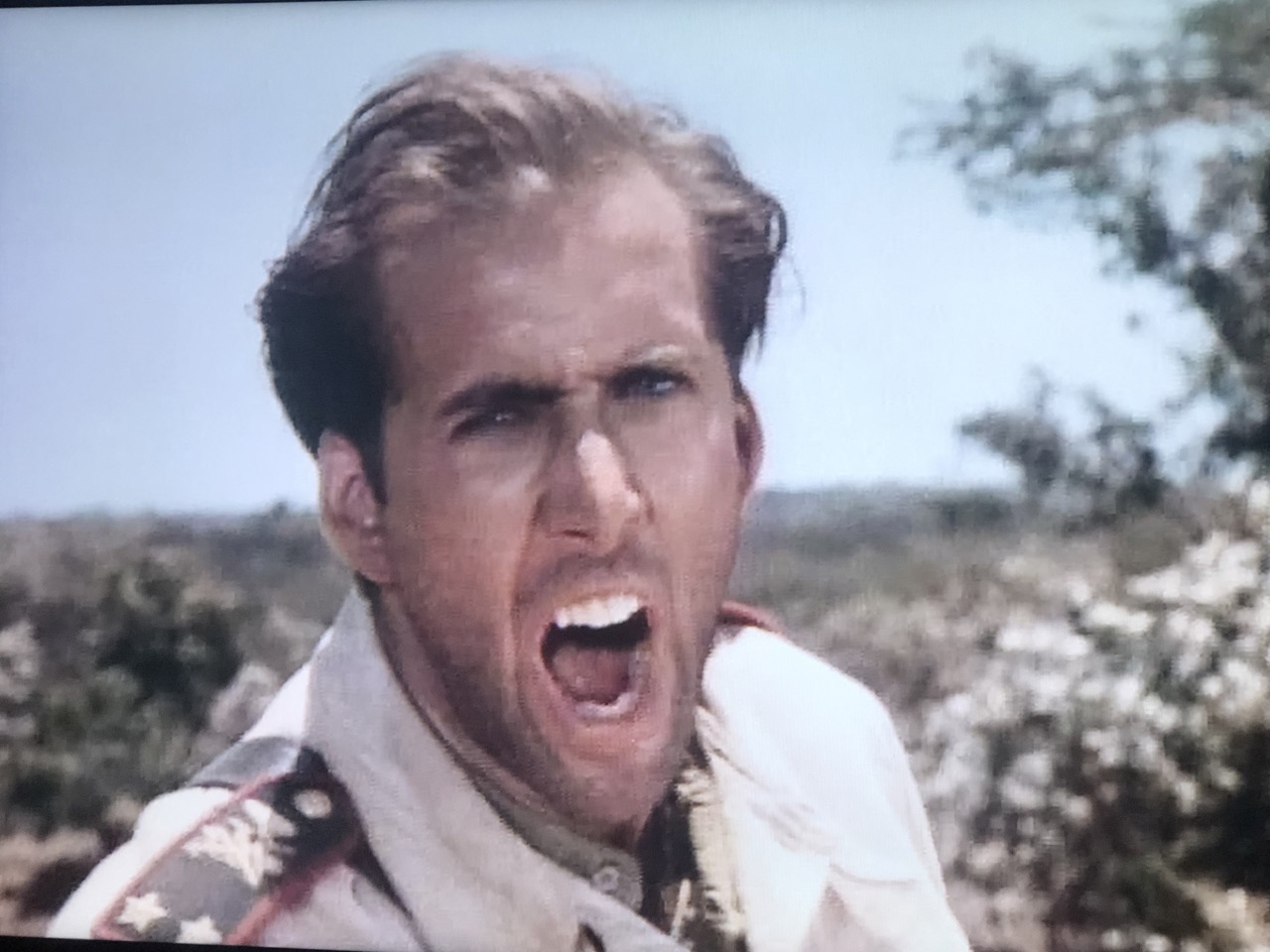
Summary: Once again I was surprised in both good and bad ways by a lesser-known Nicolas Cage film. Would I ever rent Time to Kill again (especially given the gas mileage, expense, and time required to do so). Absolutely not! Am I glad I did it once. Yeah, sure, I guess. If nothing else, for the smoking lizard and this rage face...
Tune in to the next WATC(H) blog post to learn about which movie converted me fully to Nicolas Cage fandom in the 1990s…

 yeti speak...
Leave a comment