What could happen to you?
It could happen to you.
What’s it? In this situation it is not Pennywise the Clown.
No, this it is not nearly so scary. This it falls well within the realm of serendipitous good fortune, as one of Nicolas Cage’s Sunshine Trilogy movies (his three serious takes on the good guy / rom-com).
This it is the shiny-happy-people-laughing kind of it that one thinks of when they think of the friendly policeman playing stickball with the neighborhood kids (no one thinks this anymore); the poor down-on-their luck folk who wind up winning the lottery; or the mismatched / star-crossed couple who find their one true love at the end of the rainbow.
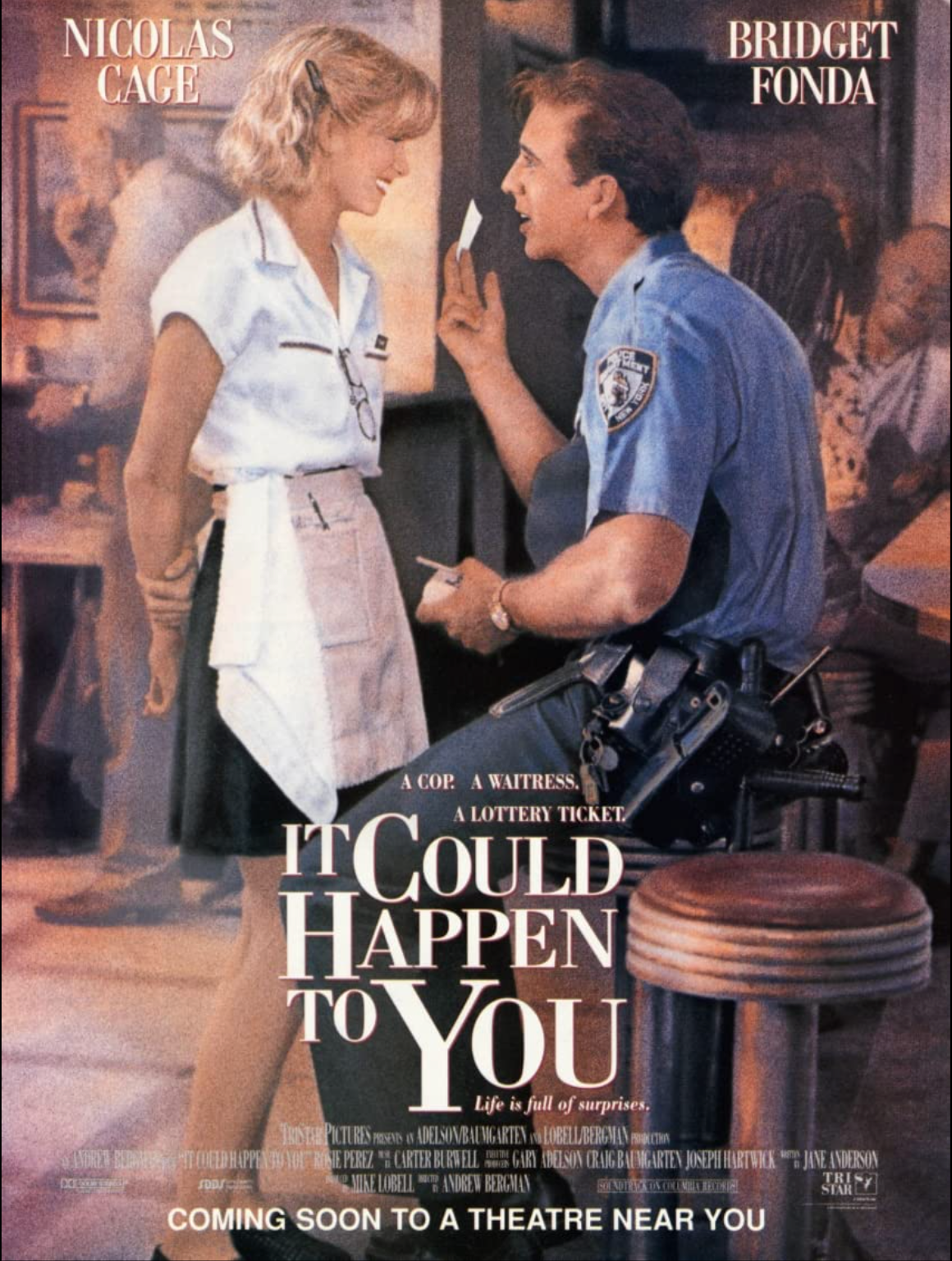
In fact, that it precisely describes the storyline of movie #22 on the WATC(H), It Could Happen to You (1994).
The skinny on It
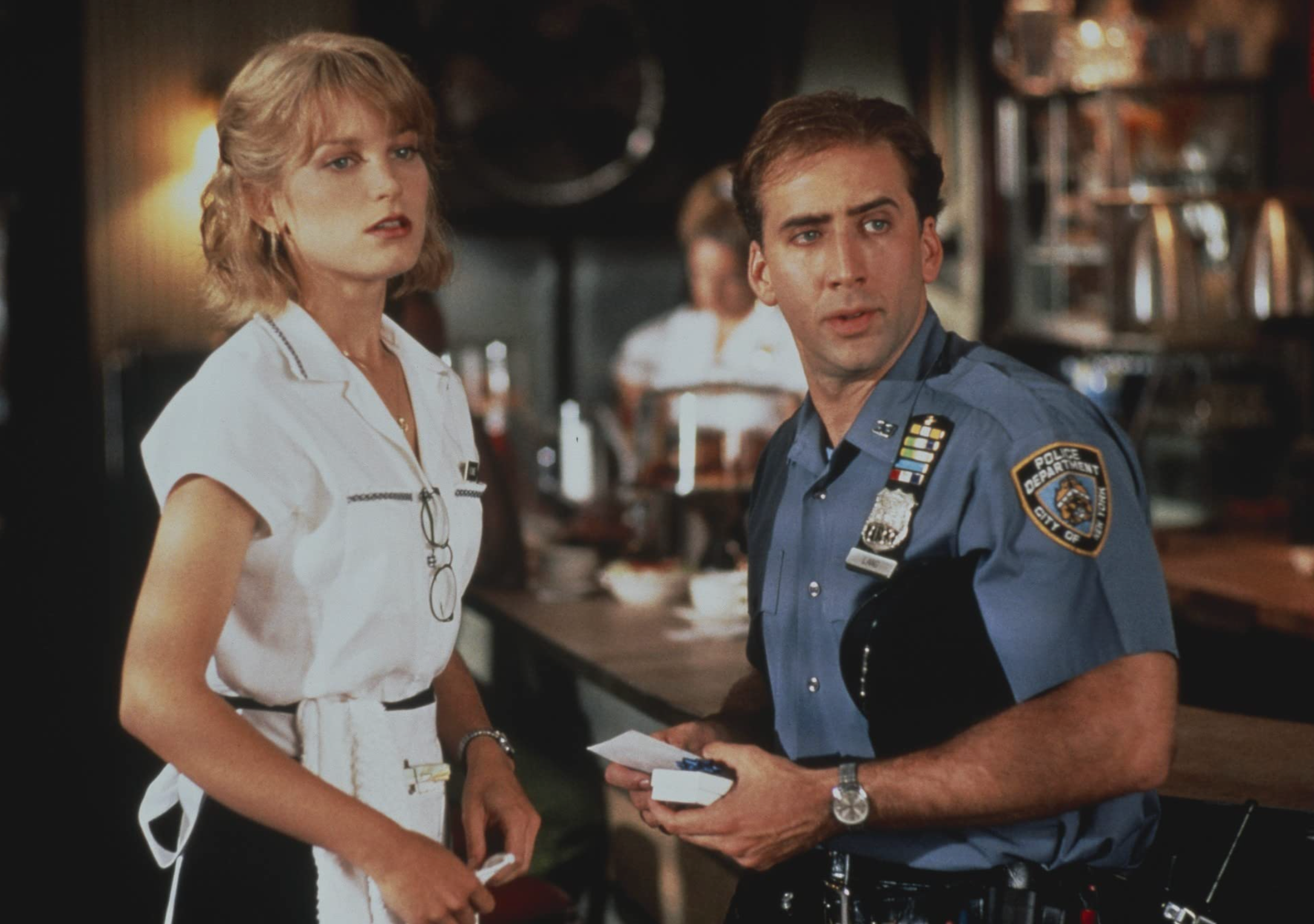
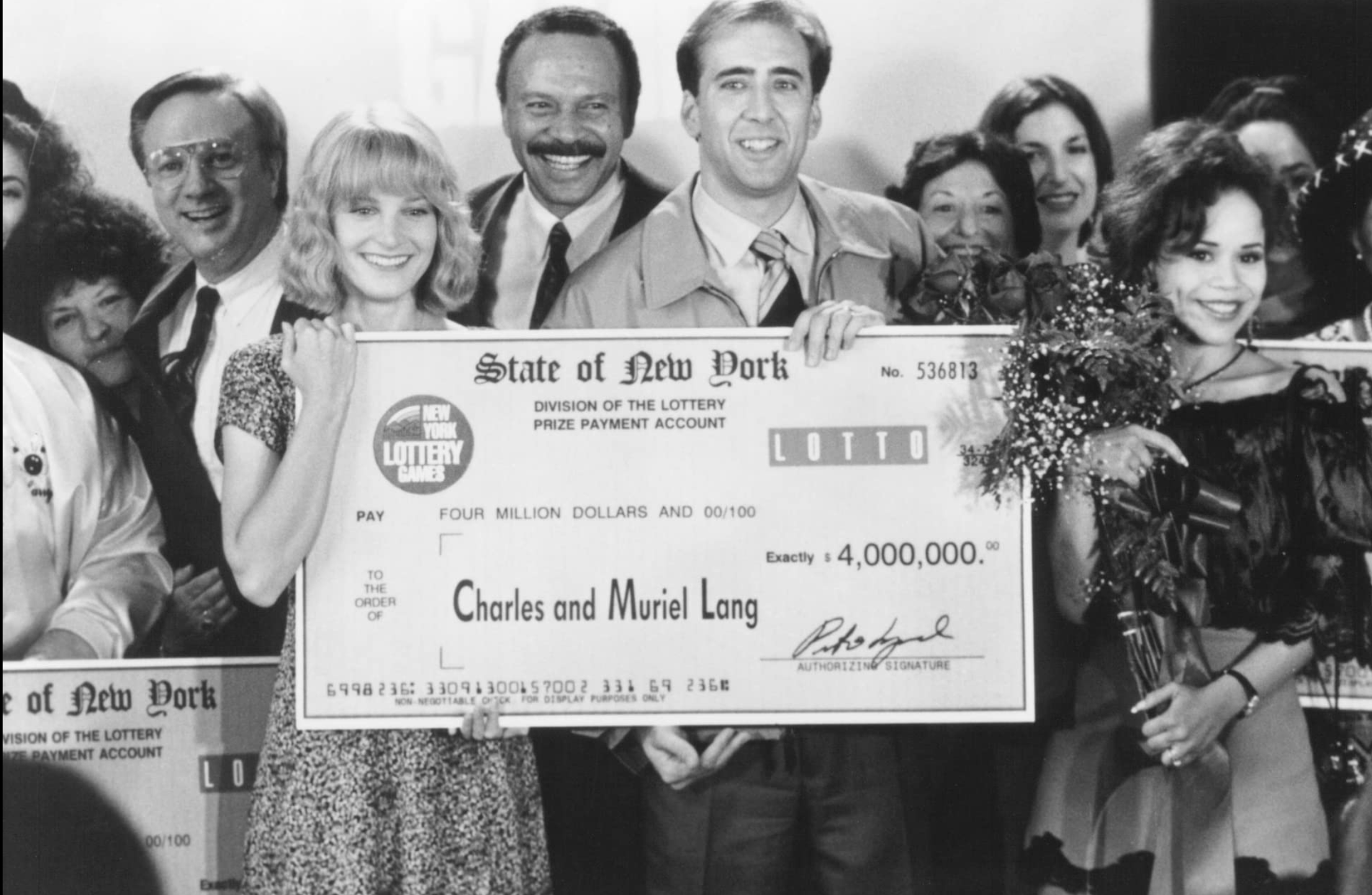
In this movie we get to see the softer side of Mr. Crazy Cage as Officer Charlie Lang, a New York City beat cop who is in an unhappy marriage to a fortune-and-fame obsessed hair stylist, Muriel (played by Rosie Perez) but who’s life takes an unexpected turn when his numbers win him the state lottery to the tune of $4 million dollars.

Complicating what would otherwise be a pretty boring story about a nice man forced to co-exist with a whinging and greedy wife (who would likely spend his entire fortune in the span of a few weeks), is the fact that Charlie has already committed to split his (assumptive) winnings in a “forgot to give a tip” bargain with the financially strapped waitress Yvonne Biasi (played by Bridget Fonda). Compelled by his promise to make good on the “tip” of half his winnings, Charlie returns to the restaurant and gives the waitress her $2M dollars, cementing his “good Samaritan” standing in the city, ruining his status with his money hungry wife, and sparking a friendship that would blossom into love between the two good-hearted / selfless characters in this film.

Yvonne, who seems to be a pragmatic and open-hearted character who has just suffered from the bad luck of poor life and love decisions, (she’s been separated and bankrupted by her manipulative husband, Eddie, played by Stanley Tucci) finds friendship and a shared optimism in the person of Charlie. As their two worlds are pulled closer together within the gravity of their own generosity, the money becomes a means to propel them to do more for the people around them (rather than the suck them into the vortex of selfish consumption that has infected both of their spouses).
As the “mo money mo problems” pulls Charlie and Muriel into more contentious divorce proceedings, the murky relationship between Charlie and Yvonne (and Yvonne and Eddie) and the means by which the lottery numbers were picked (Charlie / Muriel’s anniversary date mispicked / misremembered) brings the good vibes to a crashing halt in court as both Charlie and Yvonne are forced to give up ALL their winnings to the manipulations of Muriel. With nothing left but their love, the two friends decide that their relationship was really all that mattered anyway, which leads us to:
The happy ending [spoilers to follow]
One of the great cinematic devices used in this film was the use of the Narrator, Angel Dupree, played by the multi-talented Isaac Hayes. (And if you don’t recognize that name or the man’s face below, you really just need to go right now and listen to this song from his original score for the 1971 blaxploitation classic movie, Shaft, and “shut yo’ mouth!”) In It, Angel plays the narrator who, by breaking the fourth wall, talks directly to the audience and experiences the unfolding action between Charlie and Yvonne along with us in real time.

As the film opens, Dupree’s sonourous voice introduces us to the characters and setting of the story:
“Once upon a time in New York, there was a cop named Charlie. He was a very decent guy…a good listener…he loved kids…he had patience…and common sense. He was resourceful….he was just a good cop.”
After this initial opening monologue, we see Dupree at various times appear in the crowd as a “seeming” bystander to the action as it unfolds. What we don’t discover until the end of the movie, in a somewhat dramatic fashion, is that Dupree is actually an “undercover” photographer who is working for The New York Post and he has been taking pictures and telling Charlie / Yvonne’s story in the press from beginning to end.
In fact, if you pay close attention while watching, you’d notice that the whole movie is outlined quite well in the The New York Post headlines that show up throughout. Some headlines describe the current action, while most tell what is happening, big picture, between Charlie and Yvonne.
- THREE WEEKS ON A SLAVE SHIP [This shows when Yvonne’s boss at the cafe is berating her mercilessly.]
- BAILIN’ OUT THE BASEMENT [This shows during the scene where Charlie gives Yvonne her $2million tip.]
- COP GIVES WAITRESS $2MILLION TIP
- LOTTO COP NABS CROOKS
- LOTTO ROBIN HOODS [This is the final straw for Muriel when Charlie / Yvonne spend the day giving away money.]
- A NIGHT AT THE PLAZA: LOTTO LOVE
- LOTTO TRIAL BEGINS
- DEAD FATHER PICKED WINNING NUMBERS
- COP & WAITRESS LOSE
- THEIR DARKEST HOUR
- COP WEDS WAITRESS
Now the last two headlines tie up the happy ending and reveal the fact that Angel Dupree has been following the couple around town as a journalist and is the one who was telling their story.
After the trial, when Muriel has stripped the couple of their millions, Charlie chases a distraught Yvonne back to her coffee shop (which she must now sell to pay back Muriel.) After Charlie asserts that the money means nothing to him and that he only wants her, the two agree to stay together and move to upstate New York and start over. While they are kissing and weeping (as lover do I guess) there is knock on the door of the cafe.

A homeless man is knocking on the window and demanding entry. The grimy man mimes a scooping spoon to his lip as signal to beg Yvonne for a meal. Full of her characteristic generosity Yvonne opens the doors for him and offers to make him some soup. The man, of course, is Angel Dupree, in disguise. While the happy couple embrace, he sips soup from a cup. (This is prophetically funny because early in the movie, Yvonne’s boss is berating her about getting stiffed on a meal, and asks, “What do you think we’re running a soup kitchen here?” Which is exactly what she seems to be doing at this later point in the movie.) In between sips, Angel reveals a secret camera attached to his arm which he clicks away at, capturing Charlie and Yvonne in a heartfelt embrace during their “darkest hour”.
In his last article, Dupree describes how although the now paupered millionaires, Charlie and Yvonne, have nothing to give, they still have the charity of spirit and action to provide a meal to a hungry man, even then within their darkest hour. This story of course goes 1994 viral all over New York via The New York Post article.
And this is where the Hollywood happy ending comes in. Fast forward a few days. The cop/waitress are returning back to the coffee shop “one last time” before leaving for upstate New York and their new life together. When they attempt enter the store, the door seems stuck, but is actually partially blocked by a pile of mail that has been left there. When they open the first letter it mentions their story THEIR DARKEST HOUR and how more people should be like them in this world. The letter contains five dollars. Another letter reveals another small donation for their apparent kindness.
If you’ve seen It’s a Wonderful Life then you probably know what has happened. Boomerang karma has come around, good deed for good deed, but instead of his the family and friends of George Bailey coming through with a bunch of money, we have the city of New York itself (firemen, ferry boat workers, and hood rats) chipping in on the kickstarter campaign for Charlie and Yvonne. All in, the couple raises $600,000, which allows Yvonne to re-open the coffee shop and Charlie to rejoin the police force.
The last scene of the movie shows the two happy not-quite millionaires setting sail on a giant hot air balloon with a New York Post headline emblazoned across it’s inflated side that says COP WEDS WAITRESS. As they ascend to the heavens of their love and coming life together, the two pour all the colorful letters (that took them three days to open) over the side onto the city that has bequeathed them. (We’ll forgive the littering. It was 1994.)

(Aside: while this movie was 85% It’s A Wonderful Life, it was also 15% Miracle on 34th Street with its parallel “love on trial” quite literally court scene AND the U.S.P.S.-as-calvary delivery of the final good verdict at the end.)
Curveballs
If nothing else, the WATC(H) entertains me because of the random trivia and curveballs that come up now again in unexpected actors (Isaac Hayes, really?), odd parallels / contrasts, and striking thematic touchpoints or 7-degrees of Kevin Bacon connections. In this one, I enjoyed the surprises of:
- Wendell Pierce playing Charlie’s beat cop partner, Bo Williams. For fans of The Wire, like me, it’s kind of funny to see him playing a younger version of Detective “Bunk” who is obsessed with the New York Knicks and just being a good wing man to Charlie.

- This is the first time we see Nicolas Cage appear as a character in Yankee Stadium. That was a curveball I was not expecting in this movie. While I don’t like to see him wearing a Yankees cap, it did seem kind of iconic.

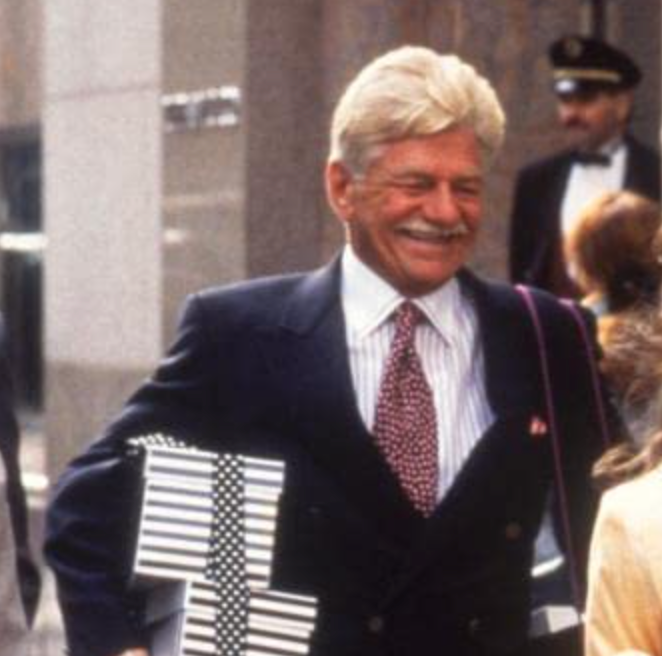
- Seymour Cassel plays Jack Gross in It Could Happen To You, a smarmy con man who seduces Muriel away from Charlie and then taking her for all she has–stealing her millions and fleeing the country by the end of the movie. Seymour Cassel plays Tony Cataracts in Honeymoon in Vegas (another Sunshine Trilogy film) and he plays in the poker game that Tommy Korman has set up to seduce and steal Betsy away from Jack Singer (Cage).

- Richard Jenkins plays C. Vernon Hale, Muriel’s lawyer and by proxy, Charlie’s adversary in this movie. Richard Jenkins also plays Agent Peyser in Trapped in Paradise (Cage’s next movie) who also is an adversary of a Cage-played character, Bill Firpo.
Best lines from Charlie Lang
“Of course we have enough money to have kids. Cops have kids. Firemen have kids. If only rich people had kids there wouldn’t be any public school.”
“No I’m not whipped. I’ve got adult responsibilities.” [CHARLIE respond to the neighborhood kid, Jesu.]
“Decaf please. I’ve reached my target heart rate for the day.”
“That’s what I want…a meatball.” Throws hands in the air emphatically.
“A promise is a promise.”
“It like we’re on two different channels now: I’m CNN…and she’s the Home Shopping Network.” [CHARLIE speaking of Muriel.]
“Because of you…I have you.” [CHARLIE to Yvonne.]
First for a Nicolas Cage character as Charlie Lang
- Tackles a guy
- Saves a blind man (with a cane) on a cross-walk by hoisting him onto his shoulder
- Delivers a baby on the bus
- Plays stickball with street kids
- Soaks his feet in a plastic basis
- Buys a stranger a necklace to hold her glasses
- Holds a giant promo check
- Knocks a guy out by throwing a can at him.
- Gets shot in the arm
- Goes roller blading in Central Park (into a lake)
- Comps everyone on the New York subway system to a free ride (whoopee)
- Plays baseball in Yankee Stadium
- DOESN’T throw a tantrum
Recurrences
- Shaves on screen (see Red Rock West, Cotton Club)
- Makes a reference to getting leprosy. “I’ll probably catch leprosy from the water, but I’m fine.” (See Time to Kill)
Summing it Up
In 1989, Faith No More released a pretty famous alt-rock song called Epic that would holds it own against the grunge movement carried forward by Nirvana, Alice in Chains, and Pearl Jam. The song is all about “it” and the chorus goes:
You want it all but you can’t have it. (Yeah, yeah, yeah)
It’s in your face, but you can’t grab it. (Yeah, yeah, yeah)
It’s it. What is it?
It’s it. What is it?
It’s it. What is it?
This song and this band are about as discordant and far removed from Nicolas Cage’s Charlie Lang character and the feel-good rom-com It Could Happen to You as possible, and yet…there’s something about the ‘it’ that they speak of that hints a similar ethos. What Charlie and Yvonne had in each other, their ‘it’, money couldn’t buy or contain. It can’t be consumed, bartered, or sold. It can’t be grabbed or had. It just is what It is. And as strange as the Sunshine Trilogy was along the narrative and acting career arc of Nicolas Cage, hey, I’ll take It.
I mean…what other choice do I have?

 yeti speak...
Leave a comment