I have been procrastinating writing this blog for a few days now. I have my reasons for this reluctance. In no particular order: I loathe Las Vegas. I have been there a few times on business-related trips and have had the misfortune of staying right on “The Strip” during those visits. Upon first experiencing the Vegas strip, with its loud casinos, intrusive tourist traps, and name-and-claim-your-vice-on-demand-and-in-the-open protocols, the words of Obi Wan Kenobi (speaking of Mos Eisley) almost immediately came to mind: “You will never find a more wretched hive of scum and villainy.”
But it’s not really the “villainy” of Vegas that bothers me (what happens in Vegas stays in Vegas or whatever) so much as it is the human desperation that’s so palpable there, and providing that catalytic spark that drives the entire engine. You can see the desperation while watching grandmas at the slot machines, or “high rollers” at the blackjack tables. You can see it in the always-too-young Vegas showgirls trolling for photos on the streets. Or in the frat boys and bachelor party goers sipping their beers and mixed drinks, smoking their blunts, and cat-calling as they get up to no good on the muggy sidewalks of the Strip. The desperation I see in those who love Vegas is the frantic all-or-nothing want that comes from the yet-to-be-fulfilled fantasy of riches, voyeurism, sex, and other highs (that come from drugs, gambling, sports, entertainment, and all-things erotic or taboo most everywhere else in society.)
I know I sound like a prude or a wet blanket. I’m really not. I appreciate many of those risk-reward things in smaller and more controlled doses. You say: Why not “live and let live” and stop taking Vegas so seriously? That’s a fair criticism, but I guess I just see Vegas as this big shiny carrot that a million hands are trying to grasp onto that floats always on the edge of the desert horizon–just out of reach. If you look at the people’s zombie-like faces under the glare of all those lights (like I have whenever I’ve gone there) you’ll notice a vacuous discontent–a longing that never seems fulfilled. People don’t look or seem happy, even while laughing, getting drunk, watching magic tricks or cutting loose. It’s all a big con and I can see right through it.
At least that’s my cynical take. Hate, hate Vegas.
The other reason I’ve been procrastinating this post is because Leaving Las Vegas (1995) is Nicolas Cage’s most critically acclaimed and recognized film. He won an Oscar for his portrayal of the alcoholic Ben Sanderson who goes to Vegas to drink himself to death but along the way meets Sera (played by Elisabeth Shue) a prostitute who sees a sensitive and redeemable side of Ben, and starts an unconventional relationship with him, but ultimately cannot turn him from his destructive path. My reluctance to blog about Leaving Las Vegas is that so much attention, acknowledgement, and critique has already been scripted and published about this film, what could I possibly add to the discussion that’s new? Any insights I have in this arena will pale in comparison to most anything that’s already been written about it already.
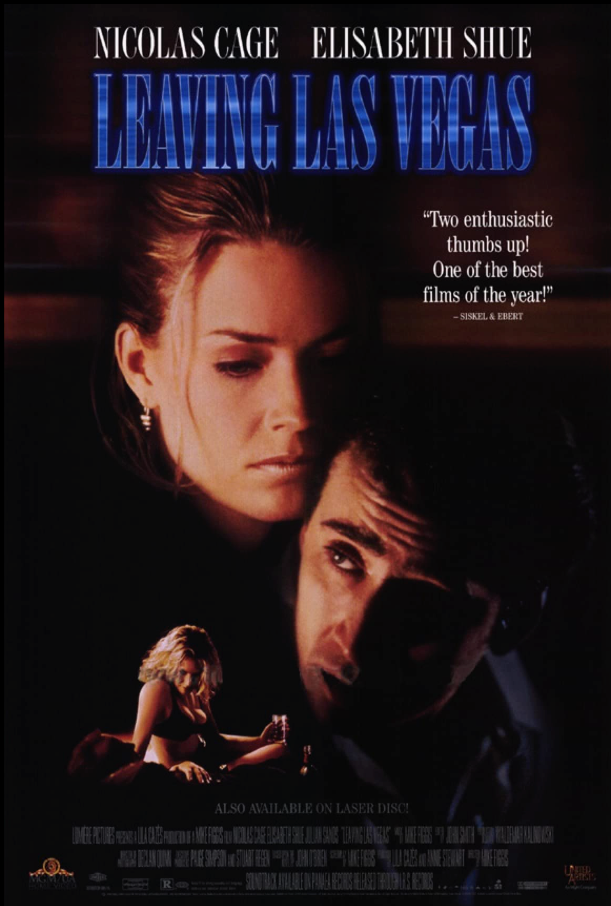
(I almost considered using ChatGPT with the prompt “Draft a movie review of Leaving Las Vegas in the style of yetispeak.blog and use references from World According to Cage posts”. But I’ll save that lazy man’s trick for another day.)
Lastly, I have been procrastinating writing this blog because I remembered watching Leaving Las Vegas during its release in the 90s and remember it being a compelling and memorable performance from Cage and Shue, but ultimately I recalled a very, very depressing (if highly realistic) portrayal of the downward spiral of alcohol addiction. It took me a couple days to work up the nerve to watch the film again, knowing what I was about to embark upon and how it would be a gut punch experience, but that’s what the WATC(H) is all about. It’s beginning to end Cage with no skips, no retreats, and no whining.
You just have to grit your teeth, bear down, and take on that next Cage movie no matter what it is…so here goes nothin’, folks.
The World According to Leaving Las Vegas
If desperation is a defining characteristic of Las Vegas as I suggest above, then it is the perfect setting for the story and the narrative arc of Ben and Sera. The film Leaving Las Vegas was based on John O’Brien‘s first novel of the same name. O’Brien, who was an uncontrollable alcoholic himself when his book was published, took his own life a few weeks after selling the movie rights. Really sad when you think about it. Many reviewers have assumed that the film was semi-autobiographical and essentially O’Brien’s suicide note, but O’Brien’s own sister, Erin (also a writer) disagreed with this assessment:
“After studying his body of work so painstakingly, [the book] was the beautiful poetic way to check out: Taking that long slug of liquor and gurgling into your death with this beautiful woman.”
Regardless of the autobiographical parallels with O’Brien, Nicolas Cage took his approach to the role of Ben pretty seriously. At the encouragement of the director, Mike Figgis, Cage did his own research on serious alcoholics. He spent two weeks binge drinking in Dublin and had a friend videotape him so he could study his own speech. He spoke with hospitalized career alcoholics and had an alcoholic consultant on set. The result of this research is a highly believable, visibly emaciated / underweight and jaundiced Nicolas Cage as Ben, who you can almost smell the 100 proof alcohol wafting off of his skin and right through the TV screen.
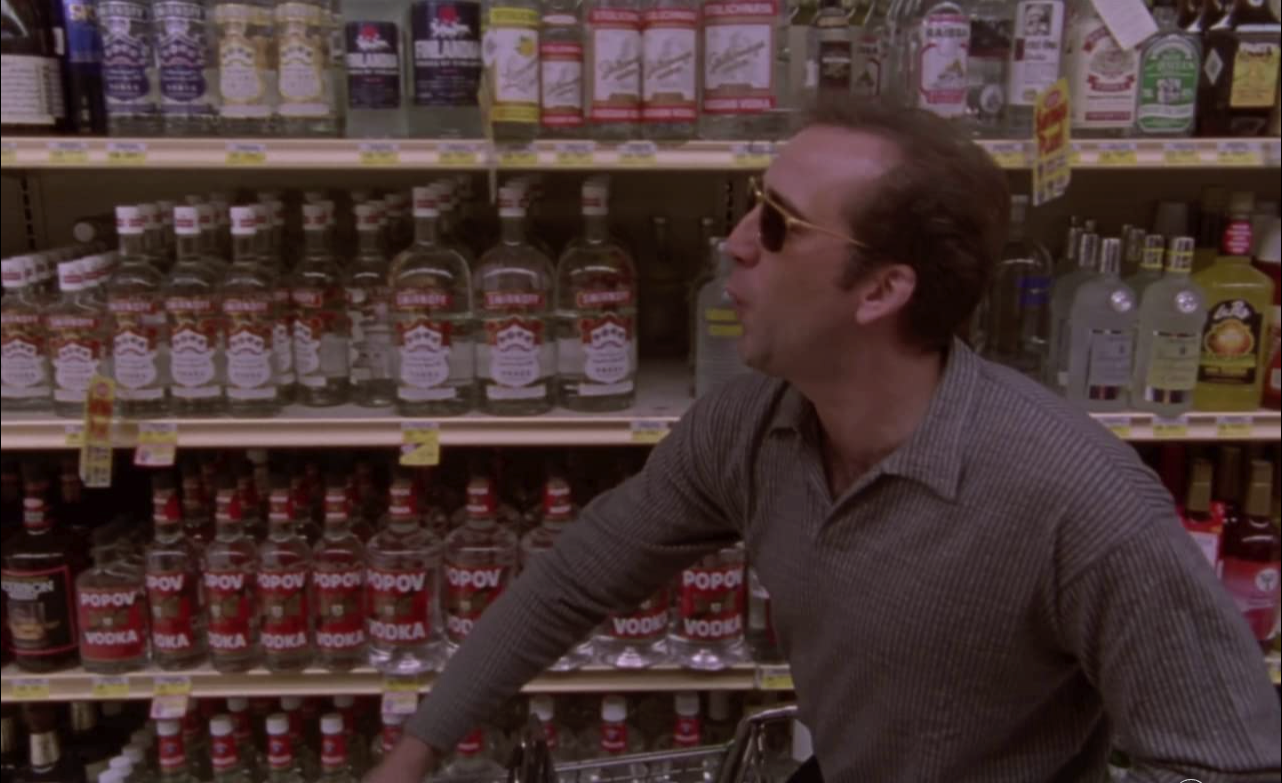
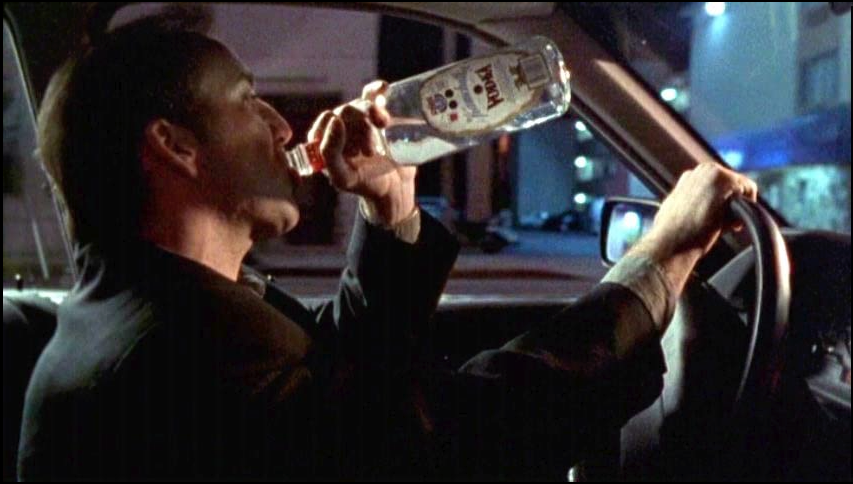
In some ways, this role seems ideally suited for Nicolas Cage because it allowed him to showcase a wide range of emotions in both his use of dialogue / slurred speech and his well-studied “silent movie” German expressionistic style that he once referred to as Western kabuki. We’ve seen Cage experiment in these forms before in everything from Vampire’s Kiss, Deadfall, Raising Arizona, and Wild at Heart, but in Leaving Las Vegas, we get to witness the fated culmination of emotions that is somehow both tragically shameful and expansively empathetic.
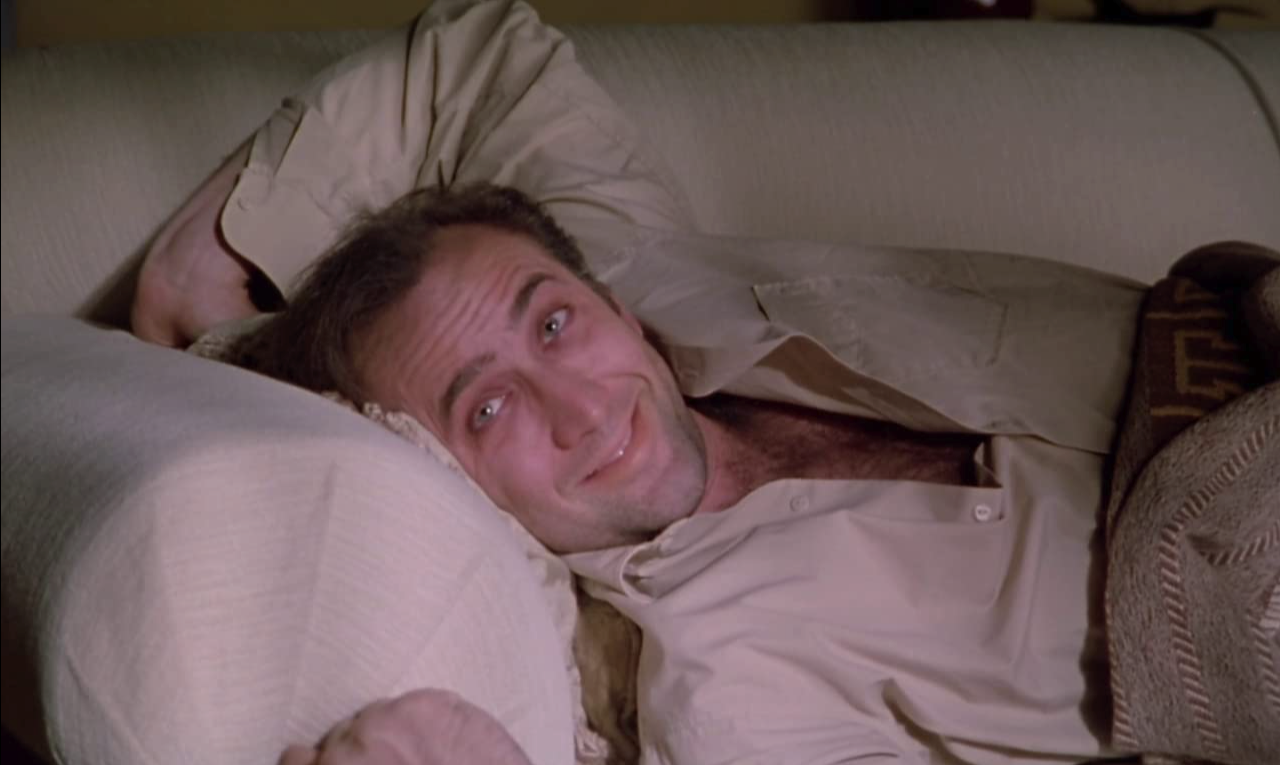
Many of Cage’s films are best framed and remembered by his delivery. The words and how he delivers them make the experience memorable. But in Leaving Las Vegas, it is the images, his facial expressions and gesticulations, and the framed scenes themselves that burn brightest into the conscience. For example:
- The awkward early scene in the nice restaurant where the visibly drunk Ben is borrowing money from a friend (for the last time it seems)
- The bank scene where a “drying out” Ben is too shaky to sign a check and must come back later once he has stabilized with alcohol.
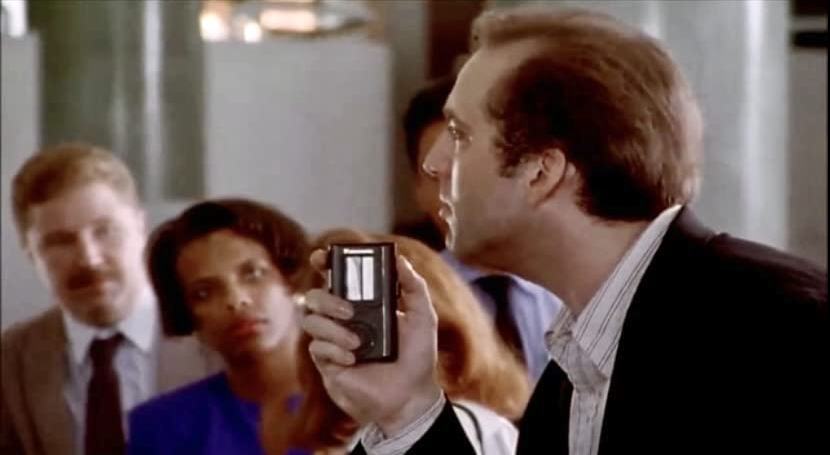
- The delighted stroll Ben takes, strutting down the liquor aisle as he loads his shopping cart with his many preferred poisons.
- The scenes where Ben alternates between slugging vodka (and then hiding it) while driving behind the wheel as a policeman eyes him suspiciously from a motorcycle.
- The scene where Ben is too drunk to notice that a prostitute whom he hired for a blow job is actually sucking on his finger (removing his wedding ring) instead of his manhood.
- The many staring-into-the-abyss of self moments throughout the film where Ben is seemingly stuck in a moment he cannot get out of.
- The quiet moments, in the midst of the storm that is Ben’s life and destruction, when Ben and Sera find common ground / connection, even in the midst of the tension of alcohol / sex / violence that swirls around both of them.

A lot more could be said about the plot, the acting, the music (some nice Sting songs and jazz numbers throughout the score) and the narrative arc of Leaving Las Vegas, but I’ll leave those for now, as others have likely already explored those topics and themes in greater depth and etails.
But I will close the post with 1) a maybe controversial take, and 2) a brief mention of the not-too-subtle signals that foretold the obvious conclusion to this tragic movie about addiction.
A controversial take
I think Elisabeth Shue was the wrong choice for this role as Sera. I like Elisabeth Shue as an actress. I had a pretty hard crush on her in the 80s due to her appearances in film favorites like The Karate Kid, the Back to the Future sequels, and Adventures in Babysitting. So you’d think I’d be more tolerant of her appearing alongside Cage as a heart-of-gold prostitute who helps usher Ben through his last month of life in Las Vegas. From an acting standpoint, I thought she was able to throw off her type-cast of being the pretty girl next door / love interest in order to take on this grittier role and she did her job well. She delivered a compelling performance, but similar to my feeling about Julia Roberts in Pretty Woman, I just had a really hard time buying that “this woman” with “these looks” is driven to (or chooses to take on) the hard life of a street prostitute. I’m sure it happens, but the suspension of disbelief, for me, was challenged. She even looked “too put together,” well-dressed, fashionable, nice make-up, for me to really take it at face value.

Admittedly my knowledge and experience of the real world of prostitution (especially in Las Vegas) is non-existent, but I’ve seen prostitutes before (even here on the streets of Seattle) and by-and-large they do not look anything like Julia Roberts or Elisabeth Shue as a type. I realize that there’s probably a high degree of variability here and maybe I run across sex workers every day that I don’t recognize as such, but still…that’s just how I tracked with this movie.
What made this casting situation even harder for me to accept with Shue, is that for Sera, we are not really given to understand what has lead her to this life to begin with. In a sense, Sera is the narrator of the story and is telling Ben’s story almost in a documentary style (I think Sex, Lies, and Videotape was another indie movie popular during this period that may have influenced this directorial decision). We know that Sera has a pimp, Yuri (played by Julian Sands) who has chased her from Los Angeles to Las Vegas and his violent and paranoid temperament keeps Sera doing tricks and placating his more volatile self.
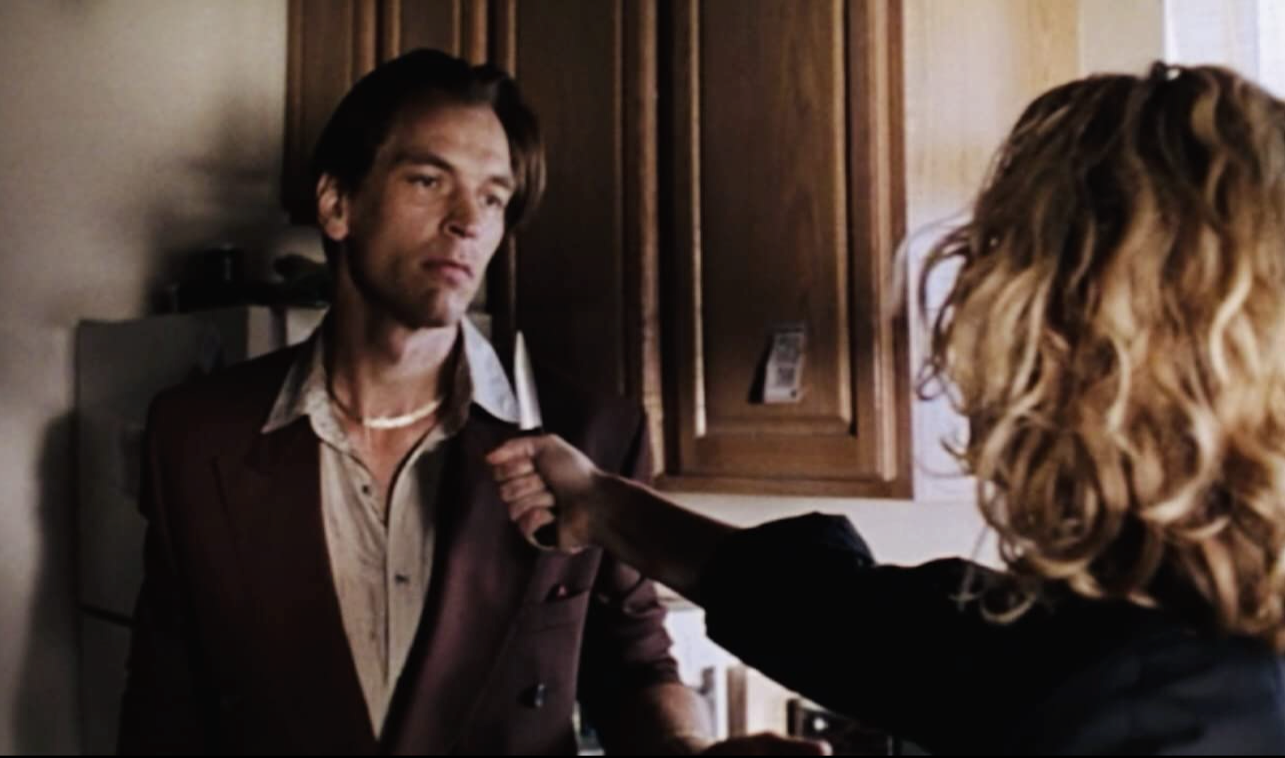
But we don’t really know what trauma she has been through (other than Yuri’s obsessions) and her main Achilles heel seems to be mostly loneliness, which is why she is so interested in pursuing a relationship with Ben. I do wonder how this movie would hit me if they’d chosen someone who didn’t have the natural good looks of Elisabeth Shue or someone who had their own addictions (drugs) or trauma (sexual abuse) that would have paired her more naturally to Ben and his.
The writing on the wall
The other interesting signaling that showed up in not-so-subtle ways throughout Leaving Las Vegas was the foreboding of literal signage. So many of the scenes of glittery Vegas casinos and nightlife, play to the backdrop of brooding jazz or melodic Sting vocals, and if you pay attention there are also some signs of what is happening to or going to happen to Ben as he relinquishes himself to his addiction. We all know what Ben plans to do to end his life and it seems unlikely that he is going to be derailed from that dark purpose (even with his relationship to Sera) so these “signs” act more as Easter eggs within the film rather than subtle warnings or foreshadowing of what we all know is on the docket already.
- The first motel Ben checks into in Vegas is called, The Whole Year Inn, but he sees it as “The Hole You’re In.”
- At one point we see a brightly lit Vegas reader board sign in the background that says Unfinished Business.
- At the mall, as Ben and Sera are descending an escalator, the sign above them reads, This End Up (Furniture).
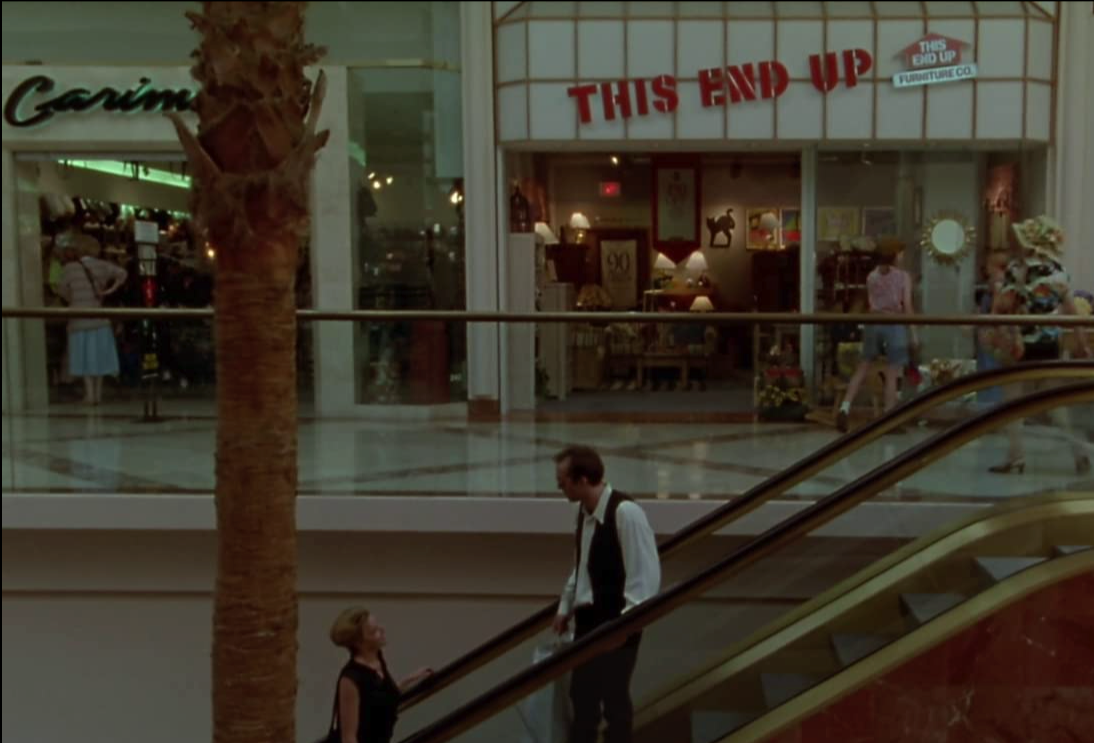
I am not sure if these message are delivered as tongue-in-cheek references or not, but they all seem painfully specific and indicative that this thing we are watching will not end well–as severe addictions so rarely do.
Best lines from Nicolas Cage as Ben
“I don’t know if I started drinking ’cause my wife left me or my wife left me ’cause I started drinking, but fuck it anyway.”
“I’ll tell you, right now… I’m in love with you. But, be that as it may, i am not here to force my twisted soul into your life.“
[SERA asking how Ben feels] “Like the kling klang king of the rim ram room.”
[SERA] “Are you saying that your drinking is a way to kill yourself?”
[BEN] “Or, killing myself is a way to drink?”

Firsts for a Nicolas Cage character as Ben
- First time cast as a raging alcoholic
- Out of work writer
- Burning all his clothes / possessions
- Drinking and driving
- Drinking a martini on the Vegas strip
- In a committed relationship with a Vegas prostitute (as opposed to prostituting his committed relationship while in Vegas)
- Getting head butt in a bar
- Falling drunk into a glass table (and smashing it to pieces)
- Pawning a Rolex watch
- Experiencing delirium tremens
- Oscar winner!
Recurrences
- Spending time in Vegas (see Honeymoon in Vegas)
- Shopping in a grocery store (Multiple)
- Dying on screen (See Deadfall)
- Creepily hitting on a woman who just “not that into him” (Multiple)
- Driving out for a weekend away in the desert with the woman he’s dating (see Fire Birds)
If winning an Oscar is the pinnacle of an actor’s career, then this officially marks the climax of Nicolas Cage’s career as an actor. This seems oddly ironic to me based on the fact that Cage has reached the top while expertly depicting a character at the very bottom in Ben who is at the nadir of his life of addiction and exits without fanfare. This movie, much like the life/death of the writer of Leaving Las Vegas, John O’Brien, is such a tragic tale of addiction, desire, and human desperation. Since we still have three-quarters of his career remaining, I am going to hold out hope that there is more for us to gain from Nicolas Cage’s career and that he will continue to surprise us with the roles he takes and the movies that he makes great (or simply his own).
Thankfully, I have no immediate plans to return to Las Vegas, nor do I anticipate watching Leaving Las Vegas ever again. It was interesting to do so in light of my Cage experiment, but my spirits will sail a bit higher knowing that I’ve accomplished the task (once and for all) and conquered the procrastination I faced to not do it.
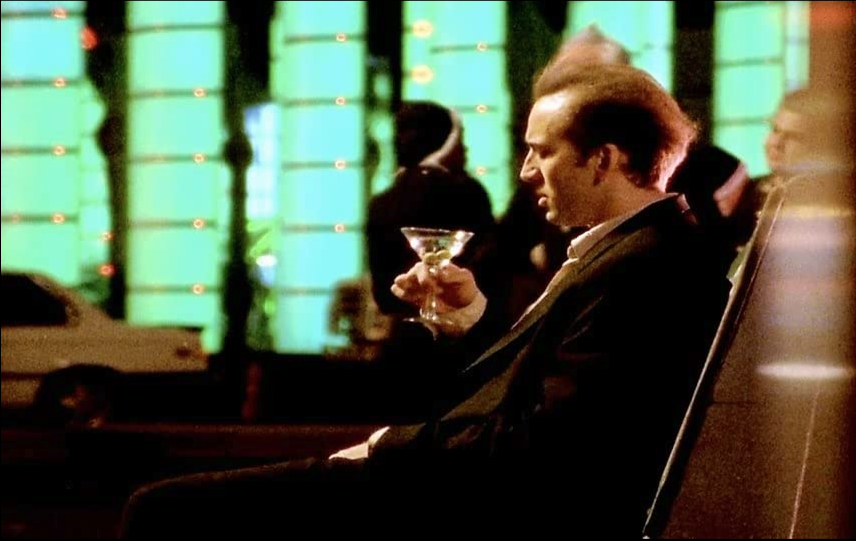
Maybe I’ll reward myself with an afternoon drink. Or maybe on second thought…

 yeti speak...
Leave a comment