As I sit down to blog this next installment of the WATC(H), I am reminded that it is, in fact, the beginning of Memorial Day weekend, a time when Americans honor those who have fallen (=died) in military service to our country. In a small, mostly insignificant way, there is an odd parallel or convergence with this timing, and its acknowledgement of military sacrifice (and loss) within the storyline of the film I just watched The Rock (1996) starring Nicolas Cage, Sean Connery, and Ed Harris. But before we get into the loss of human life and the political snares that come with it as depicted in the film, let’s first speak of another loss.
Announcement: I recently “lost” a dependent to the next stage of adulthood when my youngest daughter Colette graduated from Columbia College Chicago and moved into her first apartment. 😭
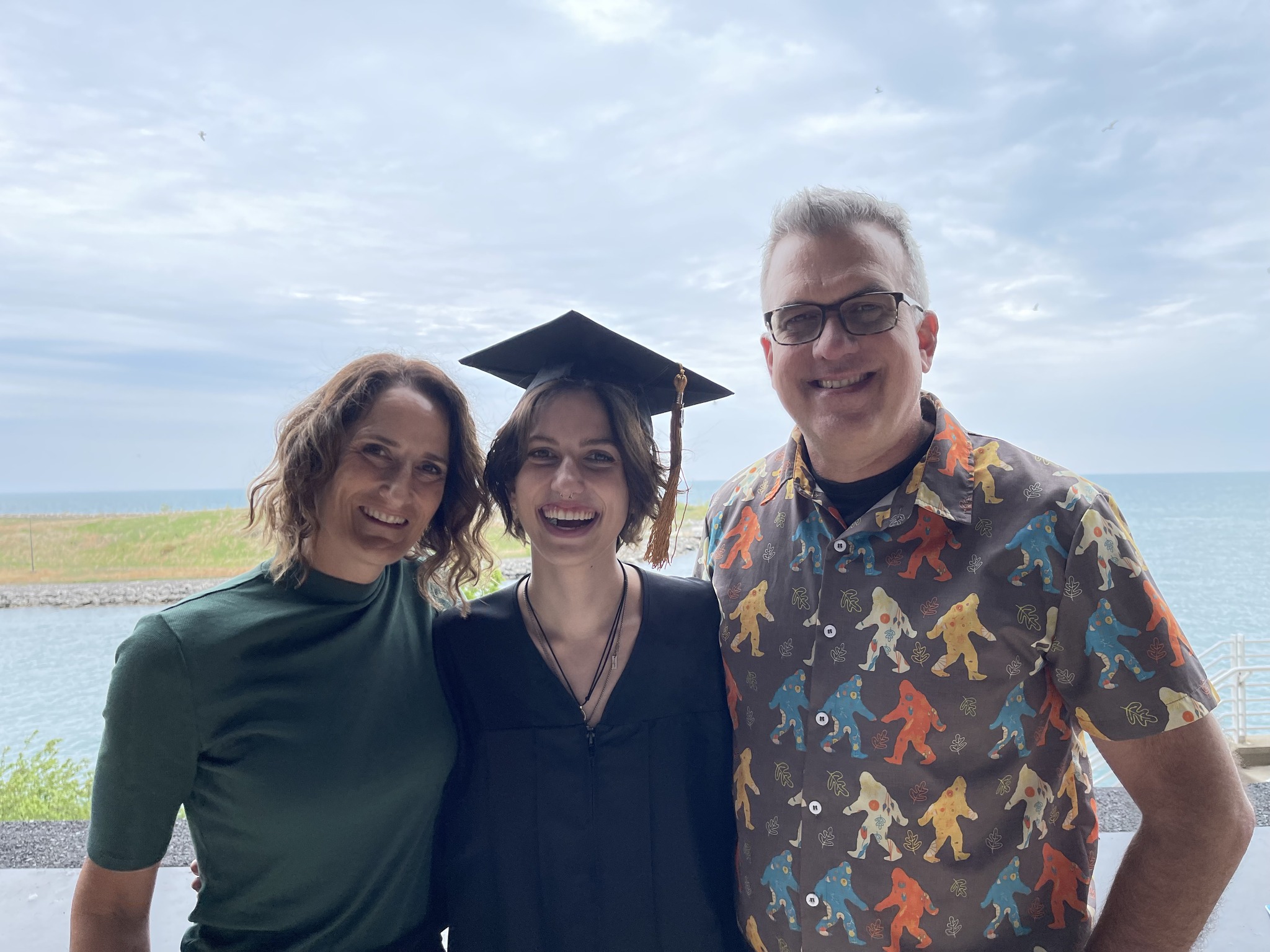

OK, admittedly that is not something to mourn. It’s something to celebrate (and we did!), but still, it’s hard not to get a little sad or nostalgic for the good ole’ days at a time like this when your children are taking flight and moving on to the next stages of independence. (You’d think given my melancholy, she would at least take some sympathy, and let her old man win a game of online Star Realms as a consolation prize a time or two, but alas, she does not. Merciless that kid. She doesn’t even try to mask her pride in defeating me. I am thankful for the technology, even when I get soundly defeated at the game I introduced her to.)
When I think about loss and nostalgia this way, I am reminded that in 1996 I, myself, graduated from college. The SAME year that The Rock hit the movie theaters, I was an aspiring journalism major moving into my own apartment and looking for work. Much like Colette, I had a job, but wasn’t sure where the career part was going to come from. That post-college summer is a hopeful, expectant, and anxiety producing time of life. But it’s also very freeing as you gain your independence and envision yourself in an autonomous world without the oversight of parents or educational institutions.
Another loss. I have been reading this book Age of Cage: Four Decades of Hollywood Through One Singular Career. Essentially, a much better, more experienced, professional film critic, Keith Phipps, has done my work for me by writing a book about Cage’s life in film. Everything that I’ve been doing with this experiment, he’s already done. I didn’t start out reading this book. A friend pointed me to it after I was well into my experiment. Phipps distilled Cage’s career all down into a pretty tight little book that provides analysis of the movies along with pertinent details of Cage’s life, times, and trivia. The loss is not that this book was written; I’ve found the book highly entertaining and resonant with my own review, thoughts, and experiences with Nicolas Cage and his works. The loss is that, with one chapter to go, I physically lost the book. A library book no less.
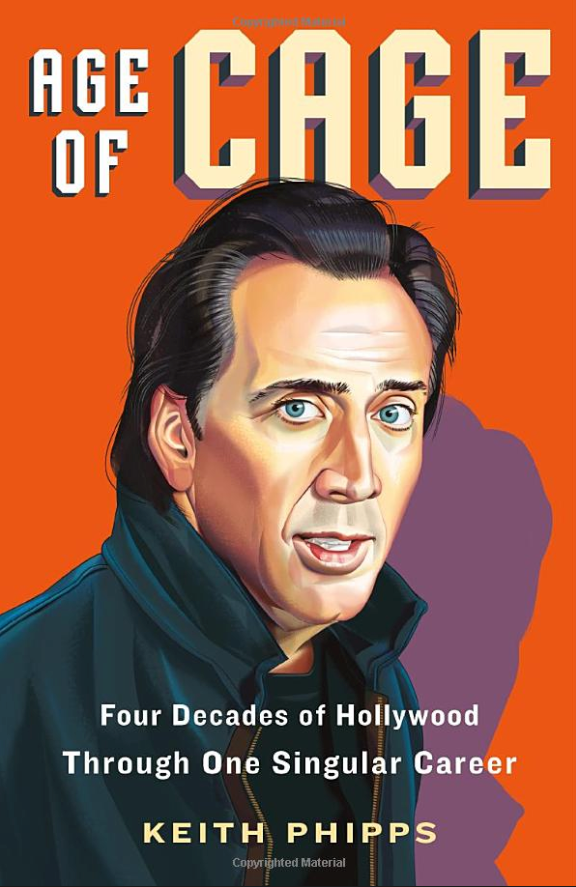
While picking up my older daughter, Anna (another coming graduation in the distant horizon!), from the SeaTac airport, I somehow misplaced the book I brought along for baggage claim reading. I’m not sure exactly how it happened or how I allowed it to, but I definitely did not come home with Age of Cage. So, not only did I lose the book and the opportunity to finish it (which I have since done thanks to Kindle) I ALSO had to pay the Seattle Public Library $27.99 from my own pocket to settle my account / tab. So given the movies I’ve rented and now the book replacement, I’ve probably invested $50-60 in this little experiments so far. Ah, the price of my own entertainment.
One final loss. While watching this movie, I couldn’t help but feel a tinge of sadness from missing Sean Connery. It had been a long time since I’d seen him in anything (or watched a movie he starred in). I knew that he had retired from acting not too many films after The Rock. But I had completely forgotten that he actually died in 2020. That was a weird year (overall) with a lot of great artists making an exit along with a few million people globally due to Covid, but still. Growing up watching someone like Connery practice his craft, it’s no surprise that I got a little nostalgic about seeing him again. We’ve spent a lot of hours “together.”
Between The Rock and a hard place
No, I’m not talking about the wrestler-turned action hero Dwayne “The Rock” Johnson who would dominate the blockbuster movies of the 2000s. I’m talking about the blockbuster The Rock (1996) that would help spawn the new evolution of Mr. Nicholas Cage into an action hero extraordinaire. But as with all things Cage, this metamorphosis from the eccentric outsider / degenerate kook into gun-toting macho man happened in chrysalis-waves of development where each role became the molting and morphing ground for his next iteration.
Enter Stanley Goodspeed.

In The Rock, Cage plays Stanley as a Dudley Do-Right sort of character whose expertise in chemical weapons makes him a valuable FBI asset, but mostly within the controlled walls of a laboratory and not out in the field. In his personal life, Goodspeed is faithful to his simple pursuits (i.e. he listens to the Beatles on vinyl in an age of CDs) and to his commitment to girlfriend Carla (played by Vanessa Marcil) whom announces in an opening scene that she is pregnant and wants to start a family with Goodspeed. Goodspeed is a good guy with a specific set of skills and because of that he is pulled like a magnet to the Rock.
Enter General Francis X. Hummel.
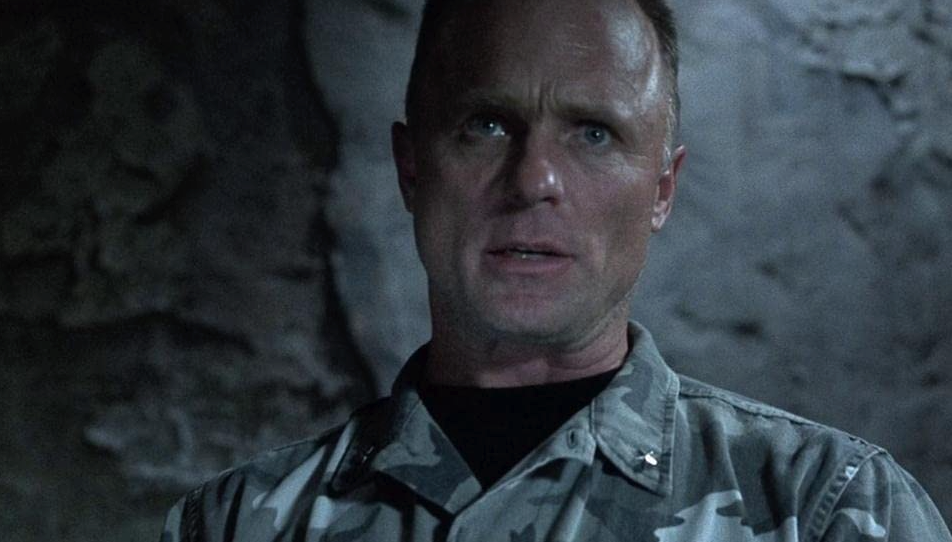
Hummel (played by Ed Harris) is a career Marine who has served the U.S. military in missions, both acknowledged and covert, from Vietnam to Iraq and all places in between. He has seen so much action, lost so many soldiers, and witnessed so much bloodshed, corruption, and political playmaking, that he figuratively and literally “knows where the bodies are buried” and how to unearth them to achieve his purposes.
When he loses the grounding presence of his wife (shown via her headstone at the start of the film) Hummel resolves to enact “one last mission” to enforce justice for the families of the U.S. soldiers who lost their lives in combat but who were left uncompensated and unrecognized for their efforts by their own government. (“You know I tried everything and I still don’t have their attention,” he tells his dead wife.)
As a self-righteous patriot, General Hummel is willing to become a traitor to his allegiances (like Jefferson, Franklin, etc) by enlisting a group of mercenaries to take a tour group hostage at the former island prison of Alcatraz (aka “the Rock”) and by threatening to unleash missile-directed with chemical weapons upon the metro area of San Francisco. This, he feels, “will make them listen”, them being the U.S. government whom he is extorting for 100 million dollars that he says will be delivered to the families of the voiceless / nameless veterans. Is Hummel a hero (like Jon Stewart?) or a villain? Well, to put it plainly: it’s complicated.
Enter John Patrick Mason.
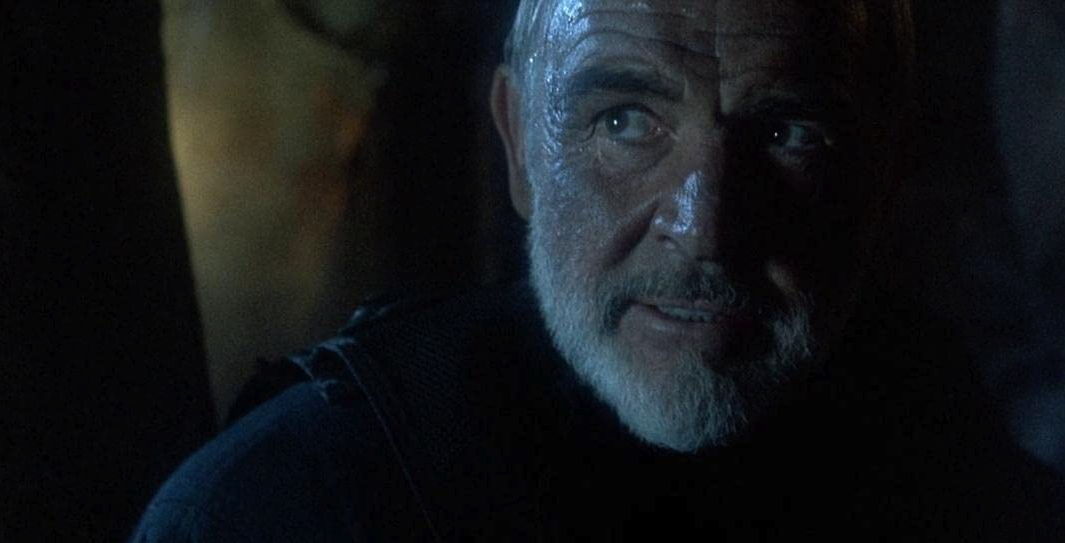
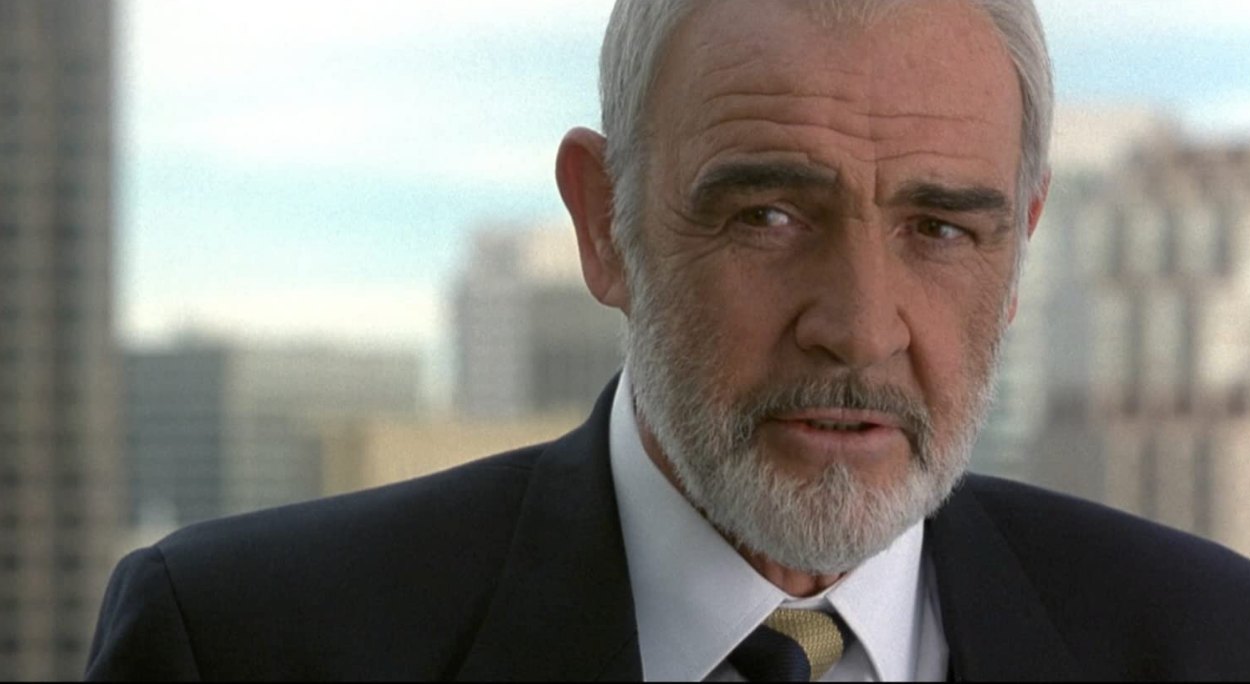
Hummel is not the only guy with legitimate beef against the U.S. government and their unjust dealings. With Mason (played by Sean Connery), we have a former British SAS operative who was captured under suspicion of stealing State secrets. The FBI believed Mason had a canister of microfilm that he had taken from U.S. intelligence that contained everything from the real killer of John F. Kennedy, to Area51 aliens, and (theoretically) much more. Fearing he would be killed for even having seen this information, Mason hid the microfilm and would not provide any information about its whereabouts under FBI questioning. Rather than provide him with a fair trial, the U.S. government covertly imprisoned Mason and sent him to prison at Alcatraz from which he eventually escaped on to be re-captured and put in a higher security prison. The government controlled the narrative and essentially alienated him from his American wife and daughter. This was all given as back story, but when General Hummel takes the Rock (and it’s tour group) captive with an arsenal of chemical weapons, the U.S. military needs someone with familiarity to help lead the mission into Alcatraz to defuse the situation. Yeah, you’re seeing the team up here, right? Mason and Goodspeed. Like chocolate and peanut butter.
Enter Michael Bay.
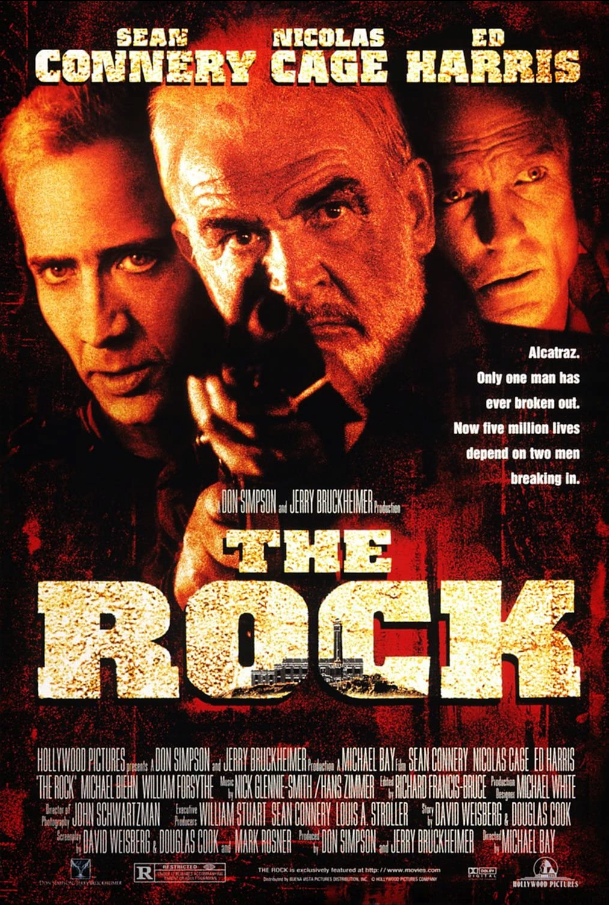
Michael Bay is not a character in this film. He is also (I am shocked to now discover) not the guy who produced or directed the lifeguard soap opera of the early 90s called Baywatch starring David Hasselhof and Pamela Anderson. (I would have bet money that was the case, but I think I would have lost that money after researching a bit.) But Michael Bay did, in fact, direct The Rock, as well as direct and/or produce a number of music videos from my youth (go Meatloaf, go Meatloaf!) and was responsible for many, many explosion-rich, MacGruber-style over-the-top action movies like the Transformers franchise, Bad Boys franchise, Pearl Harbor, Armageddon, The Purge and others. Bay has a unique style all his own which was on full display here on The Rock.
So adding all these elements up, the sum of its parts accretes into this high intensity experience of being right between the Rock and the hard place.
With Stanley Goodspeed we have a noble-minded do-gooder trying to prove he can hack it in the unfamiliar field of battle, when he is called in to advise on how to dismantle the chemically charged nightmare weapons.
We have John Mason, whose prime motive (at first) is to again escape the clutches of the men who imprisoned him, and re-connect with his estranged daughter, while still caring enough about Goodspeed and the innocent lives at risk that he is compelled to take down the mercenaries.
And we have Colonel Francis Hummel, whom we kind of empathize with and want to succeed (in taking down a corrupt and immoral U.S. bureaucracy) but whom we also can’t side with because of the serious concerns about the methods he is using to achieve his objectives (e.g. innocent human casualties).
Then we have the guy pulling all the pieces together, in Michael Bay, hitting us with with some intense rocking guitar solos, Call of Duty style military incursions, war room hostage negotiations, laser-sighted sewer trench shootouts, flaming billows of percussive explosions, and F16s skirting beneath the Golden Gate bridge threatening doom to all “prisoners” of Alcatraz Island.
It’s popcorn. It’s adrenaline. It’s fun. Big likes all around. (And it’s also kind of silly, and I kind of like that about it.)
The World According to Stanley Goodspeed
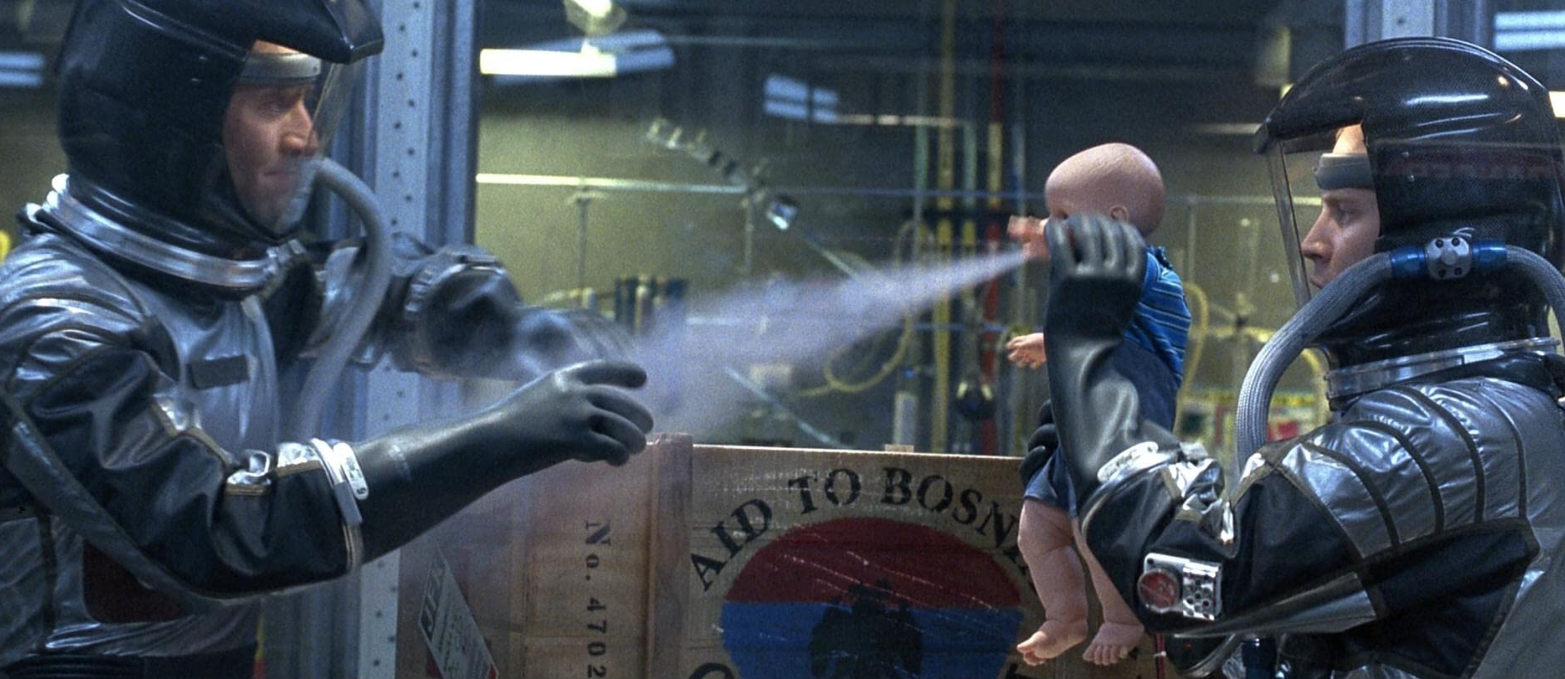
The thing to like about Stanley G for me, is that he knows his own tastes (e.g. vinyl over CD, nerf guns and rube goldberg machines) and he has a specific if nerdy set of skills, but he’s still willing to try new things. When he and a fellow FBI nerd on his team are tasked with removing the contents of a mysterious, i.e. terrorist package (“Did you bring the cockroaches?” being the canary in the coalmine I guess) he finds a baby doll that spews poisonous gasses all over the place. But Goodspeed (true to his name) and cool under pressure, doesn’t question his qualifications to defuse the bomb before the noxious gasses kill him and everyone in the lab. No, he improvises and works under pressure, and is willing to risk the mistake to get the result he wants (life). And, he defuses it in time. It works for him. He’s got that growth mindset.
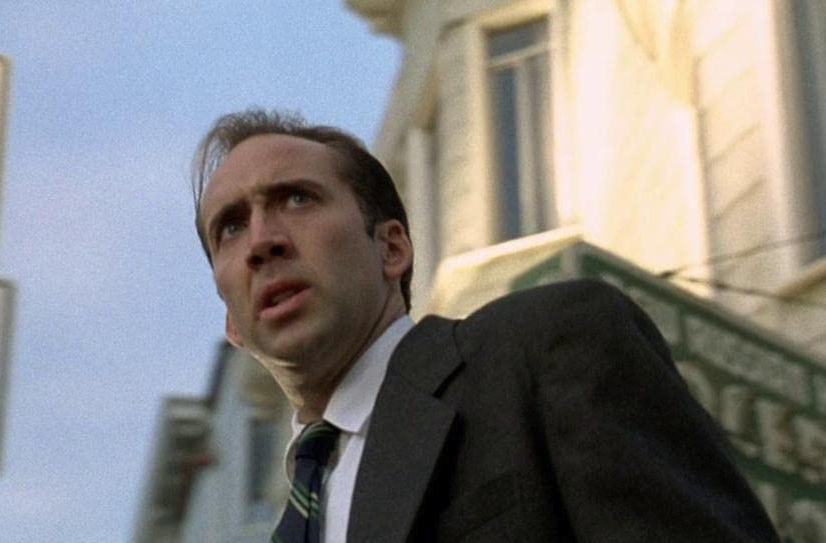
When his bae, Carla, gets home and tells him she’s had an interesting day (after he’s spent the day defusing a baby doll chemical weapon), he says, matter-of-fact, “Yeah, I had a pretty interesting day myself.”
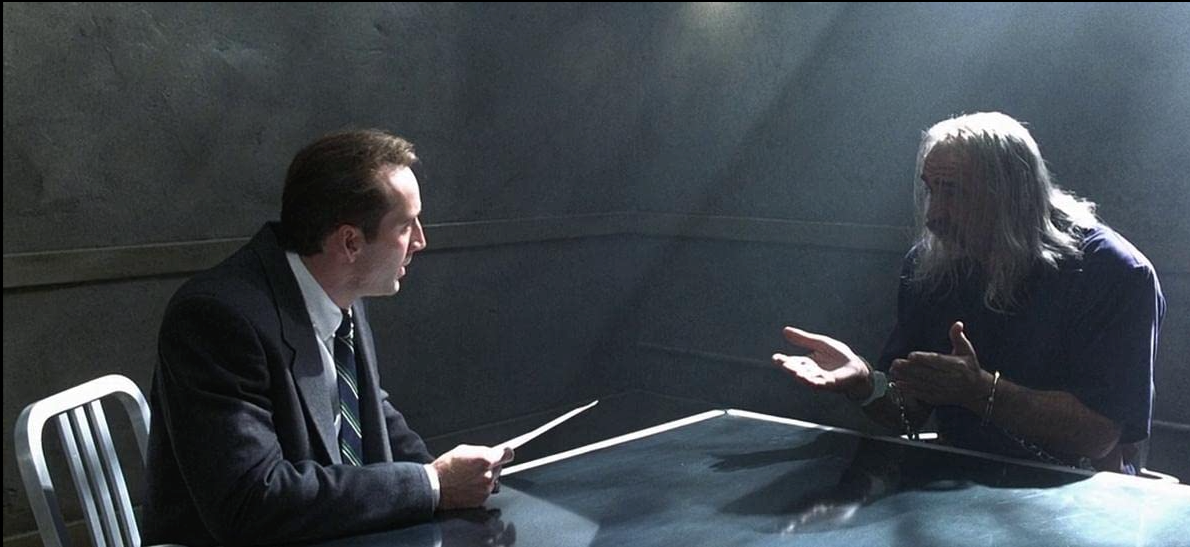
When called upon by the FBI to take part in a top secret training exercise, he says, “I have to go to San Francisco,” only to discover that instead of consulting or dismantling chemical weapons, he’s asked to interrogate a political prisoner / secret agent. Again, growth mindset. He doesn’t balk at the opportunity, he just goes for it.
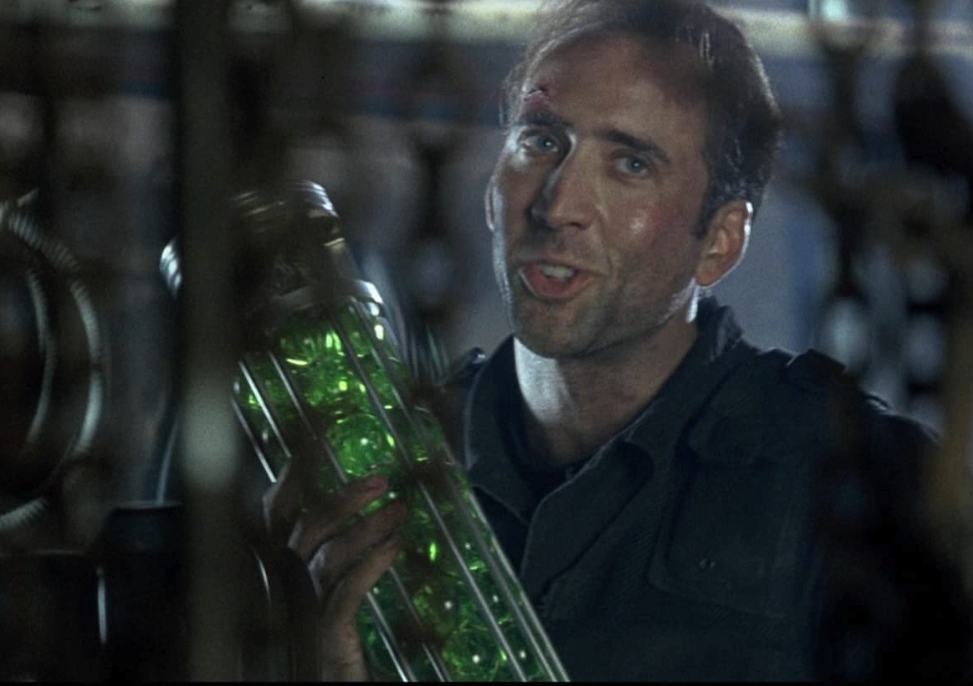
When he realizes he will be involved first-hand with Mason “on the ground” for this mission to Alcatraz, he’s quick to point out his need for a weapon. “I’m a chemical super freak actually, but I still need a gun!” He then has to point this gun at Mason a few times to get him to fall in line and stay on task. (He’s a good manager, too, I suppose.)
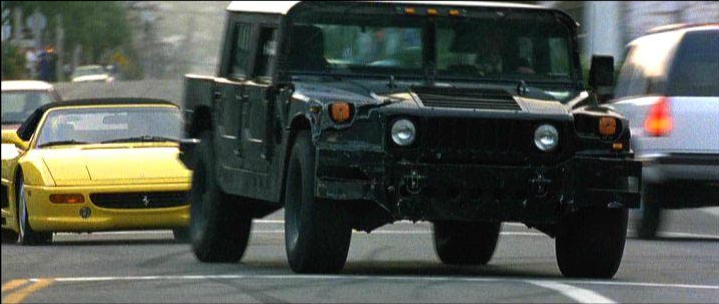
When Mason takes off in another escape attempt within a Humvee, this Stanley doesn’t bow to his inner desire to get a pretzel like Stanley from The Office. Oh, no sir. He “sees” Mason’s Humvee and “raises him” one yellow Ferrari! Chases him down. This is not a hidden skill that Stanley has been holding close to his chest. No way! He just acted in the moment and screamed down the hilly San Francisco streets. No questions asked. He bags and tags Mason for the police, only to cover for him with his suspicious daughter. Good guy, Goodspeed!
Sure, sure. Like all of us, Goodspeed might not have the strongest stomach for what is to come. (He throws up in a sink when he realizes he will have to actually go to Alcatraz and accompany the military insertion.) But that doesn’t mean he buckles under pressure.
While dismantling one of the chemical weapons, he warns Mason, “The second you don’t respect this. It kills you. Put it over there.”
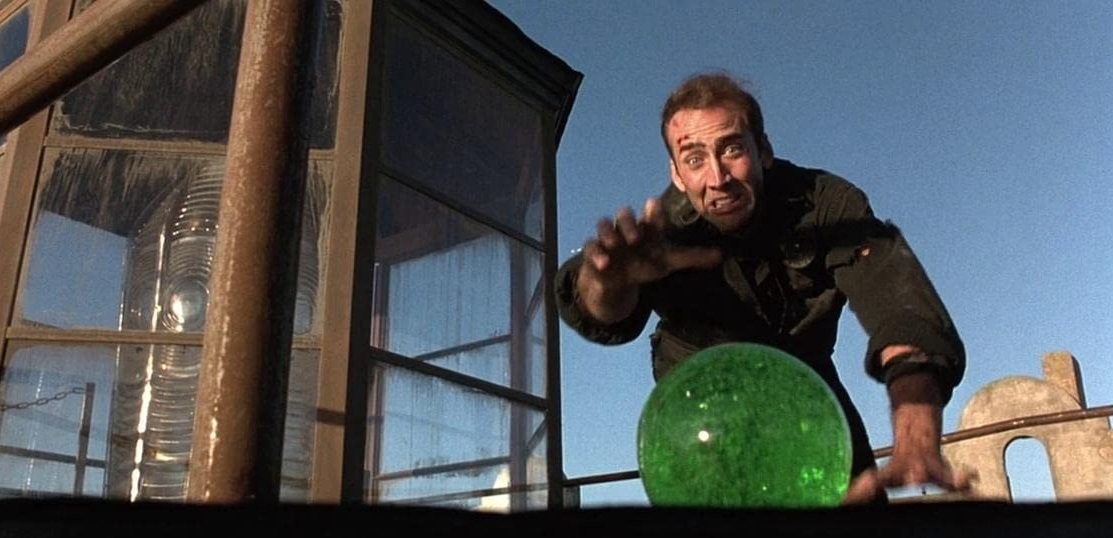
When his hand is forced, he can fight with the best of them. A skill he has never practiced (likely) and certain never perfected. Near the end, after dismantling most of the missiles, he is forced to shove a green sphere of chemical nastiness into the mouth of an assailant mercenary who is trying to kill him. The gas, of course, bubbles and melts the dude’s face in a bubonic plague nightmare devolution. Goodspeed, who also inhaled some of the gas in the process, must thrust a pretty sizable needle (antidote) into his own heart. That’s pretty badass.
But even with all this risk-for-growth, Goodspeed is still true to form, a nerdy anal-retentive scientist who swears off using swear words even when he gets angry. “What do you say we cut the chit-chat, A-hole!?!” he asks Mason in a moment of frustration. In another scene he is astounded at Mason’s escapability prowess, “How in the name of Zeus’s BUTTHOLE,” he yells, “did you get out of your cell?”
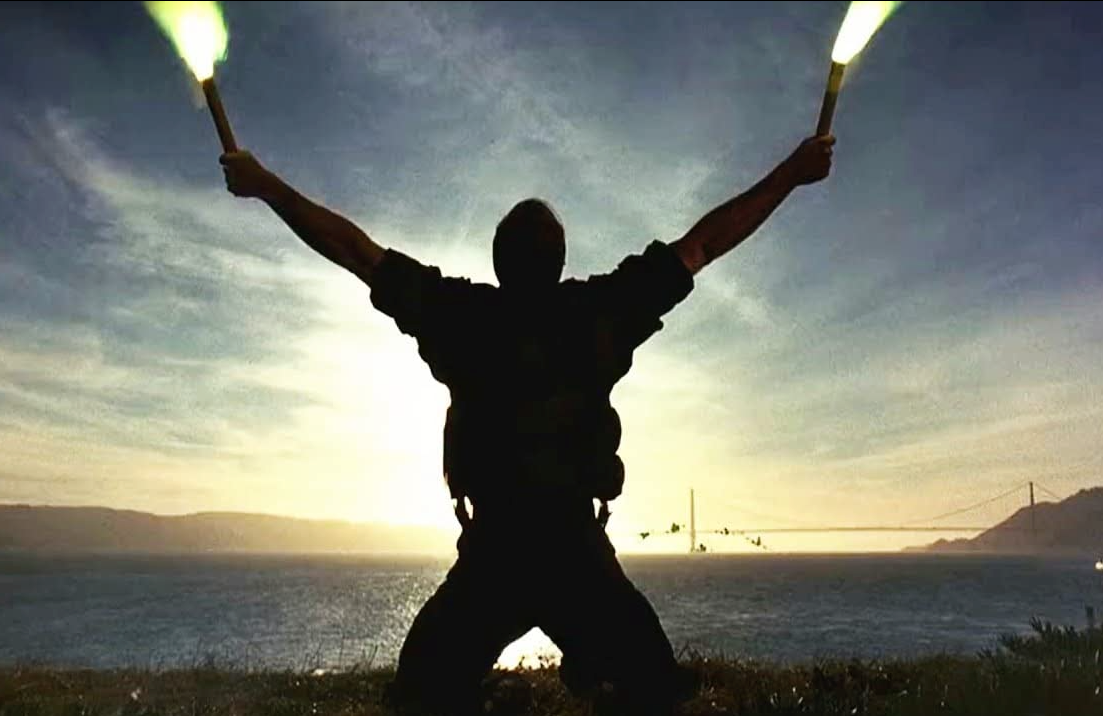
In the end Goodspeed wins. He dismantles the bombs. He uses flares to call off the military strike planned for the island. Hostages are unscathed. He feeds the FBI a story (that Mason died in the conflict) so that Mason can make his clean escape from their grasp (since that was the stated agreement, if not the intended one.) He recovers the U.S. intelligence microfilm that Mason had hidden for decades in a rural church pew, “Want to know who really killed JFK?” he ponders…

While Goodspeed is not the stereotypical action hero, he is definitely a Nic Cagey action hero and working out what would establish him in this world of action-oriented characters in blockbuster films for many years to come.
Other tidbits about the Rock
- Ed Harris is a great actor and he is an important centerpiece to this film. In the end, his conscience wins out over his call for recompense (as he can’t pull the trigger on killing thousands of innocent people), but by then the damage has already been done, and he has handed over the keys to the mission to unprincipled and truly violent, self-serving men.
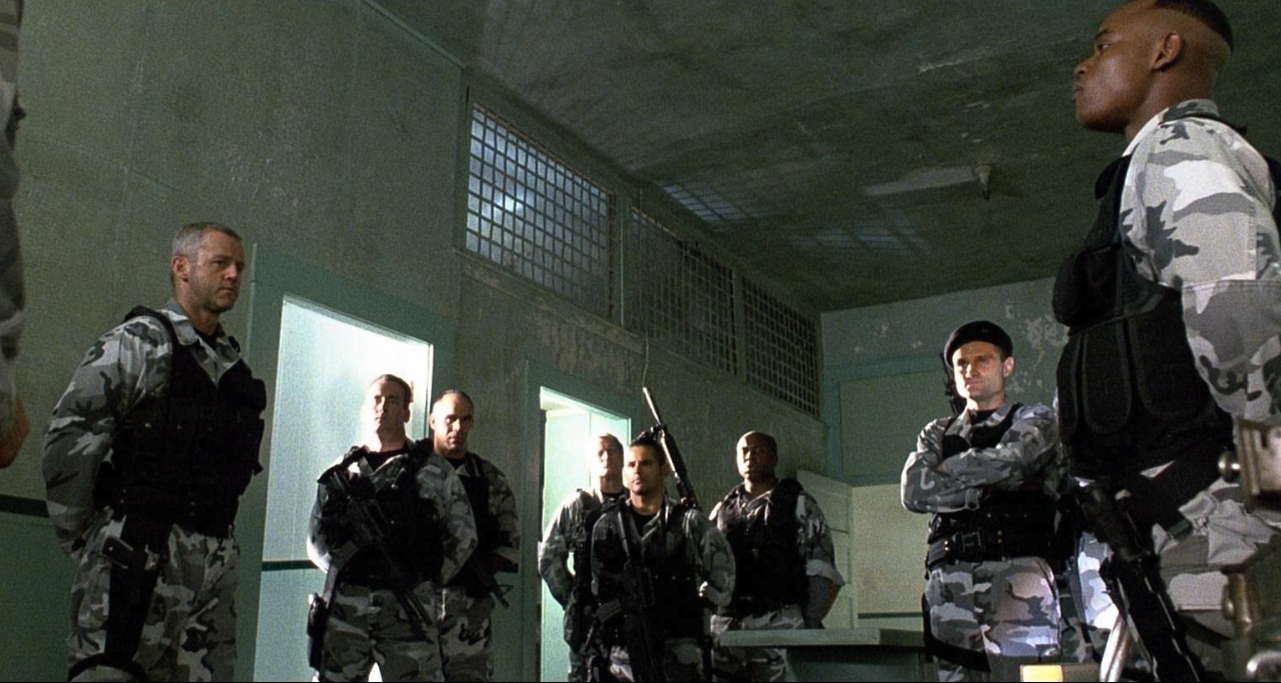
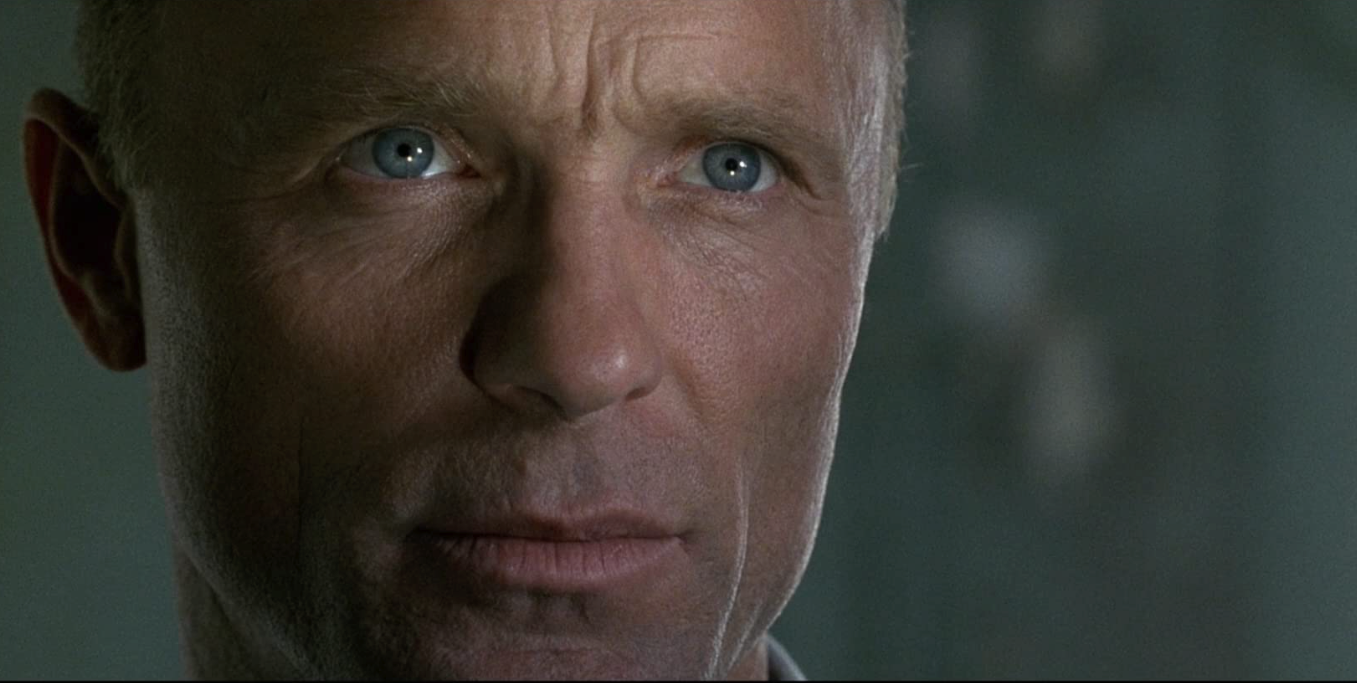
- There’s a nice cross-section of actors that Cage has shared the screen with before this film. William Forsythe plays an FBI agent / handler (he was Evelle from Raising Arizona), Michel Biehn (from Deadfall) plays a mission commander, Philip Baker Hall (Big Junior Brown in Kiss of Death) plays another government agent.
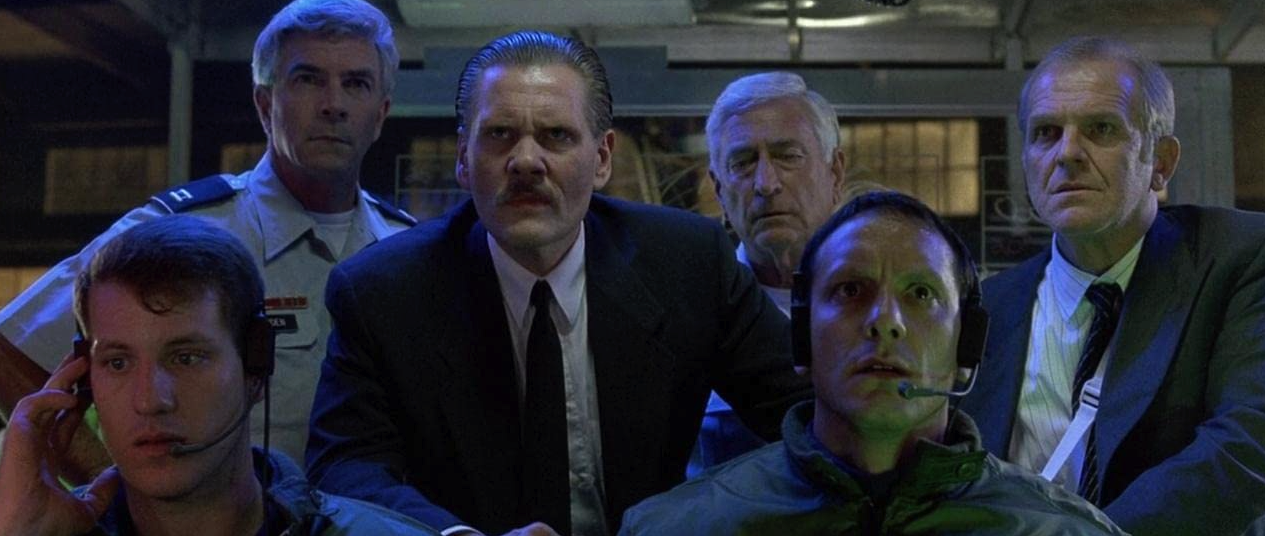
- And then there’s a lot of other recognizable actors in here from other shows: three of Hummel’s soldiers are played by David Morse (12 Monkeys), John C McGinley (sarcastic RD in Scrubs), Raymond Cruz (Tuca from Breaking Bad/Better Call Saul) and the West Wing chief of staff (Jon Spencer) is the FBI Director Womack in The Rock, the man most obsessed with keeping Mason under wraps.
- Evidently (according to this movie) there’s a whole mine shaft system under Alcatraz Prison. I have no idea if this is factual, but it seems entirely unnecessary as well as unlikely that an island prison would have subterranean passages where digging would occur. I guess if you’re in for an Indiana Jones style action sequence though it makes a lot of sense?
Best lines from Nicolas Cage as Stanley Goodspeed.
[Obviously the two lines with “A-hole” and “Zeus’s butthole” being referenced above.]
“I’ve got some bad news and some really bad news.” Stated while trying to defuse the baby doll.
“The world is being Fedexed to hell in a handcart.” [This is strong language for Mr. Goodspeed.]
“Unless you’re a 20 year old guitarist from Seattle. It’s a grunge thing.” Asking Mason about the situation with his long scraggly hair.
“NOT THE ROCKET! NOT THE ROCKET!”
Firsts for Nicolas Cage character as Stanley Goodspeed
- First time in San Francisco
- Scientist
- Interrogating a prisoner
- Defusing a bomb, deadly weapon
- Referencing class pop music (other than Elvis)
- Not throwing a tantrum
- Stealing an item from a church
- Going to a prison (as a non-prisoner)
- Being exploded off an island into a bay
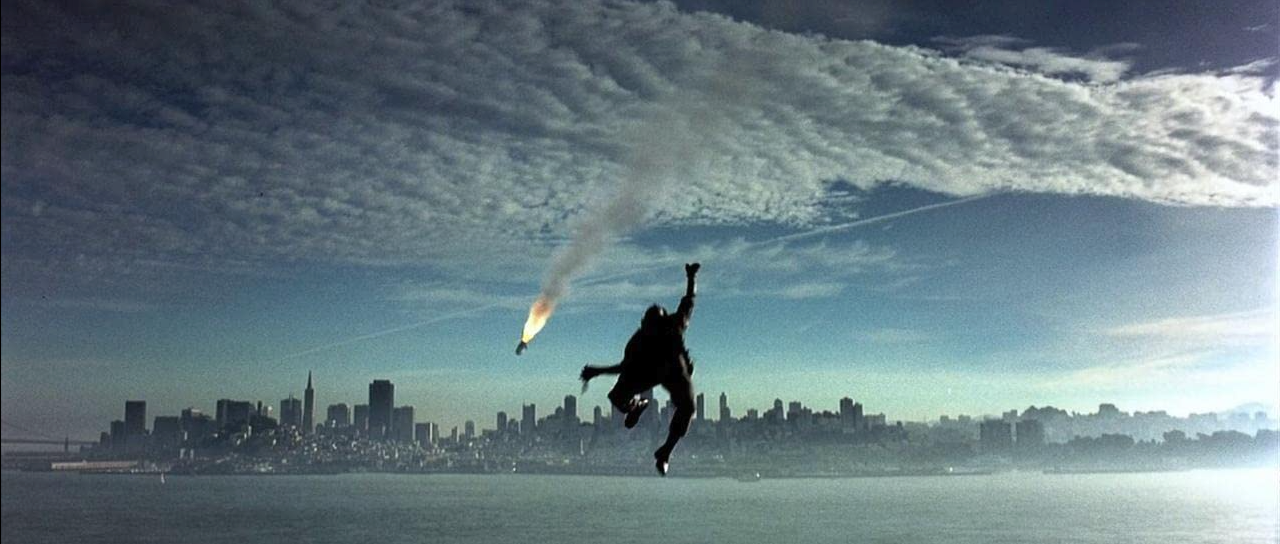
Recurrences
- Stabbed in the heart (see Vampire’s Kiss)
- Being put in jail (Multiple)
- Getting an unmarried girl pregnant (see Racing with the Moon)
- Driving a Ferrari (see Never on a Tuesday)
- Being in a military conflict (Multiple)
In Memoriam
Not to get too serious, but seems kind of fitting to close out this review with just a little memorial for those who have fallen in the line of duty while in service to our country. There are real service men and women who, much like the men / women that Colonel Hummel mourned, remained on the battle field once the smoke cleared and gunshots waned. Their names and actions may be remembered even if their bodies lie in an unmarked or unknown place.
There were likely heroes like Stanley Goodspeed, in our many wars, the real do-gooders who didn’t really belong there, but many of whom fought courageously and died for other, or came home very changed.
There were also likely the more mercenary and unprincipled men who may have killed for the wrong reasons or the wrong causes. There may have been misguided folks or true heroes who may have felt unappreciated or unheralded by their country they served. I want to remember them, too.
Then there are the governments that beat the drums of wars (both for just and unjust causes) and those that hide the truth or bring it to that strong green light. While this movie is not Saving Private Ryan, by any means, it does bring some complicated questions to bear on this discussion of patriotism, service, and war. While remaining mostly a popcorn blockbuster kind of action movie that distracts and entertains for a few hours, I did find the storyline compelling and the characters complex. Even good ole’ Goodspeed, that goshdarn fool of a man.

 yeti speak...
Leave a comment