Sometimes a film’s sense of style trumps the need for the story substance. In the Brian De Palma-directed neo-noir thriller, Snake Eyes (1998), we get to see this sentiment played out in all the style of an unfettered Nicolas Cage on full display, in a role he was truly made for, under all the bright lights and glamor of a stylistic and well shot film that lacked a more compelling and constructed story arc.
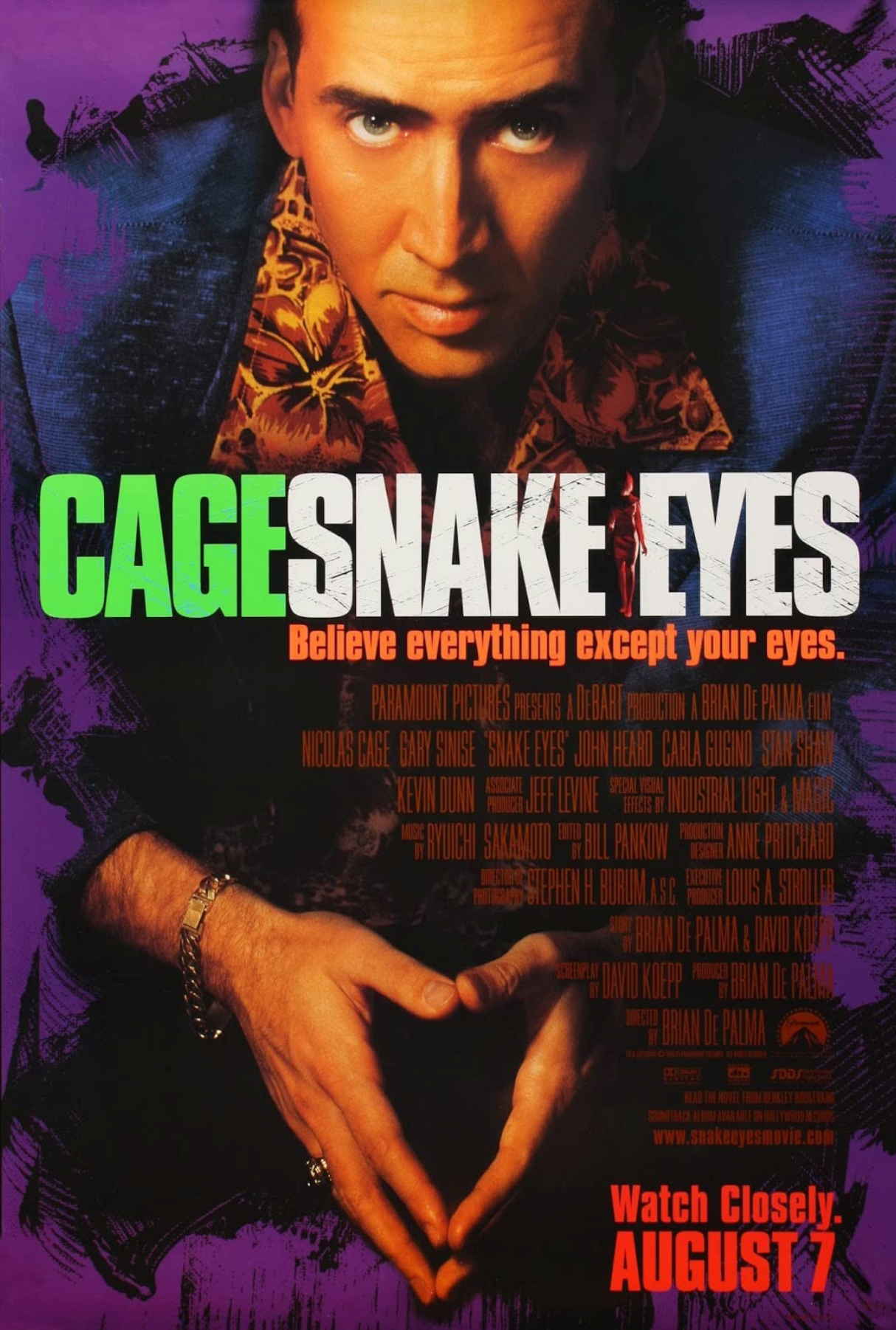
A Washington Post review articulated this much better than I just did, “Brian De Palma’s Snake Eyes is an earthworm in snake’s clothing–visually dazzling, with a complex, patterned, iridescent skin, but whose story is ultimately commonplace and lowly.”
Some reviewers also criticized the film for being a watered down version of De Palma’s previous works–tense Hitchcockian thrillers and crime-action-oriented mysteries such as Blow Out, Body Double, The Untouchables, Carlito’s Way, and Mission: Impossible. I haven’t seen many of those movies in a while, so I can’t speak to the truth of this, but I will say, for a B- effort, this movie gets an A- score from me for being highly watchable and mostly interesting. The ending fell a bit flat, but I blame this on a screening audience and not on De Palma which we’ll get into later.
But first let’s set the scene on Snake Eyes.
What’s It About?
Not to be confused with the G.I. Joe movie Snake Eyes (2021), De Palma’s 1998 Snake Eyes takes place in Atlantic City at a heavyweight boxing championship bout at a casino. The film is considered “neo-noir” in that it is (courtesy of Wikipedia) a revival of the post-World War II era films from the 1940-1960s which were “dark films” in both lighting, sinister storylines, and a shadowy cinematographic style.
In Snake Eyes, we are introduced to the frenetic and brash Rick Santoro (Cage) a corrupt homicide detective who has ringside seats to the fight courtesy of his childhood bestie, now naval Commander, Kevin Dunne (Gary Sinise) who is running security detail at the fight for the attending Secretary of Defense, Charles Kirkland (Joel Fabiani), and the casino owner and weapons magnate Gilbert Powell (John Heard).
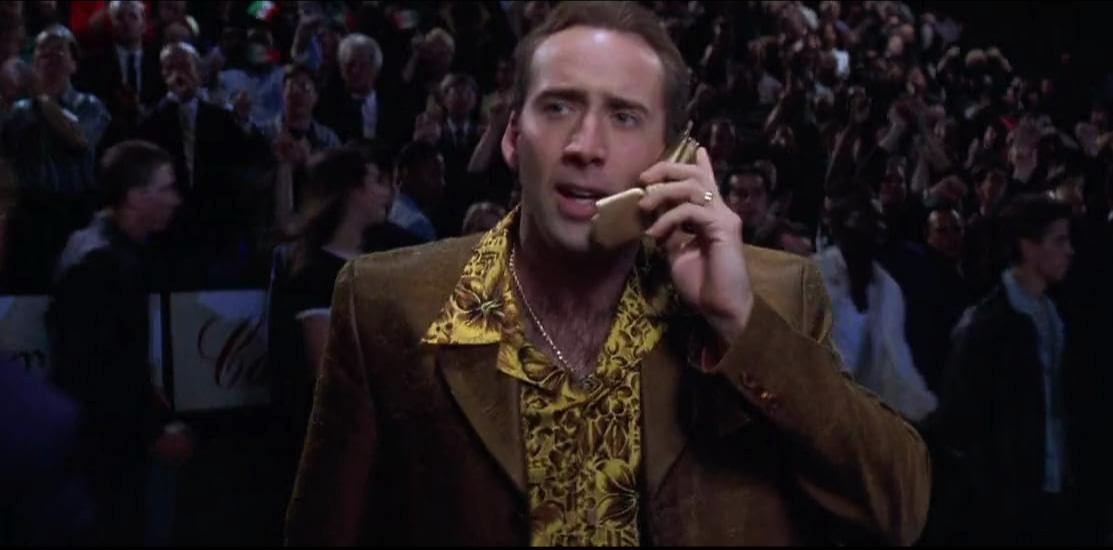
Santoro, who as the fight begins is juggling phone calls from his wife and mistress, reliving old times with Dunne, flirting with seatside bombshells, and hyping up his favored boxer, the home-grown and fellow Neptune High School alumni, Lincoln “the Executioner” Tyler (Stan Shaw) finds sharp focus on the fight in the midst of this storm of activity as a mysterious woman shows up to sit next to him and have “a word” with Kirkland.
As Tyler takes a knockout blow (or was it?) from the challenger, a spray of blood splatters across Santoro’s face as the Secretary of Defense has just been assassinated and the arena erupts in a sea of panicky chaos.

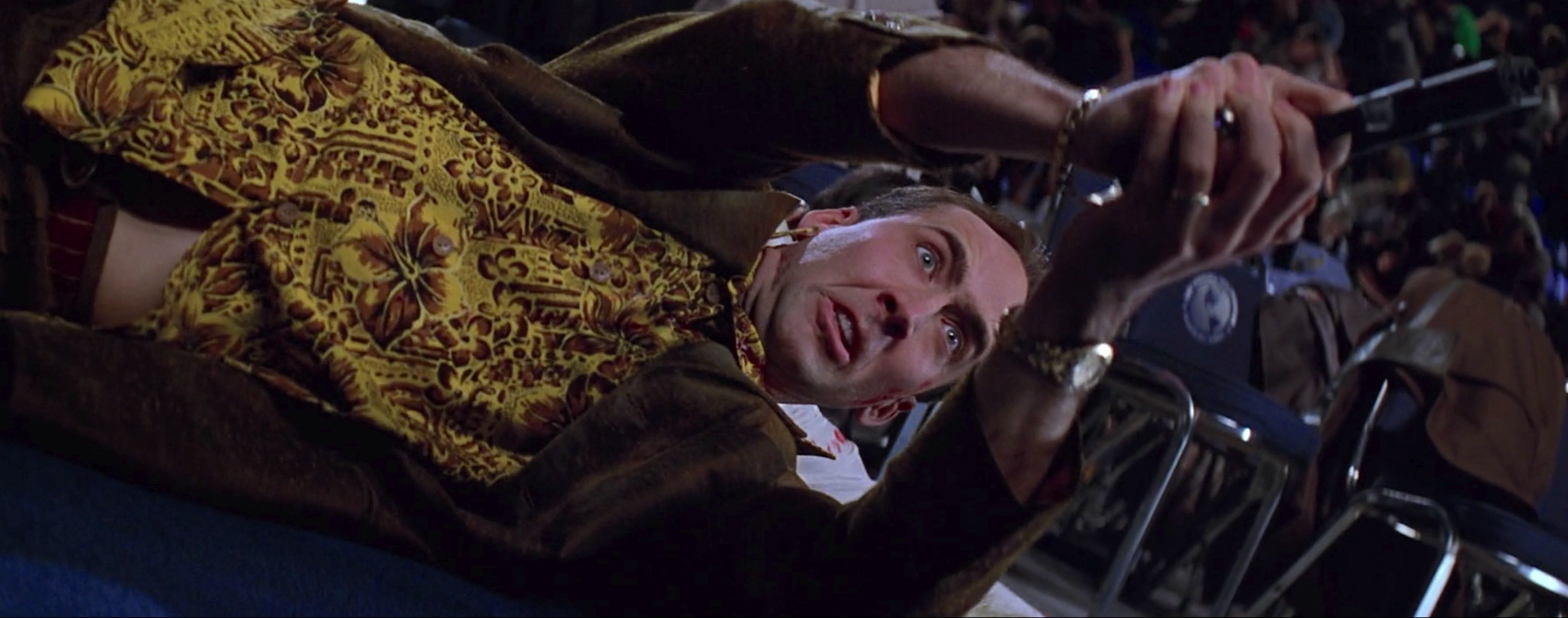
Santoro hits the floor with his gun drawn as the mystery woman flees, the boxer opens his eyes to see what’s going on, and Dunne (somewhere in the stands above) shoots and kills the assassin.
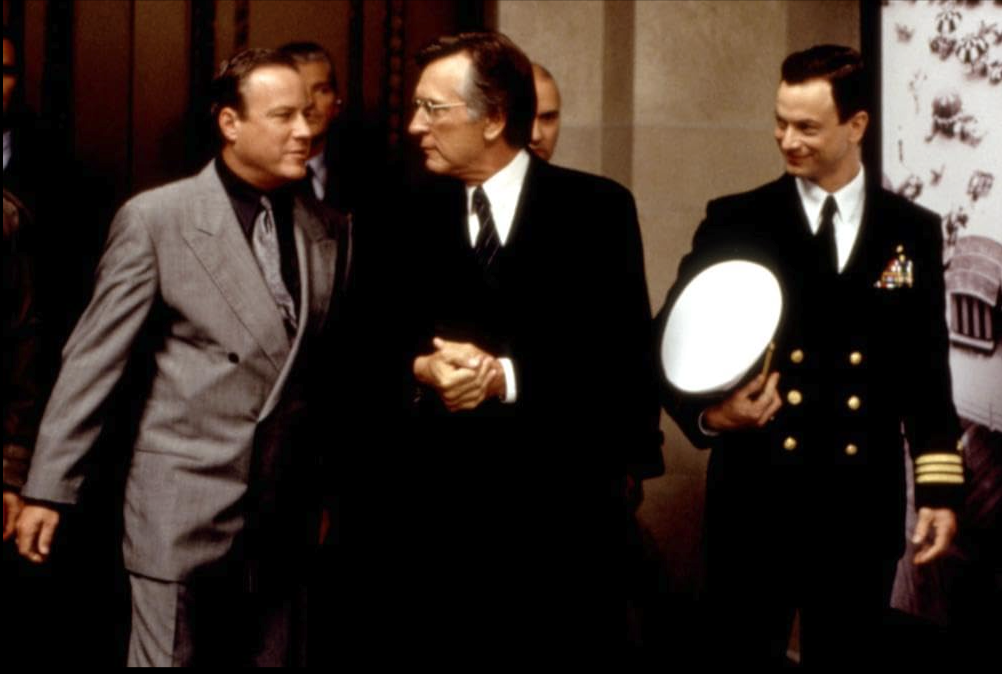
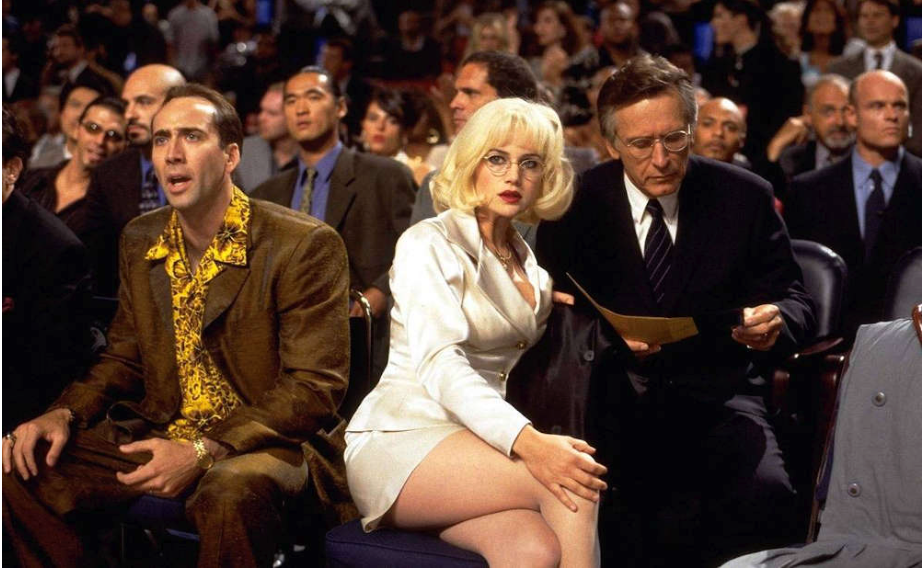
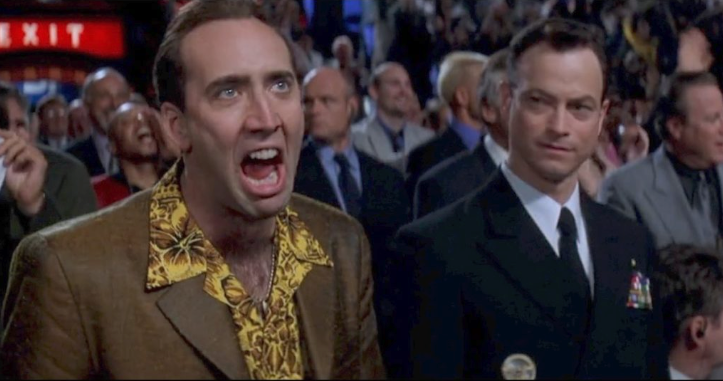
From here, Snake Eyes takes us down the path of a murder plot (or was it a conspiracy?) in which Santoro and Dunne must put the pieces together, find the mysterious woman Julia Costello (Carla Gugino) and lock down the casino / arena with its 14,000 eye witnesses before the political / PR / media fallout can catch up to Dunne for his failure to keep the SoD safe from harm.
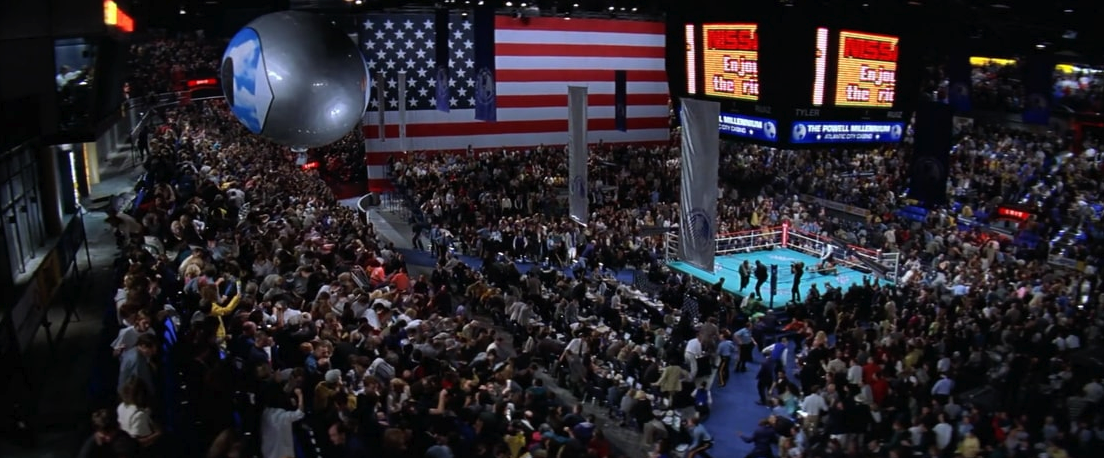
As the police work unfolds under Santoro’s scrutiny, the lens of different character perspectives and the lens of different camera angles that captured the assassination (often depicted through De Palma’s use of a split screen) reveals that what appeared to happen at face value was different from what actually happened. Shocker! As Dunne looks desperately for the fleeing Julia, Santoro unwinds the spool of conspiracy to discover that Kirkland’s death was indeed plotted and executed by not one, but a group of people.
Spoiler #1: Dunne was behind it all. Spoiler #2: Julia was a whistle-blower trying to make Kirkland aware of military cover-up Dunne / Powell orchestrated related to a missile system they wanted to sell to the government.

Ultimately, Rick catches up to Julia before Dunne, only to discover his friend has gone to the dark side (for many of the same reasons Gen. Hummel did in The Rock). Rick is forced to reckon with his default stance of looking away from crimes when it benefits him OR take down his best friend in the name of justice (before Dunne can kill his final target, Julia).
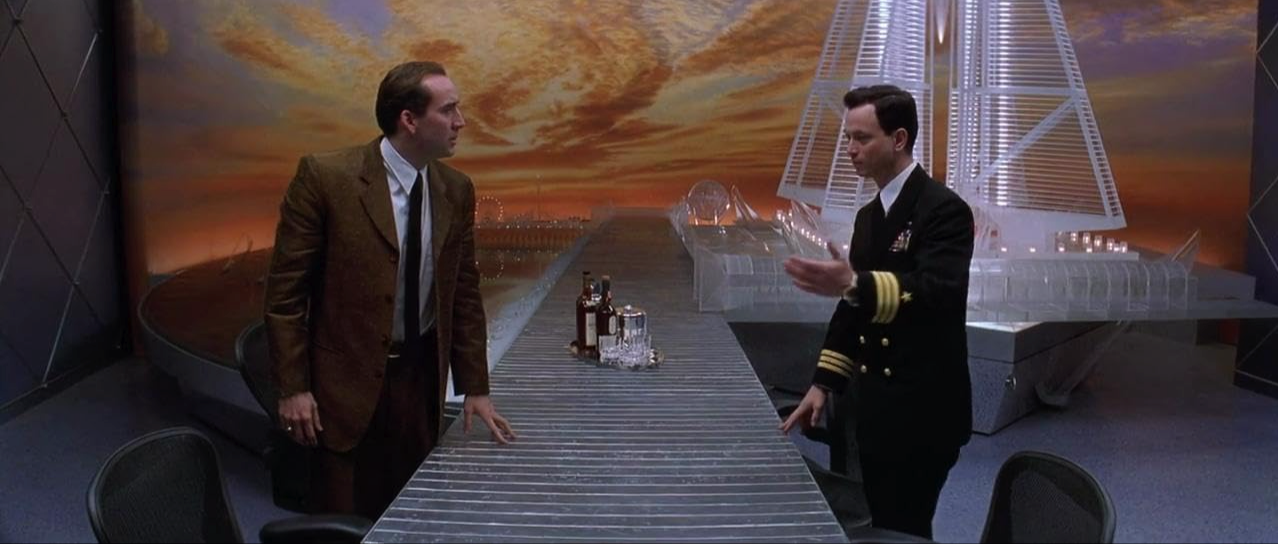
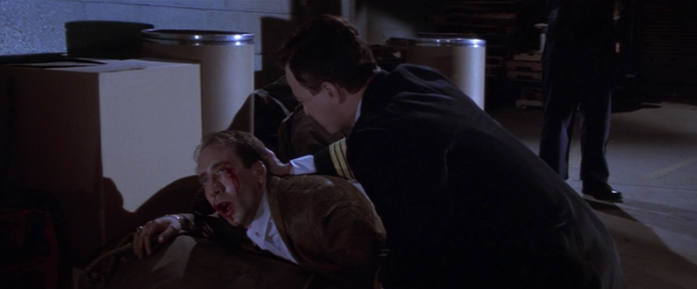
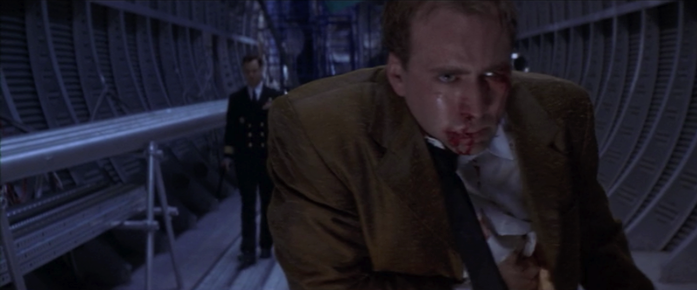
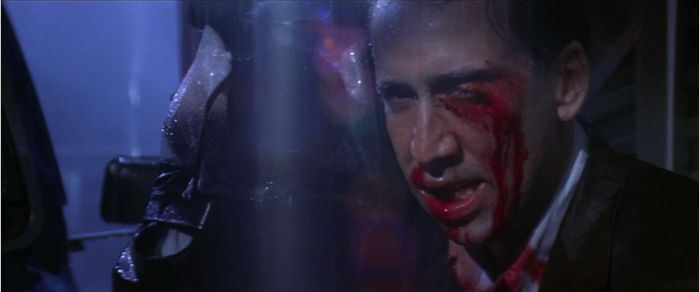
Confronted with this choice and a million dollar offer from Dunne, Rick instead chooses the path of most resistance, gets the snot beat out of him by Lincoln, and must have a final showdown with Dunne to save Julia and bring light to the conspiracy.
What’s Working
This movie works for me because it is prime-time Cage. As one writer put it in this article, “(Cage’s) willingness to give nearly every project he takes on an above and beyond approach, giving it his all when the movie itself may not need or deserve it, has made him one of my favorites.” Same.
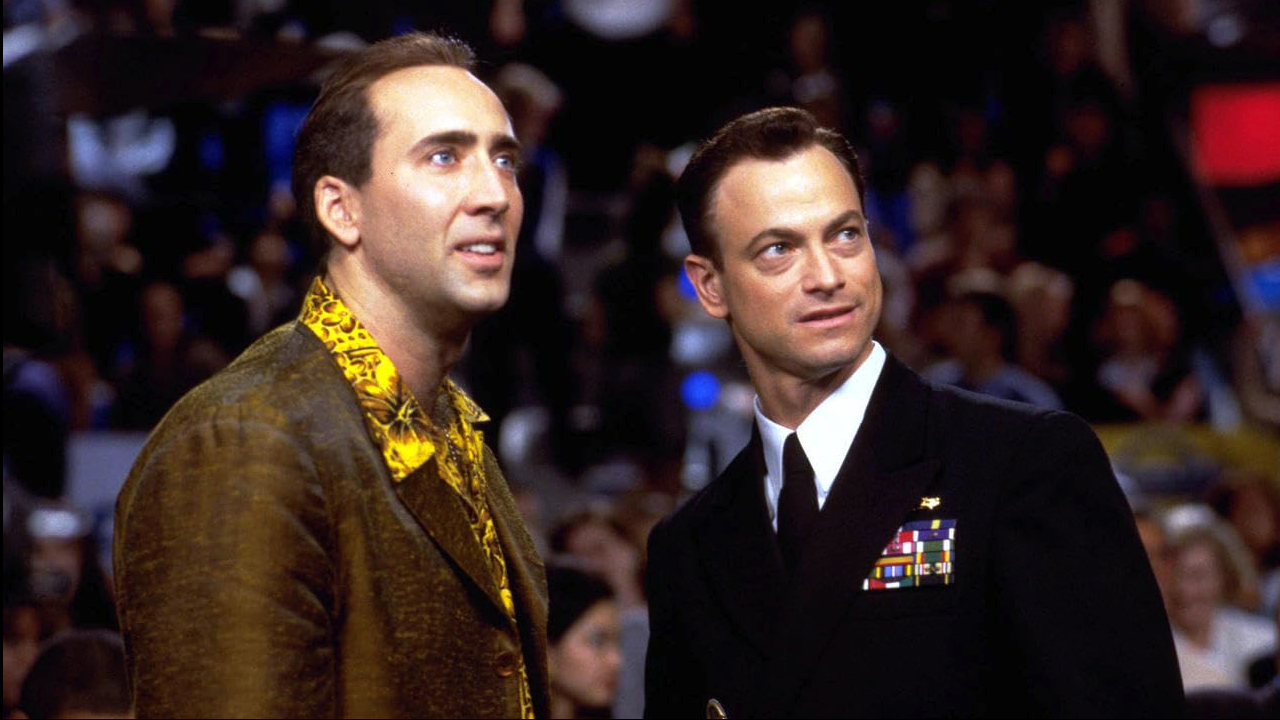
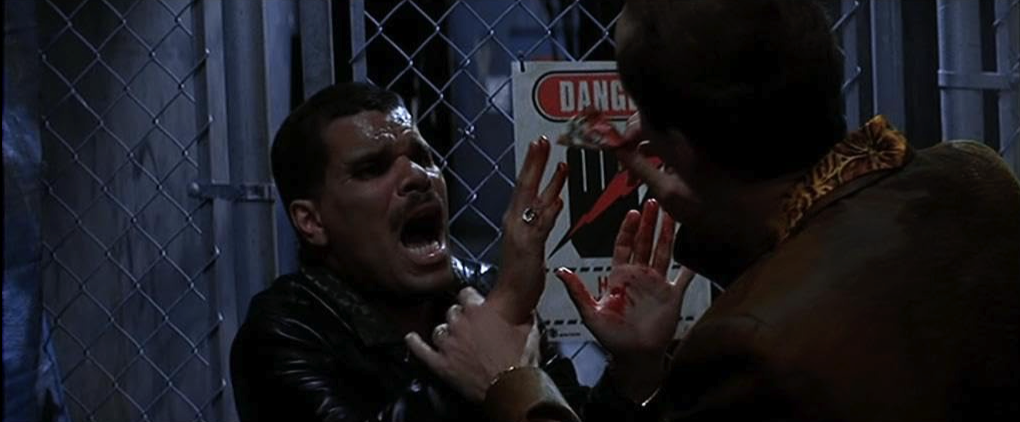
In Santoro, everything Cage does is “above and beyond”: his fast-talking whip-fire speeches, his philandering, his gambling, his shameless abuse of criminals (poor Cyrus / Luis Guzman), his lionizing and later denigrating of former sports idols (Lincoln), his justifying of bad decisions, his finally sticking to his guns, his exasperated phone conversations about ordering pizza, and his over-enunciating of angry, frustrated syllables.
All of it…just works!
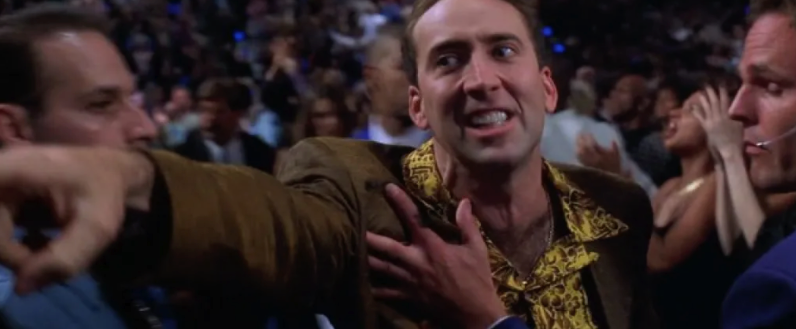
Most of all, this movie works because of its strong sense of style. In an interview with resident grandma / movie interviewer Bobbie Wygant, Cage is sporting his snakeskin jacket from Wild At Heart. He talks about how this movie Snake Eyes was a throwback to his more quintessential movies, and that’s why he dusted off the jacket. While he doesn’t wear this specific jacket in the film (I don’t think; he should have) his Wild At Heart “individualistic and personal freedom” style is evident here. His sharkskin suit in Snake Eyes sits somewhere between the fashion of Sailor Ripley and Eddie (from Deadfall). Plus, the wide-collar Don Ho shirt, the gold chain, the gold bracelet. What’s not to love?
Camera work. De Palma is known for his “filming without a net” takes where he would shoot scenes from 5-20 minutes all in a single take. The opening arena / fight scene, clocked in at roughly 20 minutes, was one of these epic long shots. The cameras follow the actors, without a cut, unless someone makes a mistake and then they have to shoot the whole scene over again. Cage talked about how this process worked only because the actors rehearsed and rehearsed and rehearsed, and that sometimes they got it right in only two or three takes. Other times they’d have to shoot it over again, and they’d all point fingers at each other wondering, “Who screwed up? Was it you? Was it me?”
The story. The story itself isn’t bad. I liked how the movie was plotted. I liked how the different perspectives and reframing of events reveal the truth of what occurred. The film kind of gets a bad rap for being tired or unbelievable (“commonplace”, “lowly”) and maybe that’s the case because we’ve seen so many movies that show crimes that unravel like this. Or maybe De Palma just has a high bar, especially when you are being compared to Hitchcock from a thriller perspective? For me, the story breaks down, not because of how it was structured, but because of the timing of some of the major reveals, and the way that the movie doesn’t really stick the landing. Which gets us to…
What’s Not Working
This film would be better, if not for the last half of it. The fact that Dunne is behind the conspiracy is a nice (if a little predictable) twist, but the film lets the audience be “in the know” way too soon. I know this is likely intended to build tension for the time when Rick makes this discovery himself, but did it need to happen that way? Couldn’t the clues have come in a little more slowly and without showing us all the “behind the scenes” murders that Dunne needed to commit to hide his trail? Did we need to know Dunne was behind it half-way through? I like me a good whodunit, not a bad howdunit. It felt like the magician showed us how the trick was done about halfway through, pulling the rug out from under his own magic.
The ending. De Palma wanted the movie to end in a hurricane, literally. The opening scene foreshadows a big storm coming into Atlantic City, the media covers it, and Julia is trapped in the blustery outside near the end of the movie while Dunne is racing to find her. De Palma’s vision was that all the “corruption” in the movie could only be wiped away by a great vengeful act of God / nature. Industrial Light and Magic worked on some of the early attempts at CGI for this hurricane using some of the techniques used in Twister.

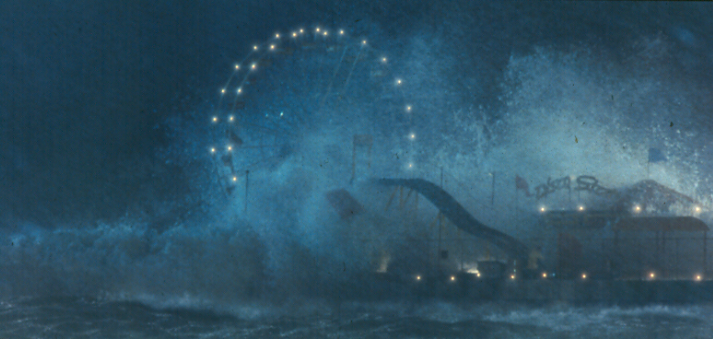

This original hurricane ending was previewed by audiences, but it did so poorly with them, the production company forced a change in the original ending. This isn’t De Palma’s fault and it isn’t Nicolas Cage’s fault. Audience sentiment, not the director’s vision, made this a meh movie in my opinion. Now would a hurricane make sense with the plot and the story arc? Maybe not, but you can’t promise a hurricane and deliver bits and pieces of it throughout the film and then have it just NOT HAPPEN. SPOILER: Instead we have a showdown in a storm, a police vehicle crashing into the room where Dunne, Rick, and Julia are facing off, and a defeated Dunne shooting himself in the chest with a silencer rather than face up to the crimes he’s committed. What. After all that?
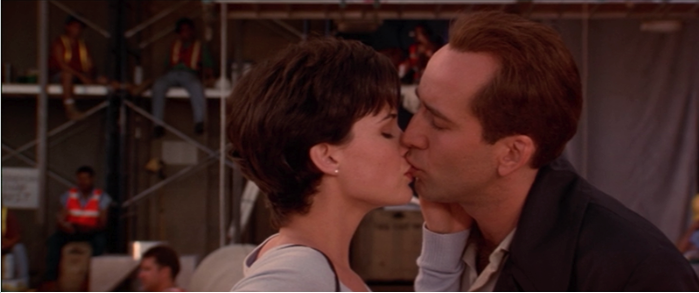
Julia as seductress and love interest. I also had a hard time with Julia’s character in this film. I liked that she had blurry vision throughout, due to losing her glasses in the assassination melee (and the way De Palma reveals this to the audience), but the way she decides to seduce the fattest guy in the casino just to go up to his hotel room as a hideout stretched my suspension of disbelief. And the fact that after it’s all said and done, she finds herself attracted to the kinda slimy Rick because he saved her life (even though he’s already going “upstate” for the next 12-18 months for his corrupt-cop criminal past) that just doesn’t hold water. It may have been a sympathy kiss she gave him (I’ll never see this guy again) but for my money this was an unneeded and unrealistic conclusion to a relationship that never really surfaced.
Snake Eyes!
This is a movie that takes place in a casino, but primarily in the boxing venue of said casino. There’s a scene on the casino floor that moves the action along, and there is a gambling theme throughout related to the fight. Given that, we have the two main characters trading lines like this:
[DUNNE] “You got nothing, kiddo. Snake eyes. The house wins.”
[RICK at the end of the film, when Dunne’s plot has been foiled finally.] “Ain’t no we, Kevin! You got snake eyes!”
Two lines about snake eyes and the movie is called Snake Eyes for God sake. But why? This all seems a bit too on the nose and yet totally unrelated to the story. It seems like the wrong metaphor to me and the wrong catchphrase and frankly the wrong title for this movie. No one is playing craps. No one rolling dice, really. No one is a true gambler here. I almost wonder if it should have been a boxing catchphrase.
“You took your swing and you missed, Kevin. Below the belt even. But you just got KNOCKED OUT!” Or
“TKO, Kevin. TKO.”
Top 15 Lines from Nicolas Cage as Rick Santoro (there were more)
- “I’m on TV. I’m on TV.”
- “You kind of went the stupid way, didn’t you, Cyrus?”
- “Everybody loves Rick Santoro!”
- “Tyler, WOO! Neptune High, right? Check it out right here. Go NH Sea Devils. You and me Tyler. Yeah. Go Tyler. Go Tyler. Go Tyler. Go Tyler. Go. Woah. Look it Tyler. Look it Tyler.”
- “Well, pardon my sauvoir faire, Admiral. Why you so uptight? It’s fight night!”
- “Look I’m not like you, Kevin. I can’t have sex with the same person for 20 years. It’s not natural.”
- “But it’s my sewer Jiminy and I love it! I was made for this sewer baby and I AM THE KING!”
- “Screw procedure!”
- “If there’s one thing I know it’s how to cover my ass!”
- “I’ll call him Mr. T! The night he beat Rocky Balboa if he wants. He’s a bad pony. I don’t have to tell you right?”
- “The smart money ain’t on him.”
- “Loyalty’s my only vice.”
- “That was the plan. To give you a boner. And you got one! Congratulations, you’re human.”
- “Who the HELL do you think you are lady? You’re a number cruncher. Just crunch the numbers.”
- “Fuck you!” [Spoken to Kevin after his snake eyes comment.]
- “Ain’t no we, Kevin! You got snake eyes!” (Through busted lip and broken teeth)
Firsts for a Nicolas Cage character as Rick Santoro
- Using a flip phone
- Wearing a flared disco collar.
- Getting blood on face from an assassinated politician
- Pummeled by a professional boxer
- Knocks out a reporter with one punch
- Extreme receding hairline
- Asking someone for an autograph
Recurrence
- Cop (It Could Happen to You)
- Smoking (Multiple)
- Wagering on a sporting event (Racing With the Moon)
- Wearing a gold chain necklace (Deadfall)
In conclusion
Nicolas Cage made Snake Eyes a movie well worth watching, once again proving that he can take an otherwise just-OK movie and make it great (or a terrible movie and make it highly entertaining). For me, the verdict is still out on De Palma’s artistic vision for this one. I can’t really judge it without seeing a director’s cut that puts the hurricane ending back into play. Would I change the title, the catchphrases, and some of the plot sequencing and reveals? Yes, I would. Would those changes make for a better movie? Undetermined. I’m not Brian De Palma. Regardless, I would definitely watch this one again just to see Nicolas Cage as Santoro slinking his way from the sewer to a slightly higher rung on the moral ladder.
Nothin’ but Snake eyes, baby! All the way.

 yeti speak...
Leave a comment