In the early days of the new millennium, if Nicolas Cage wasn’t making Christmas movies, it seems he was making war movies. In 2001, the first of these war films (and his fifth book-to-film adaptation) is the World War Two dramatic romance Captain Corelli’s Mandolin. The film, directed by John Madden, and based on the 1994 novel by British novelist, Louis de Bernières, features some stunning cinematography of the breathtaking Greek isles; some Italian chorus singing that makes you want to grab the pasta & wine and get to the piazze; and some heart-breaking no-duh realizations that wars are bad for everyone (especially Mediterranean neighbors).
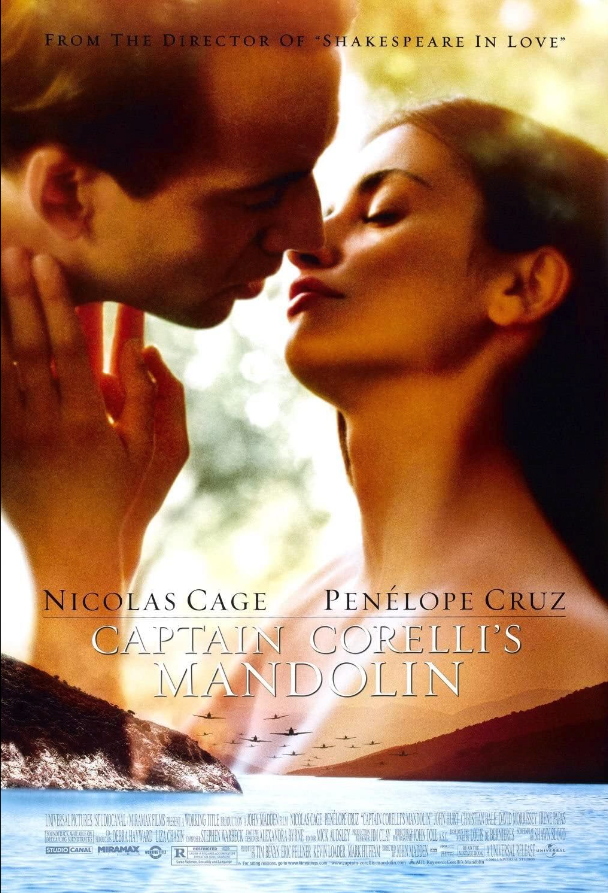
Before we break it all down, I need to point out that Nicolas Cage is no stranger to war films, and especially those set in WWII. Here’s a little chart to show Cage’s war movies and affiliations. (I’ll come update this chart later as more war movies come along…)
| Movie | War / Situation | Affiliation |
| Racing with the Moon | WWII Heading off to war at the end. | U.S. |
| Birdy | Vietnam Coming back from the war at the beginning. | U.S. |
| Time to Kill | Italian invasion of Ethiopia | Italy |
| Firebirds | War on drugs in Columbia | U.S. |
| Red Rock West | War in Lebanon (mentioned) | U.S. |
| Captain Corelli’s Mandolin | WWII Occupying Greece for the Axis. | Italy (Axis) |
| Windtalkers | WWII Protecting Navajo Code Talkers in Japanese Saipan. | U.S. |
Nicolas Cage is Not A Nazi
But he may be a fascist? In CCM Nicolas Cage plays Captain Antonio Corelli, leader of the Italian 33rd Acqui Infantry Division, player of mandolins and singer of songs; and proxy servant-by-default to the fascist, Benito Mussolini. Although Corelli’s infantry division may have not seen action or “fired a shot” in the war, they are occupying the surrendered Greek island of Cephalonia. As coastal neighbors, the Italians and Greeks, have “history” and the film pulls no punches in the long-standing prejudice / feuds between these two countries with so much shared culture.
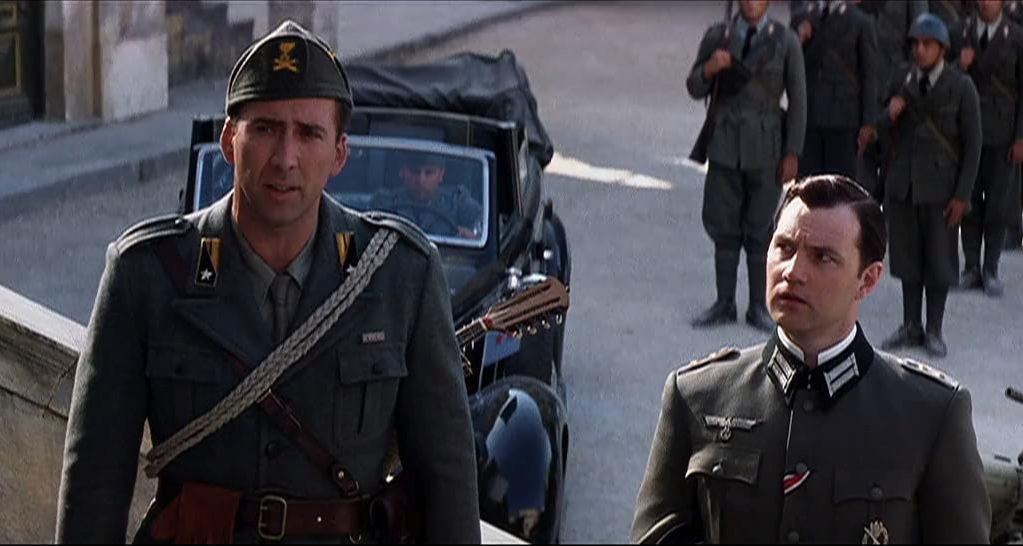
The occupied Greeks are especially unhappy with this Italian “arrangement” since Italy has teamed up with the German Nazis in this particular war, and many Greeks have been killed in a battle they expected to win in Albania.
So even though Captain Corelli is fighting on the same side as the Nazis in this war, he’s not really “on the same page” with their policies or practices, as we’ll discuss later.
I’m stating this for the record: Nicolas Cage is not a Nazi.
Cephalonia or bust
By all appearances, the island of Cephalonia is a place I’m ready to retire to. The cerulean blue waters, the white cliffs, the rolling hills, the stone buildings and labyrinthine paths: everything about the setting cries Mediterranean paradise. In CCM the charm of the place comes across right away in the stunning vistas and the quirky characters that populate these quaint fishing villages and mountain towns along the coast.

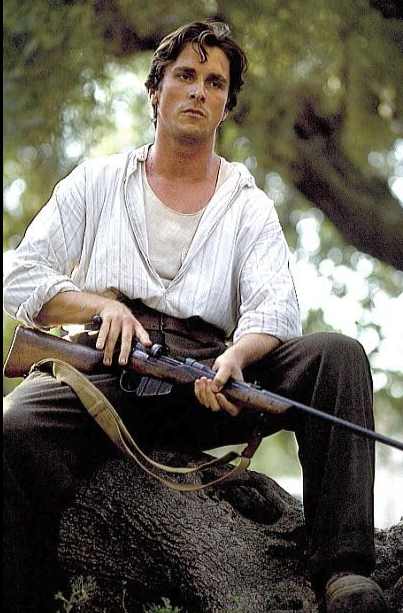
The central figures of both the plot and this Cephalonia town are Dr. Iannis (John Hurt), his daughter Pelagia (Penelope Cruz), and her somewhat immature, illiterate suitor, the fisherman Mandras (Christian Bale).

Dr. Iannis is the wise, slightly sardonic doc who is smarter than the average bear and who is the pillar of the community. He says things like, “We should not ask why we are wounded, but if the wounded can be healed.”
He’s also the kind of doctor to pull a desiccated pea out of a man’s ear (it must have been lodged there since he was a child), simultaneously curing the patient’s lifelong deafness and (unfortunately) removing the man’s main excuse for not listening to his wife’s requests. By the end the man is begging Dr. I, “Put the pea back in my ear!”
Dr. I is also a conscientious father, concerned about his daughter Pelagia’s interest in a man who is beneath her intelligence and capacity. “Everyone is too young when they marry.” He is especially concerned that she is not marrying for love.
Pelagia is perhaps too much like her father in this regard. Strong-minded. Beautiful, highly regarded, and bright.
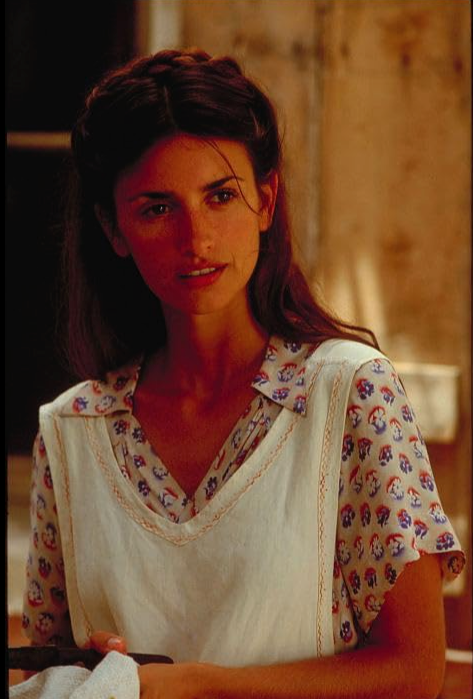
She is the headstrong, idealistic and romantic type who gets swept along by the good-looking and vibrant, Mandras. She forgives his childish pranks (e.g. throwing her fully clothed off a pier into the water, tying her surreptitiously to a chair so when he invites her to get up and dance she is strapped down and looks foolish.) And she imagines him in the way she wants him to be: passionate, emotionally available, and expressive. She overlooks the selfishness and pride in him, which leads him off to fight in the war and never return her letters. Then there’s…
Captain Corelli & His Mandolin
“It’s a-me, Mario!”
The enigmatic Mr. Cage does it again. He always operates a little off-center which makes you wonder things like, “Is this good? Or is this really bad?” As the captain of the Italian Acqui Infantry division, Cage’s Corelli is a charismatic, friendly, and likable character who cares about music, drinking wine, and noticing lovely ladies much more than war.
He also sounds a lot like Super Mario.

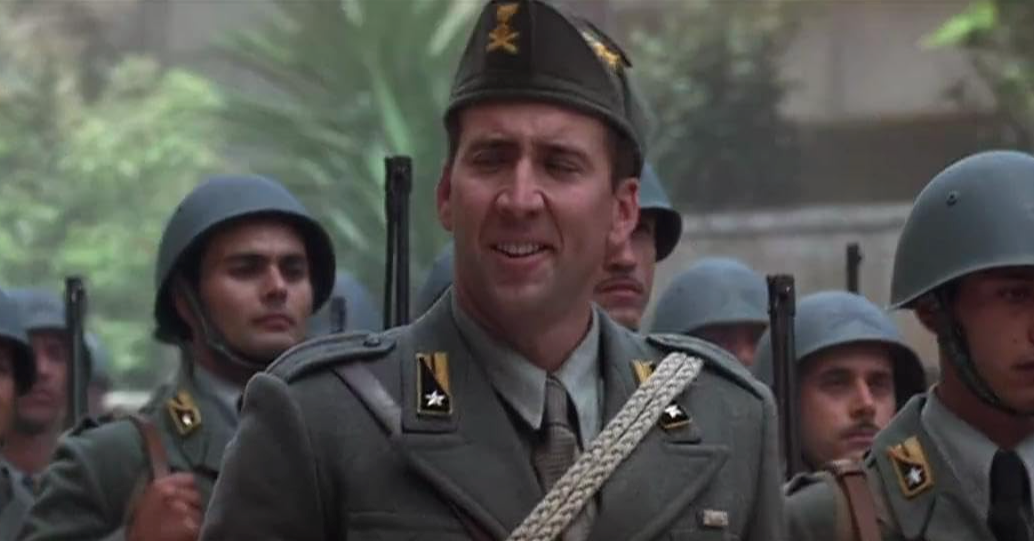
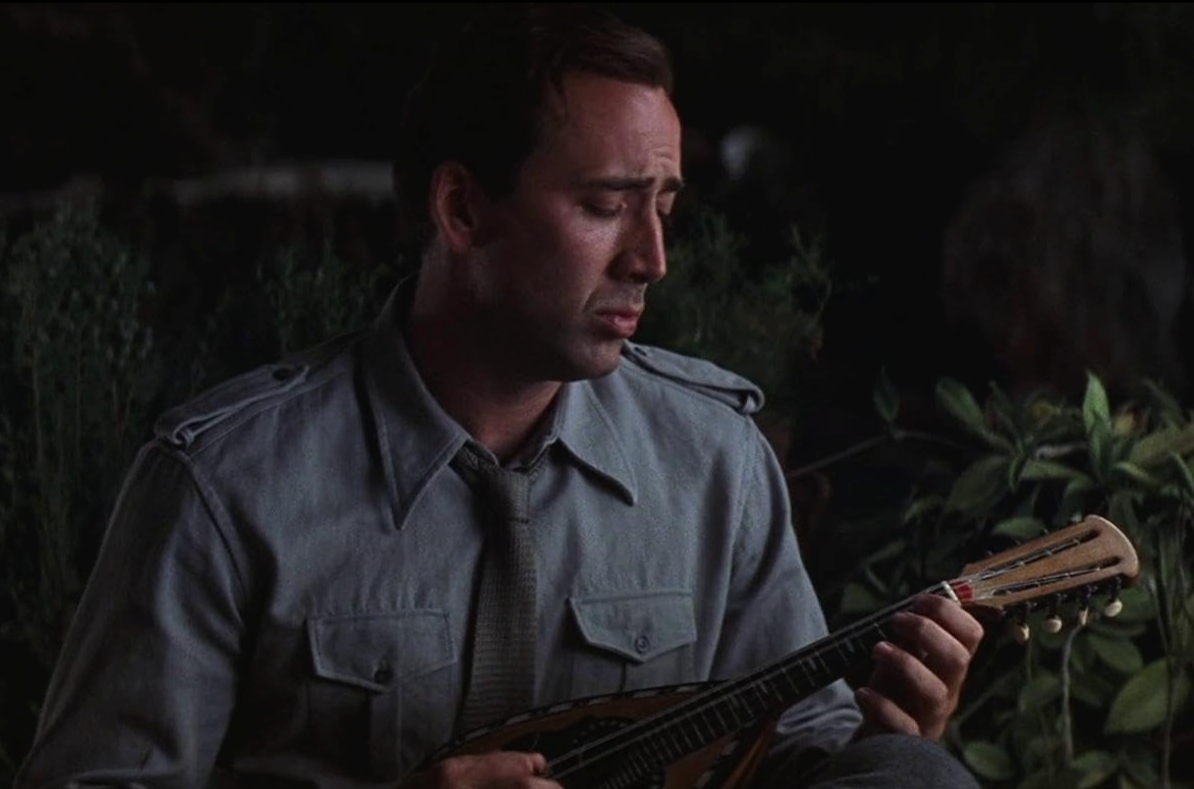
Cage is known for his affectation, his accents, his oddball stylistic choices. Unlike in Time to Kill, where he also plays an Italian officer, this time Cage chooses to go full Italian-English stereotype with the accent. You can almost see him pinching his fingers together, and waving them forward from the wrist when he speaks.
I won’t say it’s jarring, but it’s definitely noticeable. What makes it mysterious (for me) is whether or not it adds to the empathy or appreciation you have for Captain Corelli. Even though he’s “fighting” for the fascists, he doesn’t feel like a fascist. The accent is disarming I guess, but it’s also kinda funny.
Corelli also loves him some good music.
When a new recruit comes to join up, Captain Corelli asks him if he can sing and if he wants to join their “opera society.” Corelli’s then explains the three rules of engagement in his rolling Mario speech.
Rule #1 – All those called to regular musical fatigue should be obliged to play a musical instrument. Spoon, helmet, paper, cone, so on and so on.
Rule #2 – Anyone who says Donicetti is better than Verde shall be required to sing Finiculi Finicula and other songs about railways.
Rule #3 – ? (He can’t remember what that one was, so it goes unnoted.)
If the Super Mario accent doesn’t win you over, or Corelli’s love for music, then the mandolin playing will. Evidently, Nicolas Cage learned to play the mandolin for this role. The guy that taught him, Paul Englishby had this to say about it.
“Cage actually played it and there is lots of footage of him doing that. It was incredible,” said Englishby. “He really is very talented. Nicolas used to go away for the weekend. He had a private jet and one weekend he asked me to go to Venice with him so he could have his music lessons.”
The mandolin playing as well as this rendition of Santa Lucia were definitely highlights for me:
But as much as this film is about music and warfare, it’s mostly about love, and it’s…
Not Your Typical Love Triangle
And what’s more disruptive to a mismatched pair of Greek lovers (and incidentally neither Cruz or Bale have any Greek ethnicity) than a wild card Italian heartthrob (like Nicolas Cage?) While this movie is one part historical drama, it is really two parts romance with a little action mixed in for good measure.
While Pelagia is awaiting the return of her betrothed, Mandras, writing him letter after letter that go unanswered, her town is occupied by the invading Italian (and German) troops. Pelagia loathes the Italians for what they have done to her country and countrymen, but she is immediately drawn into the sphere of Corelli whether she likes it or not.
When he enters the town parade-style with his troops, Corelli spots Pelagia in the gawking crowd and yells, “Bella Bambina! Two o’clock!” This drill sergeant instruction brings all the men’s attention, turning in formation, to Pelagia as they emphatically salute her while continuing to march down the street. Suave, man, suave.
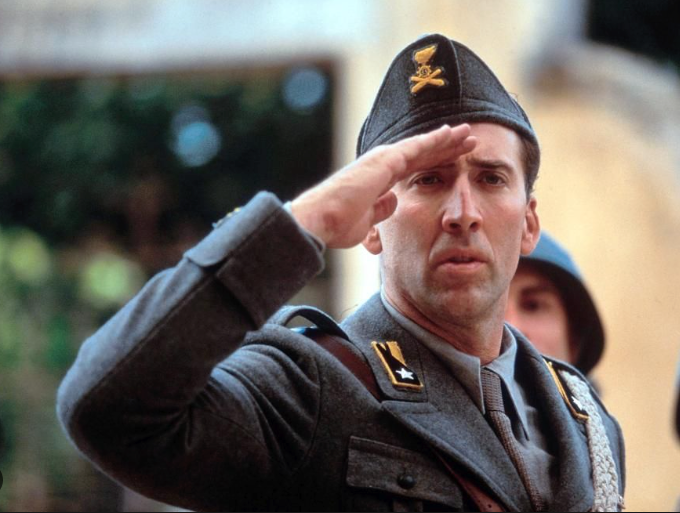
As fate would have it, the Italian officers are expected to be given rooms from the Greek citizens within the town. At first refusing to house his assigned officer, Corelli, Dr. I eventually relents on the promise that he will receive needed and regular supplies from the regiment’s medical commissary.
This arrangement does not sit well with Pelagia who is steadfast in her commitment to hate the Italians for what they have done to her country.
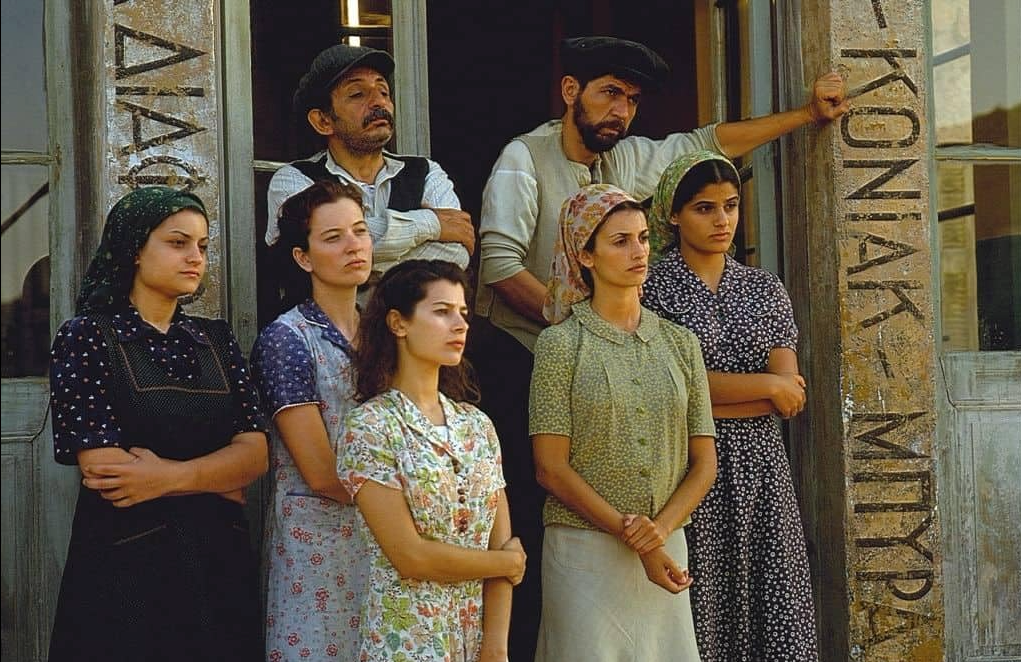
But Corelli is charming and he has a mandolin, and he never hurt nobody in his life. After many failed attempts to win Pelagia over, Corelli comes to understand her disdain for him (as a representative of the war) after a frank discussion. He leaves her home but keeps the supplies coming to Dr. I. He then starts some community building by bringing his regiment to the plaza every night for music and dancing. He writes a song on his mandolin which he’s called “Pelagia”. Smooth, Corelli, smooth.
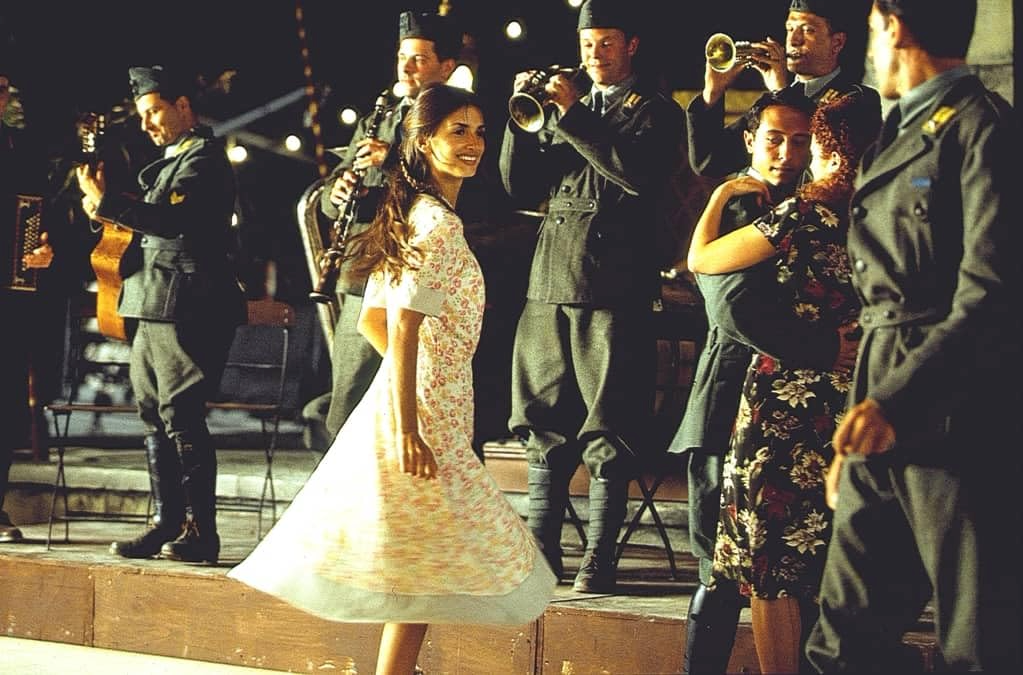
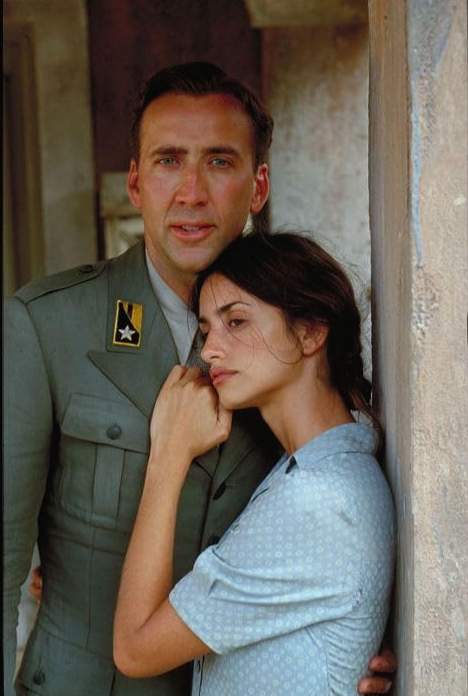

Meanwhile, the other corner of the love triangle has been quickly eroding. Mandras returns from the front wounded and disheartened. He admits to Pelagia that he cannot read (plot twist) but has had others orate her many letters to him. He suspects that she no longer loves him the way she once did and is not happy that her family is housing Corelli. Mandras questions her loyalties (rightly so) and quickly leaves again to fight against the Axis in parts unknown.
This paves the way for Corelli and Pelagia to hook up and they do. Probably the best dramatic speech in the film comes from Dr. I (delivered via the talented John Hurt) as he tries to establish Pelagia’s real feelings for Corelli:
“When you fall in love, it is a temporary madness. It erupts like an earthquake and then it subsides. And when it subsides you have to make a decision. You have to work out whether your roots have become so entwined together that it is inconceivable that you should ever part. Because this is what love is. Love is not breathlessness. It is not excitement. It is not desire to mate every second of the day. It is not lying awake at night imagining that he is kissing every part of your body. No. Don’t blush. I’m telling you some truths. That is just being in love which any of us can convince ourselves we are. Love itself is what is left over. When being in love has been burned away. Doesn’t sound very exciting does it? But it is.
In the end, what’s “left over” for Pelagia is her undying love for Corelli, but as fate would have it, the war gets in the way of that, too. The two lovers must part, thanks to the unlikely assistance of Mandras, as Corelli is forced to escape Greece and the Nazis himself by the end. He does return, of course, for his Pelagia, but not before a lot of death and destruction, an earthquake, and the will-he-or-won’t-he tension is amped up quite a bit.
When War Gets in The Way
The film is based on a novel which is based on many real life events. During WWII, Italian and German forces come to occupy Cephalonia in 1941. When Mussolini loses power, Italy surrenders to the Allies. This leads to the real-life Massacre of the Acqui Division, in which the Germans then take these now-freed Italian soldiers (i.e. their former allies) captive and then execute about 5,000 of them. An additional 3,000 died from drowning when trying to escape Greece by boat (i.e. their boat hits a sunken mine).
The cinematic version (and the book I assume) depicts the historic and lethal complication that occurs when two forces are fighting alongside one another, and one side surrenders while the other continues to fight. There were a series of mixed messages that were handed down the chain of command in 1943 regarding how the Italians and German troops should interact post-surrender.
Do the Italians 1) continue to fight on the German side, 2) fight for the Greeks on the Allied side, or 3) surrender their weapons peacefully to the Germans (or Greeks) and return home.
Corelli and his troops attempt to do option 3, but things do not go as planned, leading to a large-scale massacre of the Italian troops. He survives the mass execution, must go into hiding from the German searches, and is helped to escape to his homeland by the Greeks (Mandras even!) Incidentally, Madras helps Corelli escape in order to win back Pelagia’s heart, but by this time in their story arc it’s already too late.
Although I haven’t read the book, I guess there are some variations between the film and the historical novel. Not surprising, the British novel depicts more tragedy than the softer film.
- In the film version, Corelli returns to the island post-war while he is still a younger man because he can’t “stay away” from Pelagia and the two rekindle their love. In the novel, Corelli returns to Pelagia, but seeing that she has a child with her assumes she is married and has moved on–he leaves imbittered; only as an old man he returns to the island to discover that she has adopted the child which was left on her doorstep and the two end on a happy note.
- In the novel Mandras becomes a Communist and learns to read. When he reads Pelagia’s letters and discovers she no longer loves him, he tries to rape her. But he is thwarted by Pelagia (who has a gun) and his mother. In shame, he commits suicide.
- In the novel, after the Germans have left, Communists take over the island. Dr. I andthe other intellectuals are sent to a concentration camp and he comes back from this experience traumatized. In the movie, he survives an earthquake and seems otherwise just fine.
A Few Other Odds and Ends
- At the beginning and end of the movie there is some kind of Greek Orthodox religious ceremony where the lame, infirm, and unwell lay down prostrate on a path and the priest and his entourage pass by them with their icons / relics / ark of the covenant box. As the sick pray (writhe / convulse), there’s some expectation that a miracle will occur and they will be healed.
- The German commander, Captain Gunther Weber, who is Corelli’s Nazi counterpart is played by David Morrissey, the Governor from The Walking Dead. True to his type cast, he’s a real dick in this movie, too. He watches as Corelli and his men are shot down in cold blood by his German troop, but he doesn’t have the cajones to kill Corelli himself and finish the job (allowing him to ultimately escape.)


- Even though their Greek town is outmatched and outgunned, the leaders of the city refuse to surrender willingly to anyone other than a German officer of significant rank. When the Axis powers produce a German officer, they are still unimpressed, but say, “Surrendering to the German captain’s dog is better than surrendering to an Italian.” Ooo, sick burn.
- At one point, a Turkish mine washes onshore alarming the Cephalonian townspeople. Corelli and his regiment, discover the mine has been detonated (no longer function) but they decide to “give them a good show” so they pretend to blow up the mine. This plan backfires when Corelli and his men all get minor injuries from the shrapnel.
Firsts for a Nicolas Cage Character as Captain Antonio Corelli
- Fighting (but not really) within a Fascist regime
- Playing a mandolin
- Two handed “kisses” thrown into the air greeting
- Using Super Mario accent
- Leading a vocal choir on a beach
- Giving a woman a single rose (after saluting with it)
- Creating a fake explosion to impress a girl
- First time riding on a motorcyle
- Firing a machine gun
Recurrences
- Serving in Italian military (Time to Kill)
- Shaving (Multiple)
- Serenading a Woman (Multiple)
- Having a gun pointed at him (Multiple)
- Playing a stringed instrument (The Rock)
Best lines by Nicolas Cage as Captain Antonio Corelli
“Quick-ah get the-ah gun-ah. Somebody shoot him. Shoot him.” [Laughs maniacally.]
“In times of war we have to make the most of what little innocent pleasure there is.”
“We’ve been drinking. Singing. Generally misbehaving.”
“We’re Italian. Famous for singing, eating, making love.”
“If you ever express appreciation of Wagner. You will be shot. Without trial. And without leave of appeal.” [To Captain Weber]
“I have always found something in life worth singing about. For that, I cannot apologize.”
“I have no right to make you love me, when you weren’t mine to love.”
Summary
Against my better judgment, I actually enjoyed Captain Corelli’s Mandolin. None of it should have worked. The Spanish actress playing the Greek goddess, Pelagia. Batman playing the Joker-like boyfriend, Mandras. Super Mario Corelli playing Private Pavarotti. Yeah, the film was a happy-sad mix of a bunch of different things. My Big Fat Greek Wedding. Saving Private Ryan. A Bizarre Love Triangle. But messy, misguided films like this are exactly the kinds of features where Mr. Nicolas Cage truly shines.
It’s a-go!
If nothing else the musical numbers will have you swaying in the moonlight and twirling the noodles on a big plate full of tomato-sauced spaghetti. Or maybe polishing off that baklava? Or, whatever.
In the words of Dr. Iannis: It’s what’s left over that really counts anyway.


 yeti speak...
Leave a comment