Have you ever heard the saying, something has “gone the way of the buffalo”? I think that’s a saying, right?
Well, that’s because in the United States settlers nearly pushed the species to the brink of extinction in the late 1800s. Thankfully, due to conservation efforts of Native Americans and others, the buffalo survived, but it was a close call.
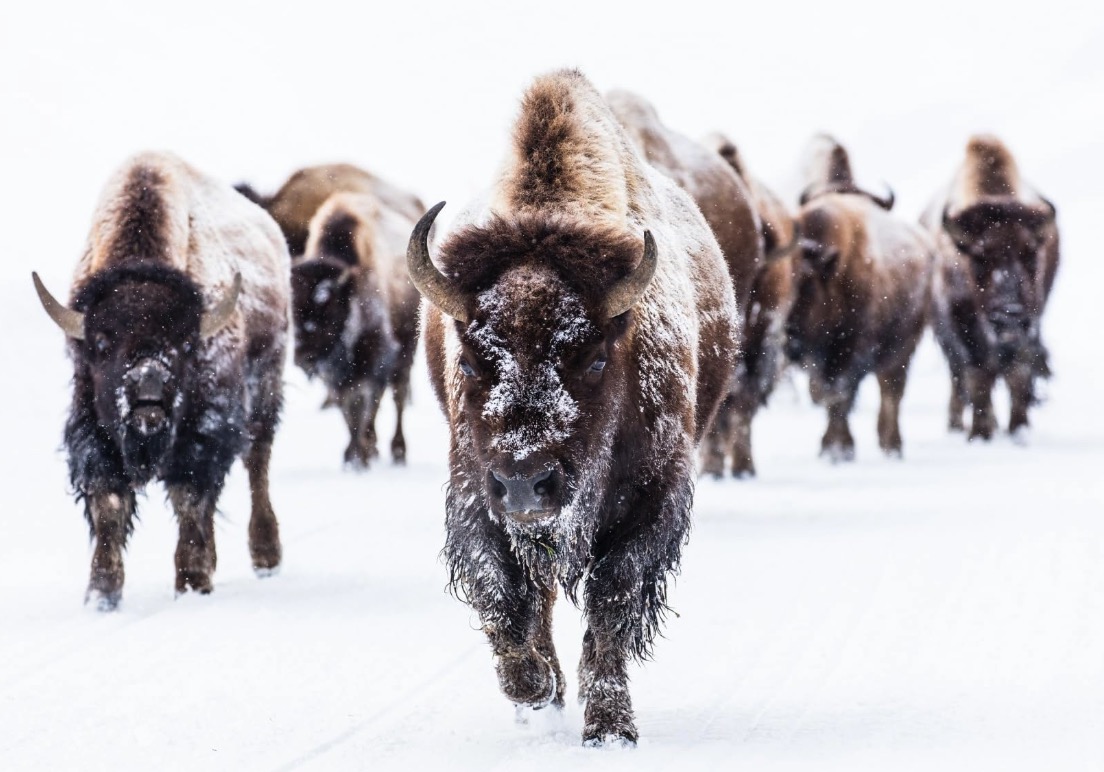
If you’ve ever wondered what the buffalo trade looked like during the post-Civil War days of the Old West, have I got a film for you.
In Butcher’s Crossing (2022) Nicolas Cage takes on the role of buffalo hunter in the first of two Western films. Get your cowboy boots and your rifle as we set out for adventure in the Colorado territory.
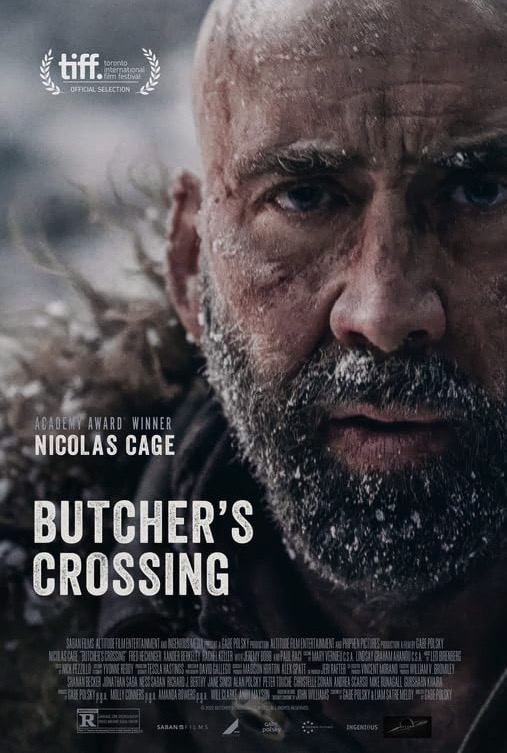
The World According to Miller
This film was based on a novel (of the same name) written by John Edward Williams and published in 1960.
Here’s a summary: In 1874, a young Will Andrews (Fred Hechinger) quits Harvard and ventures into the Wild West (Kansas) in search of purpose and meaning and to expand his understanding of the world. Seeking adventure, Will looks for a man named J.D. McDonald (Paul Raci) (a former friend / parishioner of his father’s church). McDonald runs a trading company where buffalo hide coats are a booming business. Will hopes to go out with one of McDonald’s hunting parties in order to see as much of the country as he can.
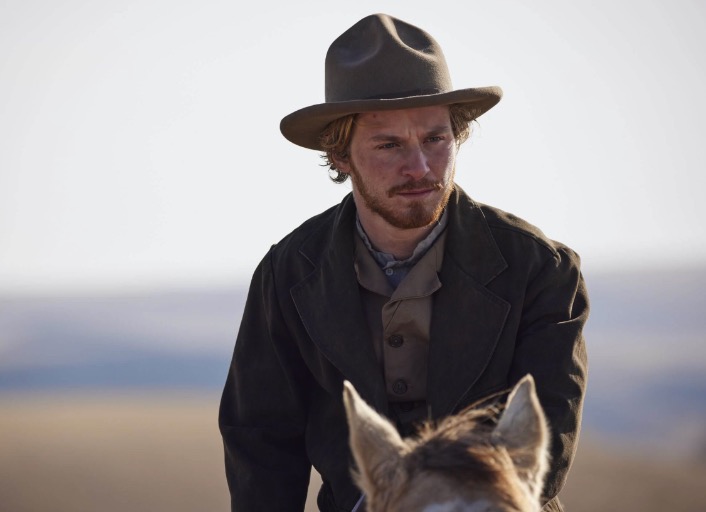
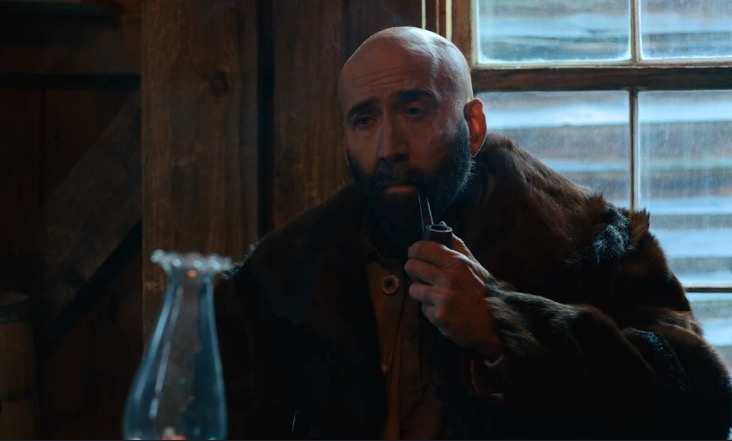
McDonald doesn’t want to “ruin” Will by letting him go out with the buffalo men so he refuses to help him in his endeavor. Instead, Will meets a hunter named Miller (Nicolas Cage) at the local saloon. At first Miller patronizes Will at first, but eventually he agrees to take Will on an expedition as realizes Will can help fund the it. McDonald introduces Will to Charlie Hoge (Xander Berkley), his one-armed camp manager (and repentant sinner / alcoholic,) and the local prostitute Francine (Rachel Keller).
McDonald spins a yarn to Will about a fairly secret / secluded place in the Colorado territory where he spotted buffalo as far as the eye could see. Miller tells Will he needs to raise $500-600 to get a party together which is most of the money Will has available to him. Will agrees to this arrangement, and after a night (almost) spent with Francine, meets up with Miller who enlists Fred Schneider (Jeremy Bob) to be their skinner on the hunt.
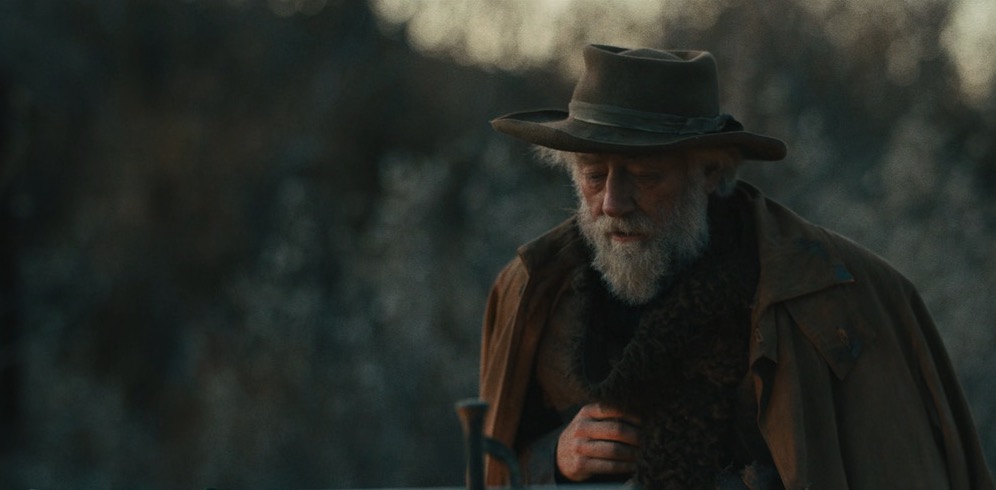
Schneider, who is a surly character, is immediately suspicious of Miller’s plan. He’s concerned about the idea of going to Colorado at that time of year, deep into Indian territory, to a place where Miller hasn’t even been for a number of years.
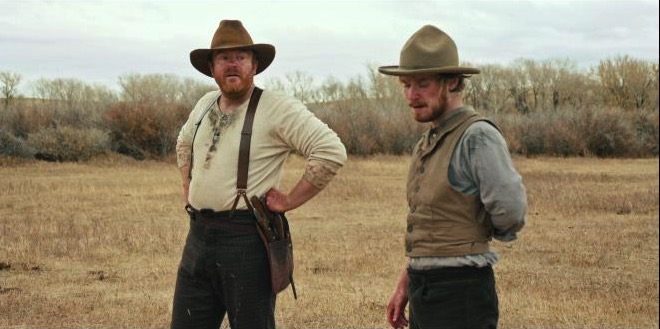
It’s apparent that Schneider and Miller don’t really get along very well–but have a relationship of necessity.
When J.D. McDonald learns that Will wants to go out with Miller, he is also very suspicious of the plan and tries to dissuade Will from going. He then goes his original refusal and offers to send Will out with one of his parties instead. Will’s mind is made up that he is going with Miller and crew.
Riding across the plains, Schneider and Miller argue a lot about lack of water, traveling across Indian lands, and potentially being lost as the party struggles with thirst and hard riding on their horses. At an outpost, they find a man who has been brutally murdered by Indians who has had his balls cut off and an antler rammed into his bottom.
They also run into a woman driving a wagon with children who appear to be unwell. Distrusting her intentions they send her on her way (at gunpoint) and provide directions to the closest fort. Things start to get tense within the party.
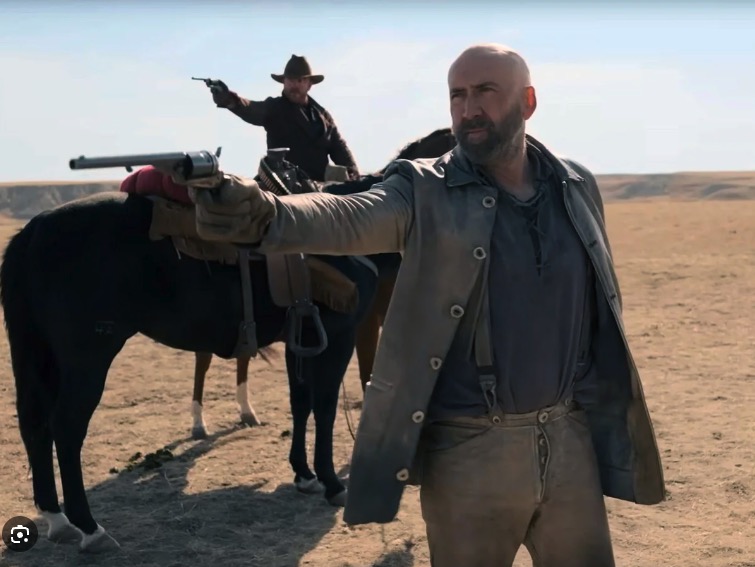
They eventually find water.
As the terrain gets more mountainous, the hunting party has to push their horse-drawn wagons up above the treeline. Then they find the valley nestled among snowy peaks that’s full of buffalo. Schneider starts to get on everyone’s nerves.
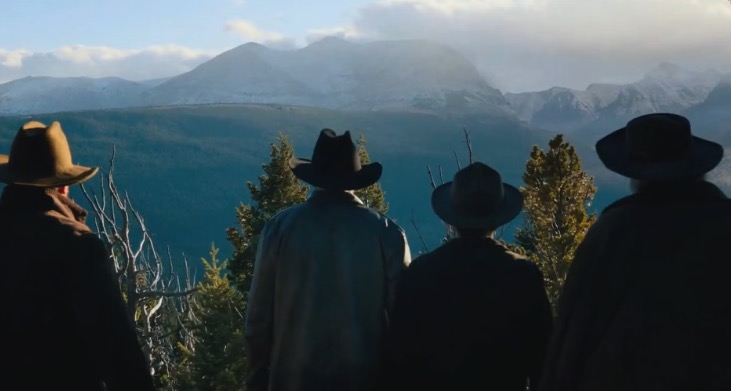
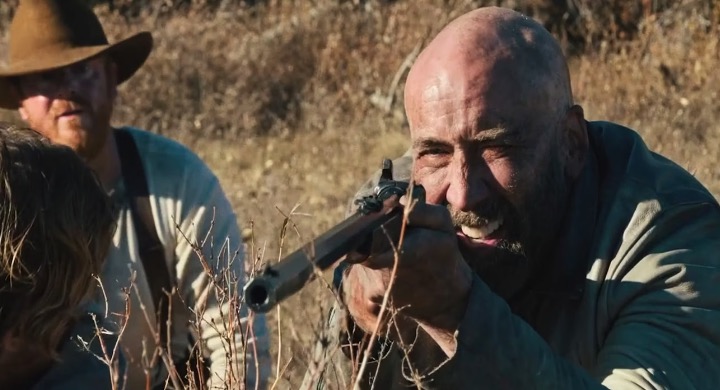
Miller teaches Will the proper technique for hunting and killing a buffalo–killing the alpha male, and then one-by-one killing them in hierarchical order. Then he shoots a whole shit ton of them. Will learns how to skin the buffalo from Schneider. Charlie puts out poison nightly (mixed with meat) to keep wolves from pestering them and their buffalo kills.
Miller gets greedy for more and more buffalo and kills more than they can skin.
Days turn to weeks on the plateau. Against Schneider and Charlie’s concerns about a change in weather, Miller waits too long and winter sets in very quickly. A blizzard strands the party with their hides and they are trapped and must wait through long winter months in the valley on the top of the mountain.
Each person in the party starts to come unraveled as the isolation, harsh environment, and unchanging diet starts to get under their skin.
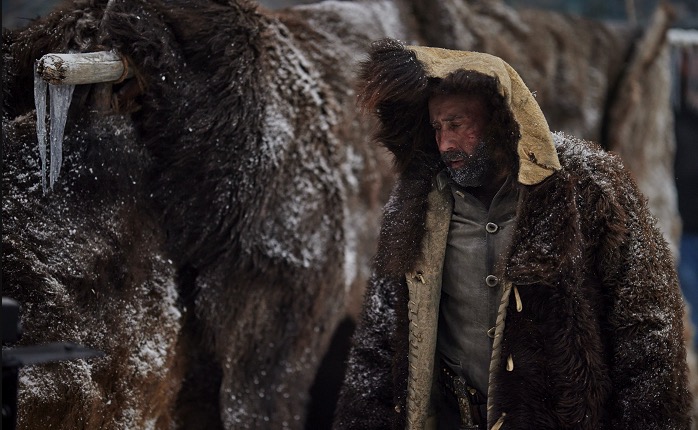
Beef between Charlie and Fred gets pretty bad when Fred tosses Charlie’s Bible into the fire. Charlie exacts his revenge by putting small doses of cyanide into Fred’s food over a period of time. It doesn’t kill him, but makes him extremely sick. Fred gets wise to what is happening and ends up beating mercilessly (essentially murdering) Charlie. Miller is angry with Fred for this (and that he is attempting to abandon the party.) Miller buries Charlie with his Bible and a bottle of whiskey.
As spring comes, they pack up the hides and head off the mountain, but Fred and the wagon full of hides meet their doom when an axle on the wagon breaks and both wagon and drive fall off of a steep cliff with all the hides.
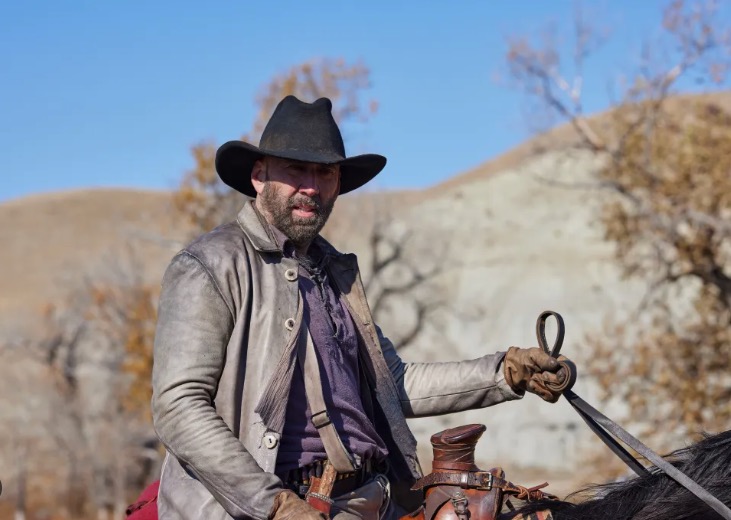
Once Will and Miller make it back to the Kansas town from which they started with at least some of the hides. They’re surprised to find that McDonald’s trading post looks abandoned and the town appears to be deserted as well.
Miller finds McDonald living in a small room at the back of the saloon looking pretty old and destitute. McDonald is surprised to see the two men whom he presumed were dead.
When McDonald hears that Miller has scored a huge boon of buffalo hides he laughs maniacally because unbeknownst to Miller and Will, the buffalo hide market has collapsed in the time they have been sequestered in the mountains. The market has been saturated driving the value of buffalo hides to near zero. Miller is furious and wants McDonald to to pay what he promised prior to the collapse, but of course McDonald is in no position to do so.
Miller leaves in disgust, and Will talks to Mcdonald and then is dealing with his PTSD from all he has experienced out in the wild.
Later that night, in anger, Miller sets fire to all the hides and the blaze catches some of the cabins on fire at Butcher’s Crossing including McDonald’s office. He then rides his horse over Mcdonald’s body, stomping him, intentionally, and killing him before riding off into the darkness.
As the film ends, we come to understand that in 1860 an estimated 60 million buffalo (bison) roamed the American West. In two decades their population fell to less than 300! But thanks to efforts of Native American tribes and conservation the population has ballooned back to over 30,000 buffalo today. Not even close to 60M but it’s a start I guess.
Bald Cage
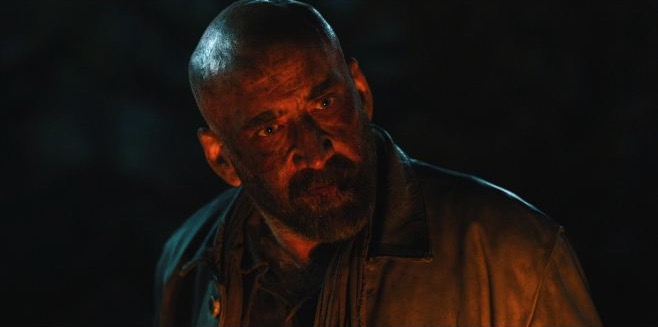
This was the first time we’ve seen a smooth bald head on a Nicolas Cage character. It made me wonder how many cowboys and hunters from the Old West went with the bald look. Around the campfire, Miller would use a knife to shave down the stubble to keep a smooth, glistening surface. I imagine the standards of cleanliness were not the best in the American West and with the buffalo there were probably lice and other critters. Going bald was probably a pretty good alternative I’m thinking.
Cage & The American West
The American western genre seems to fit Nicolas Cage better than some of his historically set films (see Outcast, Season of the Witch for examples that don’t work). He has the rugged individualist personality and peculiarity that matches that “outlaw” and “pioneer” mentality. You’d have to be a “little crazy” or desperate to take on the risks and dangers of living so far out on the fringes of civilized society. We’ll get to see him do this again in his next film The Old Way.
Things I Learned From This Film
While I don’t think the novel or this film are exactly “historical fiction” based on true life characters, the activity and the plot are based in some historical and cultural facts. I learned a few things while watching this one. I learned about:
- The rise and fall of the buffalo trade in the West. Consumer sentiment changes as products saturate the market. Once everyone has buffalo coat, who do you sell one too? When styles and fashion changes, how do you adapt to those financial realities? America has a long history of “boom” and “bust” industries and this was a good example.
- The ins and outs of buffalo hunting during the late 1800s. Hadn’t thought about this topic much, but it was interesting seeing how the animals were slaughtered (sad) and skinned and how an entire herd could be decimated in a very short amount of time. America greed and wastefulness was also on full display here as Miller just kept killing them even though skinning them takes a lot of time and energy and transporting them was treacherous.
- Social isolation can lead to all forms of dysfunctional behavior. The modern day reality TV series Alone shows how the psyche is not built for isolation over long periods of time. Even though this hunting party had each other (they weren’t completely alone), living through a harsh, monotonous winter in the out-of-doors with unpredictable food supply and some mutual distrust started to unravel them psychologically. The film does an excellent job of making this wide open space feel claustrophobic and unsettling. At one point, Will asks Miller, “Do buffalo ever go crazy?” and this is a reflective question aimed directly at himself I think. As the intensity of the isolation and psychological unraveling amped up, the characters started to see their moral fiber erode (what little they had to begin with). Which ironically was exactly J.D. McDonald’s initial concern for Will.
- Dark theology. Religion has always played a role in American history. For better AND worse, we’re a nation that has embraced a plurality of faiths. In this story, Will sees God in nature’s beauty and bounty. Charlie however sees God in nature’s wrath and violence. He lost his hand to frostbite on a previous expedition. When Will asks Charlie “Why fear God?” Charlie replies grimly and prophetically, “You’ll see. You’ll see.” If God is alive in the U.S. American landscape then both of these men are right. God is awe-inspiring in his beauty and God is damning in his senseless and relentless violence.
First for Nicolas Cage as Miller
- Playing a completely bald character
- Smoking a regular pipe (not a crack pipe)
- First western
- First time on a buffalo hunt
- Shaving his scalp
- First time in the Rocky Mountains
- Loading bullets with gun powder and hammering in the metal tips
- Completely losing his shit while on horseback
Recurrences
- Riding horses (Season of the Witch, Outcast)
- Basking in the sunlight (City of Angels)
- Field dressing / cleaning a kill (Joe, Running With the Devil)
- Gesturing with his outstretched hand Elvis-style (Multiple)
Quotables
“That ain’t nothin’. Better off choppin’ wood.”
“I work for myself, or I don’t work.”
“There was buffalo, scattered all over like a great black sea.”
“A hunt like this happens once in a lifetime.”
“Couple days of ridin’ you’ll be alright.”
“Nothin’ out here but stragglers; worthless livin’”
“There’s water for a body who knows where it is, Fred.”
“If you disappear in this country, you’re gone!”
“You think too much, you get yourself into trouble.”
“Out here, thinkin’ about what you can’t have, will drive you off your feed.”
“These buffalos spook, I’ll shoot you.”
“EAT YOUR BUFFALO MEAT!”
“I’m out here to hunt buffalo, haul back their hides, and SELL THEM.”
“Not FUCKING smilin.”
Conclusion
At times, this film drags on like a long winter and I think that’s the intention. I watched it twice and I’m fairly certain I couldn’t sit through it again. It’s not a terrible film as much as it is a nihilistic venture without much hope. There seems to be little purpose or meaning to be had in this capitalistic drive for money and dominance of nature.
Miller is the concept idealized and enfleshed to maximum intent. Halfway through the hunt, he has more than he needs from a financial / supply perspective–more than can carry home, but to him this “score” is more about the status and the personal vindication rather than just the monetary rewards.
He expresses in so many words to Will and Fred his dream that people will be in awe of what he has accomplished. He cares more about this than the lives of those who are helping him deliver the promise back to Butcher’s Crossing. I guess in some ways this massive human hubris is also an American trait–an endemic flaw that has existed here from our country’s very beginning.
If there is hope here, in this story and American history, it’s in the fact that Will somehow survived his experience–at least some part of him did–and that ultimately the buffalo survived their genocide as well. In spite of humanity’s insatiable greed and violence, we are still able to preserve some things in nature (and ourselves) worth preserving. It’s a fragile, but lasting hope.
Cue Bob Marley’s, Buffalo Soldier. Back to the plains again in our next WATC(H) offering.

 yeti speak...
Leave a comment