As I sit down to write this post, I can almost hear Beavis and Butthead snickering to themselves.
“He said 69, huh-huh, huh-huh.”
This past week I submitted my 69th job application since being laid off in February. This past weekend I also watched the 69th movie in the Nicolas Cage WATC(H) marathon.
Coincidence?
No. I am confident this apocalyptic alignment of the erotic number is just a further sign that the End Times are indeed upon us. Jesus is coming back and those who don’t believe, well they are going to go through a very long, very tumultuous tribulation period.
It is written. It is known.
Just kidding. I think, like the ex-skeptic Rayford Steele, we’re all gonna be just fine (even if it is an election year. 😮💨)
The other thing that instantly came to mind was the Ministry song Psalm 69. You can hear it if you’re into industrial metal type music that is both heretical and kind of funny (if you have a dark sense of humor).
Which brings us to this movie–hint: it’s not a film. If you have a sense of humor at all, this movie will make you laugh and cringe and keep watching (against all reason).
SPOILER ALERT: My thoughts are fairly sacrilegious about all of this stuff now, so read on at your peril.
Before we start…thoughts going in…
As a professed eX-vangelical, I have been anxiously awaiting Left Behind (2014) since I started this journey. I was highly curious why (in the name of God) Nicolas Cage would ever agree to appear in this Christian-pulp-novel-turned-movie-franchise about the rapture and coming tribulation.
It’s probably the number one argument that one could make that Nicolas Cage is unabashed and unafraid to be in LITERALLY any kind of movie or role. He will take it on with VIGOR.
And here is the supposed origin of why: In an interview, Nicolas Cage said his brother Marc is a pastor, liked the book, and wanted Cage to star in this role. So he did it as a favor then. I did some digging and can find no evidence (on the web anyway) that his brother is (or was) a pastor. What I did find was a Marc Coppola who is a DJ and radio personality and has been for his entire career.
Maybe Cage’s bro was moonlighting as a pastor at some point? Maybe not? It sounded kind of made up to me, but let’s roll with that reason.
My second question going in was how “Christiany” or “cringey” is this movie if Nicolas Cage is in it? Won’t he auto-magically raise the quality bar SIMPLY BY BEING HIMSELF? Or will the thinly veiled apologetics of the book’s authors, Timothy LaHaye and Jerry B. Jenkins, bog the story and Cage down in what is typically very bad “Christian art.”
And the answer is…
The World According to Rayford Steele
Left Behind (2014) is laughably bad.
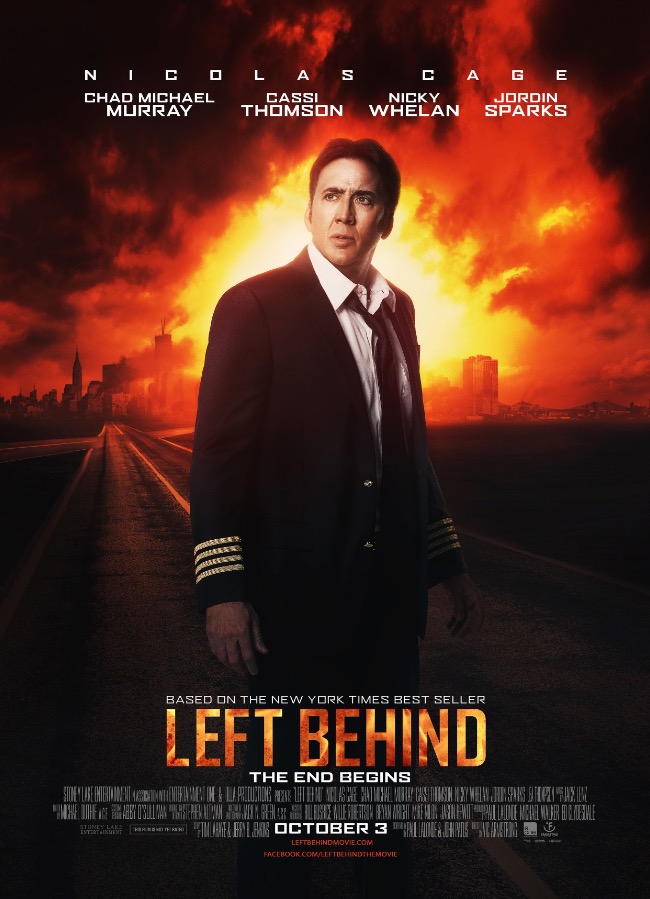
Even when I lived within the evangelical bubble of the Baptist church, I never bothered reading the book series that went on for many years. As a lover of story, I knew it would be pretty cringe and poorly executed. While I can’t attest from personal experience, I have a good inkling that my assumption would hold up (especially now).
I discovered early on in my life that “Christian” entertainment, whether it’s books, music, film, or products is typically a sub-par mimic and sad propaganda vehicle trying to capture the artistic flare and popularity of a “mainstream” equivalent. It’s plagiaristic, copycat, masturbatory stuff meant to ignite the base, please the convinced, and ultimately sell the merch. On its own, at its worst, it’s usually a little pile of hot garbage–or at its best its painfully derivative.
Did I fall for this marketing machine that aligned perfectly with my once strongly held Christian beliefs? You know I did. Numerous times and passionately over many decades of early life. I listened to Christian “death metal” bands and hip hop artists, I bought Christian t-shirts that played on pop references (Jesus is the Cure for Your Depressed Mode), I read allegorical books about Jesus as a magical Lion, and I speculated with friends about actors, artists, and musicians who may or may not be closeted Christian based on the subliminal messages in their “art”.
It’s a whole subculture down there and I can’t go into all the details about it right now.
BUT the point is, I knew what this movie would be from the outset and just because the creators were clever enough to swap out Kirk Cameron with Nicolas Cage, that doesn’t mean the “cheese” factor was going to be lessened in any way. It wasn’t. Believe me.
So what was it about?
Well, the story centers around Rayford Steele (Nicolas Cage). What is a “Rayford” and have you ever met one? I have not. Sounds made up to me.
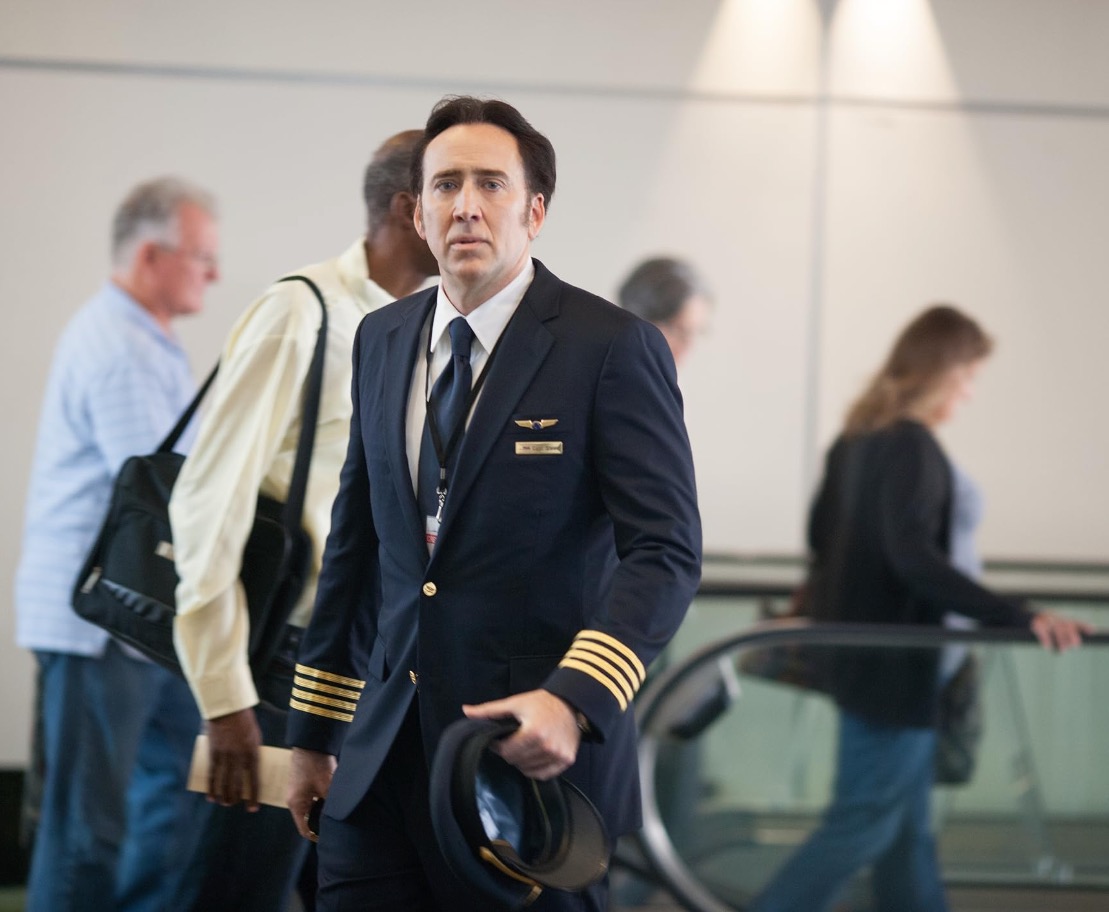
In this story, Rayford is a commercial airline pilot. His wife, Irene (Lea Thompson) has had a life transformation brought about by a conversion to Christianity which does not sit well with the rest of the family, especially their college-aged daughter Chloe (Cassie Thomson). Chloe, who has returned home from college to surprise her dad on his birthday, is angry about what Irene’s Christianity is doing to the family dynamic, pushing Rayford into the arms of another woman, while providing no logical reason or justification for all the evil and suffering Chloe sees in the world around her.

Rayford, who claims to be tolerant of his wife’s change in personality (due to belief change), is actually on the cusp of an affair with a flight attendant, and rather than stay home with his daughter and family for his bday takes a work opportunity to fly to England where he hopes to have solitary time with Hattie Durham(Nicky Whalen) at a U2 concert. Before he departs, at the airport Chloe confronts Rayford about his family avoidance, and also meets a young and dashing media crush, Cameron “Buck” Williams, Chad Michael Murray, who is also booked for the flight to England. Rayford decides to go on the flight anyway, even though Chloe is now suspicious of his motives. Chloe goes home and argues with her mom about religion, and then goes to the mall with her younger brother.

While Rayford is in the air flying the plane over the Atlantic and Chloe is in the mall with her bro, the rapture happens. For those without the theological context, the rapture is when God takes to heaven all the true believers in order to save them from the coming judgment, tribulation, and suffering the “non believers” will go through back on good ole planet earth. Chloe’s brother (and really all the children) disappears in an instant, leaving behind his clothes and backpack. On the plane, many people, including Rayford’s co-pilot, and all the children also disappear at the same instant, leaving behind a lot of laundry and belongings.
The entire rest of the movie is dedicated to 1) figuring out what happened to everyone 2) panic management for those flying to England, and 3) Chloe trying to get back home as the world around her descends into total chaos. In the end, Rayford and Chloe realize that “mom” was right all along, and that they were wrong. There’s some remorse and some “refocus” on things that really matter. Unfortunately, this is the beginning of the end in some vague way that only a sequel would tell us.


But before reuniting father to daughter, the two must work together, with Chloe’s new love interest Buck’s assistant, to try to emergency land a commercial airplane somewhere safely in New York (since the airport runways were all blocked up.) Surprise: they do it.
SO that’s the summary, but what’s the Cringe?
There’s too many to list but a trained eye can spot many many things in this film that feel disingenuous (or completely out of sync) with most “normal” folks’ lived experience. Evangelicals (not all, but many I know or have known) live in a bubble world where these things make sense. The values they hold are universalized to apply to everyone; their perspective becomes the myopic filter through which the world is seen. With that I give you my list of cringe from this movie.
Bad Music
The cheesy guitar solos and background string music are meant to create an emotional backdrop in many of the scenes–especially those where there is either action, tension or religious dialogue happening. I know this is not an “evangelical” specific device, using music over the speech; every movie has a soundtrack / scoring, but the way it’s done in this movie is about ten to fifteen years out of date. Similar guitar solos and emotionally charged synthesizer music can be heard at most churches (in the form worship music) OR in films / TV series from the late 80s or early 90s (e.g. Baywatch). I can almost hear the “altar call” when the music slows down. (The icing on the cake is at the end when we get Jordin Sparks covering Larry Norman’s “You’ve Been Left Behind” from the 1970s rapture movie.)
Unneeded Apologetics
In an opening scene, a group of reporters approaches the investigative journalist Buck Williams at the airport. One starts questioning him (unsolicited) about his thoughts on the Bible and end time prophecies. Why? We have no idea, no context, no rationale for why journalists are quizzing other journalists on their beliefs. These type of apologetic conversations that evangelicals are so inspired to start (or believe come in the flow of naturally conversation) rarely if ever happen in the real world. When they do people usually get really uncomfortable because they are not based in a real world relationship, context, or situation. It’s like when someone tries to sell you something door to door that you had no desire to buy in the first place. Painful telemarketing posing as a day-to-day interaction.
Bad Dialog
Said No One Ever: “Actually I was looking through the thesaurus on my phone this morning, and I’ve decided to go with ‘wacko’…” This was something Chloe voiced as part of her conversation about labeling prophecy believing Christians. Plausible? Meh. Maybe some people are looking through the thesaurus on their phone to find words to describe “religious people” especially family members, but my bet is this happens very very rarely. Sounds like a paranoid (if justifiable) assumption more than anything. “People think my beliefs are strange. I bet they sit around obsessing over how to best describe me.” Bubble thought.
Christian Specific Terminology
Chloe quote: “Before mom ‘drank the Kool-Aid.’ Christians voice this figure of speech a lot. The Jim Jones cult massacre brought this terminology into the collective consciousness. HOWEVER, I think it’s used LESS outside of evangelical circles than inside them. I’ve heard it used predominantly among Christians to defend against their genuine form of faith by positioning it against the “other kind” that in a death cult.
A Lot On the Nose
Who’s the best Christian band ever? U2. Yeah, of course, they get mentioned here. Don’t get me wrong, I like U2, but the other thing I remember growing up is the felt need to legitimize the faith by pointing to successful artists or celebrities who also happened to share the same values or beliefs. (Irony is that Rayford wants to take his mistress to a U2 show. Well, at least the show was Christian if the activities weren’t.)
Product Placement
Irene’s Bible is the focus of a few different scenes here. She puts her gardening gloves on it and then later Chloe looks through her mom’s Bible to find the “prayer list” her mom has kept in it. All pointing to Irene’s devotion and care for her family.
The Baddies vs. The Goodies
As much as evangelical Christians may not wish to judge the hearts / intentions / lifestyle of others, they still kinda do. I should know. Recovering eX-vangelical. Everyone judges. Not saying otherwise. But for Christians it’s kind of built into the framework. What’s bad though is that the evangelical interpretation of scripture makes it difficult not to focus on that–whether they want to admit it or not. Some people are IN God’s good graces while others are not. This interpretation ends up with a dichotomy of “those who believe truly and rightly so” (who are saved) and “those who sadly do not” (who are doomed). They are not alone in thinking this way. Many religions and worldviews make similar fundamentalist claims, but the ramification of being on the OUTS for evangelicals is literally quite dire (e.g. hell, judgment, tribulation, excommunication, etc)
In this movie we have the baddies: A Muslim (who, to the movie’s credit defies the typical evangelical stereotype of s 2-dimensional anti-Christian terrorist), a “Prodigal” druggie girl (with scarred arms and dark sunglasses who only half listened at Christian camp), a Skeptic (Chloe), an Adulterer (Rayford), a Pharisees / Hypocrite (The Pastor), an Angry Midget (sorry, Little Person), a Workaholic Dad. We also have the Goodies. Basically anyone under the age of maybe 12 who thereotically haven’t committed real sins yet OR anyone who has some real faith in God already. Those are the ones he wants in heaven early. The true Believer (Irene), the Bible Study Attender (Flight Attendant), and the Co-Pilot.
Accessories
The Bible (was it Apostle Paul?) famously says that they will know we are Christians “by our love”, but in this movie, after the rapture happens, they will know we are Christians by our accessories and planners. The mystery if unraveled based on the real-time fossils each Christian has “left behind” (and no I’m not talking about all that clothing that was piled up all over the place.) For Irene it was her Bible + Prayer Lists + Ichthus necklace. For the flight attendant it was her daily calendar with “bible study” written into it. For the pilot it was his watch with the John 3:16 branding. I mean, in theory, the Pastor should have also gone right to heaven since he was physically in the church, but evidently it’s not about “what you believe” or “what you know” about the Bible, because that’s not enough. You have to REALLY REALLY believe it in order to be protected from harm. Bummer for him.
Awkward Story Decisions
Awkward kinds of things can happen in any movie, but I tend to key in on it in Christian movies because of the bubble effect. I guess I have a radar or heightened sensitivity to it now. Subcultures (like evangelical subcultures) can become so far removed from the prevalent or mainstream (secular) culture that when the subculture tries to emulate the main (in art or life) it feels strange and disjointed. Kind of like how the vampires in What We Do In The Shadows are pretty clueless about all things human. They try to emulate humans, but really cannot. Here’s some of what I’m talking about from the movie:
- Vilifying the little person in this movie. Why? They cast him in the worst light possible light. His character was selfish, angry, suspicious, and attitudinal. Was this supposed to be humorous? At the end of the movie the Muslim guy literally kicks him down the emergency slide. For what purpose? So strange.
- Casting almost all the people of color in the film as not worthy of rapture: either entertainers (breakdancers in the mid aughts, strange) or troubled moms or the non-raptured unbelievers (even the pastor). Meanwhile, everyone who was raptured, except Buck’s seat partner who had about 2 lines in the film, were white Anglos. Sigh. Just why?!? Sadly very indicative of the demographics in the evangelical churches I grew up in.
- Chloe, in frustration, throws a Bible through a plate glass window of a French door. Yeah, I guess that happens. But this display of anger seems very symbolic I guess of the “culture war” values that many evangelicals either acknowledge of sublimate in many ways in today’s culture. Of course she’s angry at her mom for “telling the truth”, of course she’s going to take it on the Bible. Just felt weird!
- Rayford keeps a photo of his family in his jacket pocket. I guess (question mark) people do that, but it kind of felt like a prop to the family values theme they were going for here. Especially in light of the fact that he was about to commit adultery with another woman. It makes me wonder how much Christians even understand how infidelity works. At the end of the movie he even “gets his rings back” from Chloe who has saved them for him–this to me feels like the ultimate nod to “commit to marriage” at all costs.They are really drilling in the message here. Even as a now “widower” Rayford will honor his marriage in his heart until the end of his days–even though he was unhappy enough to have a fling with a blonde bimbo.
Firsts for Nicolas Cage as Rayford Steele
- Commercial pilot
- Appearance in a religious propaganda film
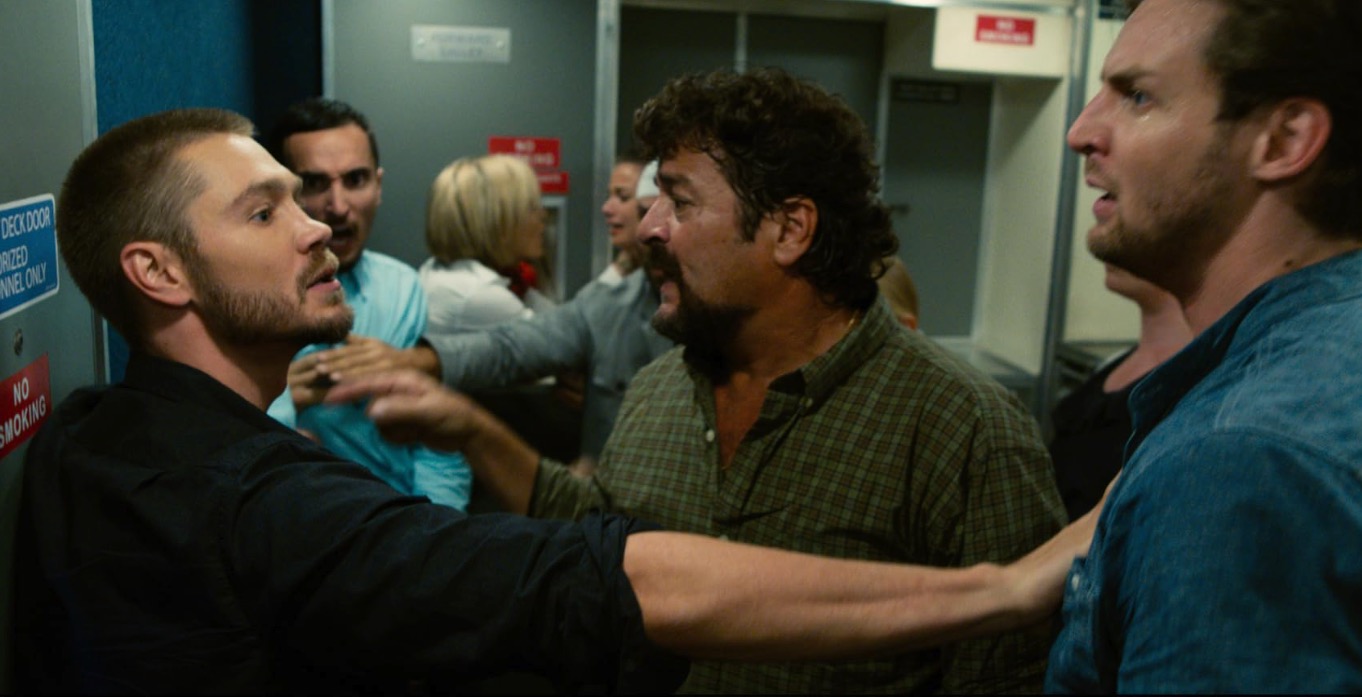
- Creating a cabin decompression issue to stifle an angry mob
- Rifling through people’s things very quickly (wallets, purses, etc)
- Sliding down an emergency slide of a plane
Recurrences
- Landing in a big plane in a metro area, but not at the airport (Con Air)
- Stepping out on his wife while globe-trotting (Lord of War)
- Facing the highly probable end of the world (Knowing)
- In a kind of rocky relationship with his daughter (Matchstick Men, The Weather Man, Stolen)
Quotables
“The changes that a person goes through between 20-50 are enormous.”
“But hey, if she’s going to run off with another man, why not Jesus?”
“Hello, I’m Captain Steele. I need you to remain in your seats with your seat belts fastened, but you can now remove your oxygen mask.”
“SIT! DOWN!”
“C’mon. There has to be someone out there.”
“I don’t know about passengers. But I do know this. There wasn’t anyone flying that plane.”
“Either I’m going crazy, or the entire world is insane.”
“Please pay close attention to our flight crew, and if you believe in prayer, now would be the time.”
Conclusion
As much as I may laugh and poke fun of my evangelical past, it has made me the man I am today for better and worse. Seeing this convergence between that world and Nicolas Cage provided me with 90 minutes of morbid fascination and laughs. I may never know if Nicolas Cage’s brother really was a pastor or not, but it’s fun to speculate about what prompted the Cage to take on a such a bizarre and “out of touch” film, and somehow take it seriously (as he always does).
In the profound words of Rayford Steele, “Either I’m going crazy, or the entire world is insane.” Maybe both can be true if you’re not a raging fundamentalist. Dude said 69, hehheh.


Leave a Reply